
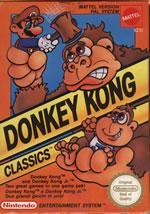
Donkey Kong Classics
Overview
Donkey Kong Classics is a double-game compilation cartridge released exclusively for the Nintendo Entertainment System, packaging the original Donkey Kong (1986 NES port of the 1981 arcade game) and Donkey Kong Jr. (1986 NES port of the 1982 arcade game) into a single Game Pak. The release was part of Nintendo's late-NES strategy to keep early classics in print as the system's library expanded and the games themselves became harder to find as standalone cartridges.
The compilation arrived three years after the NES launched — an unusually long gap for a re-release. It was developed in-house at Nintendo EAD and is functionally identical to the original two NES games, save for a redesigned, unified title screen.
Donkey Kong (1986 NES Port)
Donkey Kong is back in the Nintendo Arcade Classics series for your Nintendo Entertainment System. Save Pauline from the clutches of a giant ape who has taken her to the top of a huge construction site. You’ve gotta battle your way to the top, but its not going to be easy – Donkey Kong has a few tricks up his sleeve in the forms of barrels, barrel bombs and flaming fireballs amongst other ammunition. A taste of the arcade, from the comfort of your own home!
The NES port is a near-perfect home conversion of the original 1981 arcade machine, with one notable omission: the cement factory level from the arcade original was missing from the NES version due to memory constraints. This applies to both the standalone Donkey Kong NES cart and to its inclusion in Donkey Kong Classics.
Donkey Kong Jr. (1986 NES Port)
After defeating Donkey Kong in the original ‘Donkey Kong’ and becoming sick and tired of the infernal ape’s paws being all over his girlfriend, Mario has took his revenge and captured Donkey Kong in a cage. His only hope for escape is in the form of Donkey Kong Jr. In this game the player controls DK JR and Mario is the enemy. Jump across platforms, climb vines and avoid the traps and enemies which have been unleashed by Mario on your route to rescue Donkey Kong! There’s no time for Monkey Business, get those keys back off Mario to rescue Donkey Kong from his cage. Years after this original title another version of Donkey Kong Jr was released (2002) for the e-Reader (Game Boy Advance)
Donkey Kong Jr. is one of the very few games in the entire Mario franchise where Mario is the antagonist. The standalone NES version — and by extension its appearance here — is the closest most Western players ever got to seeing “Evil Mario” outside of the arcade original. Donkey Kong Jr. starts where the first game ends — Mario has captured the senior Donkey Kong in a cage, and DK Jr. must rescue him.
The Compilation Title Screen
The single material change in Donkey Kong Classics — aside from the cartridge label — is the unified title screen. Where the standalone games each had their own arcade-style opening, the compilation greets the player with a blue-tinted Donkey Kong Classics title screen that lets them pick which game to play. From the same screen you can also choose between single-player and two-player alternating modes (which were already present in both individual games).
The gameplay code itself is unaltered. The compilation is essentially the two games stitched together with a thin selector wrapper on top.
Nintendo Arcade Classics Branding
Donkey Kong Classics was released as part of Nintendo's Nintendo Arcade Classics brand line — a marketing umbrella Nintendo used in the late 1980s to keep its earliest arcade hits commercially available on NES. Other titles in this informal series included the standalone Donkey Kong and Donkey Kong Jr. re-releases.
The branding was a way to signal to consumers that they were buying authentic Nintendo-developed home conversions of arcade classics, rather than the third-party knock-offs that proliferated during the same era.
Why It Was Never Released in Japan
One genuinely odd fact about Donkey Kong Classics is that it was never released in Japan. This is unusual for Nintendo titles, especially ones with the Donkey Kong branding — almost everything else in the franchise launched in Japan first and reached the West later.
The most likely reason: Japan got both Donkey Kong and Donkey Kong Jr. on the Famicom Disk System and as standalone Famicom cartridges, where they remained readily available throughout the late 1980s. The Disk System's flexibility meant Nintendo didn't need to bundle the two games into a single cartridge for Japanese consumers — they could already get them cheaply on rewritable Disk System media. The Western release of the compilation was effectively a workaround for a problem Japan didn't have.
Australia is also listed as “N/A” on most release-date lists, though Australian copies of the European PAL version do exist in collectors' hands.
Donkey Kong Jr. e-Reader (2002)
Years after the original 1988 release, Nintendo brought Donkey Kong Jr. back in a new form: a 2002 e-Reader card series for the Game Boy Advance. The e-Reader was a peripheral that read printed cards which contained game data via scanned barcodes, allowing tiny NES-era games to be unlocked and played on the GBA.
The Donkey Kong Jr. e-Reader version was a Japan and North America release. It was effectively the same NES Donkey Kong Jr. code, repackaged for a portable scan-card distribution model. The e-Reader itself was a commercial failure, but the Donkey Kong Jr. cards have become collectors' items.
Reference / Information
Sub-pages, the official manual and Nintendo Power coverage of Donkey Kong Classics.

Media / Downloads
Box art gallery and screenshots for Donkey Kong Classics.