
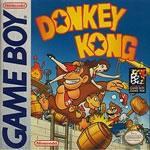

Donkey Kong
Overview

Donkey Kong for the Game Boy — known throughout fan communities as “Donkey Kong ’94” to distinguish it from the 1981 arcade classic of the same name — is a puzzle-platformer hybrid released by Nintendo in June 1994. It is one of the most quietly important games in Mario history.
Both Sequel and Standalone
The game opens by faithfully recreating the original 1981 Donkey Kong arcade game across four classic stages (25m, 50m, 75m, 100m). For many players in 1994, this was already a complete experience — a beautiful Game Boy port of the arcade classic. Then DK gets up. After Mario “defeats” DK at 100m, the ape rises, knocks Mario and Pauline off the beam, recaptures Pauline, and escapes. The game then expands into 97 brand new puzzle-platform stages across 9 new themed worlds — totaling 101 stages in all.
Predecessor to Mario vs. Donkey Kong
Mario vs. Donkey Kong (GBA, 2004), Mario vs. Donkey Kong 2: March of the Minis (DS, 2006), and the entire ongoing series can trace their direct DNA to this 1994 Game Boy title. The puzzle-platforming structure, the key-and-door mechanics, the Mario acrobatic moveset, the chase-Donkey-Kong premise — it all begins here. In 2024, Nintendo released a remake of Mario vs. Donkey Kong on Nintendo Switch, ensuring that DK ’94’s legacy continues to shape Mario games 30 years on.
Story

Much like in the original 1981 arcade game, Donkey Kong kidnaps Pauline — Mario’s “lady friend” from the arcade era — and carries her off to a construction site. Mario follows him up the construction, pulls out the rivets supporting Donkey Kong, and topples the ape onto his head, reuniting with Pauline.
The Twist
In a surprise twist, Donkey Kong unexpectedly recovers, and knocks the beam Mario and Pauline are standing on over, recapturing Pauline as she falls, and escaping to the right. Mario gets up, and pursues Donkey Kong into the city.
What follows is a chase throughout many different locations. Mario fights and defeats Donkey Kong at the end of each world, but Donkey Kong always stands up again and takes Pauline to the next location. Donkey Kong is aided by many of his friends as well as his son Donkey Kong Jr., who try to hinder Mario’s progress — flipping switches, throwing poisonous mushrooms to shrink Mario, and generally making the puzzle stages harder.
The Tower Finale
The chase escalates through 9 progressively harder themed worlds, eventually ending at the Tower world, where Mario must climb a final tower to confront Donkey Kong one last time. The Giant Donkey Kong final boss form (visible on the Super Game Boy version with full color) is one of the most visually striking moments of the era — DK looms massive over Mario in the final showdown.
After Mario defeats Giant DK and rescues Pauline, the ending shows DK chastised by his son and the family reuniting peacefully — a quieter, more emotionally complex resolution than the simple arcade victory.
Gameplay

Donkey Kong ’94’s gameplay is a puzzle-platformer hybrid that combines arcade-style platforming with deliberate, careful puzzle-solving. It’s built around key-and-door mechanics: Mario must find a key, carry it across the stage, and place it in a locked door to advance.
The Core Loop
- Find the key somewhere in the stage
- Carry it to the locked door (which is usually on the opposite side or far from the start)
- Avoid enemies, time disappearing platforms, flip switches, ride conveyors
- Use Mario’s acrobatic moveset — handstand, backflip, spin — to reach high platforms and avoid hazards
- Race the timer — each stage has a time limit; running out means losing a life
- Complete the level — placing the key in the door advances to the next stage
Boss Showdowns
Every world ends with a boss fight against Donkey Kong in a setting that recalls the original 1981 arcade fight — Mario climbs scaffolding, dodges DK’s thrown projectiles (barrels, jacks, etc.), and reaches the top to land hits. Each fight ends the same way: DK falls, gets back up, escapes with Pauline to the next world. This 9-fight escalation gives the game its dramatic arc.
Save System
Unusual for a Game Boy title in 1994, Donkey Kong supports battery-backed save data — the Game Boy cartridge has internal save storage. The German magazine Video Games specifically praised this feature, noting it as a rarity for the era.
Mario’s New Acrobatic Moveset
Donkey Kong ’94 introduced what would become Mario’s defining acrobatic moveset — a suite of new moves that gave him agency and finesse beyond the simple “walk and jump” of Super Mario Bros. era. These moves transformed Mario from a platformer into a puzzle-acrobat, and they were directly inherited by the entire Mario vs. Donkey Kong series.

Crouching
Hold ↓
Mario can crouch to avoid enemy projectiles more easily. He can also squeeze through smaller passages while crouching, ride conveyor belts in the crouched position, or be pushed along by certain enemies. A core defensive move — the foundation for the more advanced moves below.

Handstand
Hold ↓ + A
The essential move of DK ’94. While in a handstand, Mario is protected from most items that drop on him from above. Handstands also serve as the preparation pose for several other moves Mario can only execute from a handstand position. Mario can still walk left or right while handstanding, but movement is considerably slower than walking. Mario’s most iconic new move from this game.
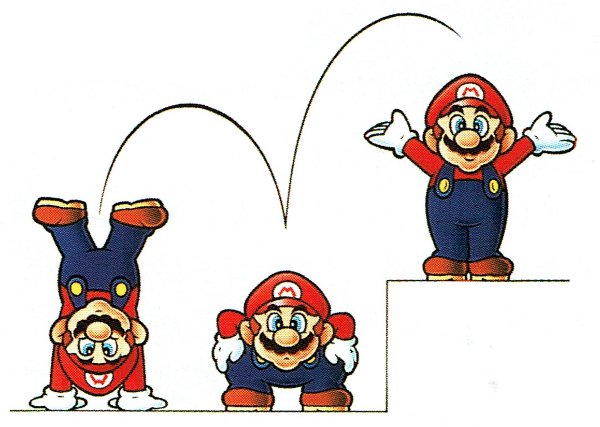
Handstand Jump
A while handstanding
Mario jumps vertically while in handstand position, allowing him to reach platforms above him. The Handstand Jump is significantly higher than a normal jump — essential for many puzzle stages where high platforms are unreachable any other way.
Handstand Double Jump
A again on the feet
If the Handstand Jump is timed right — pressing A again just as Mario lands on his feet after the first jump — he performs a Handstand Double Jump, reaching even higher platforms. The timing window is tight; mastering this Double Jump is one of the harder skills in the game and the key to many late-game puzzles.
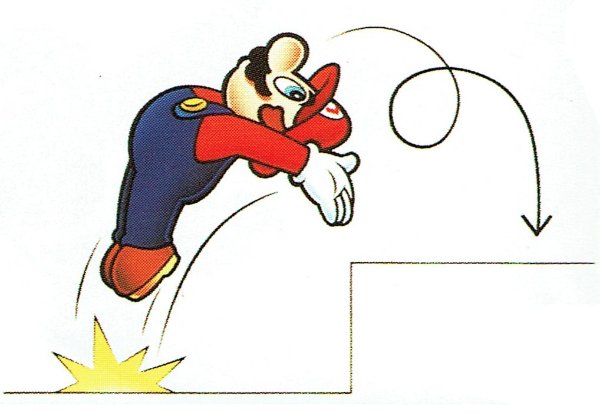
Backflip
← or → + A from handstand
Mario performs a backwards somersault in the direction opposite to the way he’s facing. Reaches platforms behind him without turning around — essential for many tight-corner puzzles. The backflip is also one of the more visually impressive moves, with Mario rotating gracefully through the air.

Spin from Wire
A while hanging from wire
When Mario hangs from a vertical wire or rope, pressing A makes him spin around the wire, gaining momentum to launch himself further than a normal jump. Used in the Forest, Jungle, and other rope-heavy worlds. Effectively a “swing throw” move.

Hammer Swing
Touch a Hammer pickup
The classic Donkey Kong hammer returns. When Mario grabs one, he automatically swings it back and forth, defeating any enemy in his path. While holding the hammer, Mario cannot jump — but he can throw the hammer upward and quickly climb to a higher platform to catch it. The hammer eventually disappears and respawns at its starting location.

Pick Up & Throw
B (near a key/barrel/can)
Mario can pick up keys, barrels, and trash cans and carry them. He can throw them to defeat enemies or use them as stepping stones. Trash cans can be picked up and thrown to reach higher areas, or stood on. Keys are the central puzzle item — carry them to the locked door to advance.
Controls
Donkey Kong’s controls are designed for precision over speed. The acrobatic moveset requires careful input combinations rather than reflexive button-mashing.
Basic Controls
| Input | Action |
|---|---|
| D-Pad ← / → | Move Mario left/right; also climb ladders horizontally |
| D-Pad ↑ | Climb up ladders or ropes |
| D-Pad ↓ | Climb down ladders, or crouch on solid ground |
| A | Jump. When held with ↓: enter Handstand. From Handstand: Handstand Jump. From Wire/Rope: Spin |
| B | Pick up / Throw — grab keys, barrels, trash cans |
| SELECT | Pause / Status menu |
| START | Pause / Save / Menu |
Advanced Combos
- Handstand → Handstand Jump → Double Jump: The signature DK ’94 traversal sequence. Hold ↓ + A to handstand, press A to jump, then press A again on landing to chain into a double jump
- Handstand → Backflip: From handstand, press direction + A to flip backwards
- Hammer Throw + Climb: Throw the hammer upward, quickly climb to catch it on a higher platform
- Pick up + Carry across stage: B-button hold to carry keys/barrels long distances. Watch the timer — keys disappear if held too long
The 10 Worlds
Donkey Kong’94 spans 10 worlds total: Construction Site (the 4 original arcade stages) plus 9 brand new themed worlds with progressively harder puzzle-platforming. Each world ends with a Donkey Kong boss fight and a chase to the next location.
Construction Site
4 stages
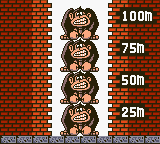

The original 1981 arcade game. Four simplified stages (25m, 50m, 75m, 100m) faithfully recreating the Donkey Kong arcade classic. Mario climbs the construction site, dodges Fireballs and DK’s thrown barrels and jacks, and at 100m must pull out all the rivets to defeat DK. This is the opening “tutorial” — a complete game in itself, before the real game begins.
Big-City
8 stages


The first puzzle world after the arcade opener. Introduces all the new mechanics: handstands, roads, ladders, keys, doors. Serves as the tutorial for the rest of the game’s puzzle-platforming structure. Features two boss fights with Donkey Kong. An urban backdrop with high-rises, fire escapes, and city streets.
Forest
varies stages


Adds vertical ropes to climb and water to swim in. The first appearance of switches — these make roads appear and disappear, fundamentally changing how the player approaches each puzzle stage. A natural environment with trees, vines, and water hazards.
Ship
varies stages


A nautical world set on board a giant ship. Introduces new water-related mechanics and currents. Sailor and aquatic enemies emerge as Mario navigates decks, masts, rigging, and crow’s nests.
Jungle
varies stages
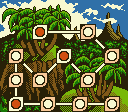
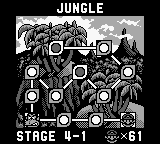
A jungle environment with vines, tall trees, and lush vegetation. DK’s native habitat — fitting that he leads Mario deeper into the wilderness here.
Desert
varies stages


A scorching desert with quicksand pits, ancient pyramid structures, and new sand-based puzzle elements. The dryness contrasts sharply with the previous Forest and Ship worlds.
Airplane
varies stages


An aviation-themed world set on board moving aircraft. Wind effects, vertical air shafts, and platform-on-airplane puzzles. One of the more unusual world themes — puzzle-platforming at altitude.
Iceberg
varies stages


A frozen iceberg world with slippery ice physics, frozen platforms, and cold-themed enemies. Mario’s footing becomes unreliable — every jump matters more. Penalty for sliding off into icy water.
Rocky-Valley
varies stages

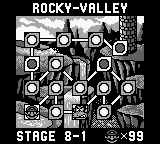
A rocky mountain valley with falling rocks, treacherous cliff platforms, and natural rock obstacles. DK’s second-to-last hideout before the final confrontation.
Tower
varies stages

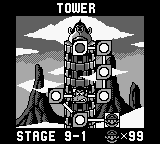
The final world. Mario climbs an enormous tower for the climactic showdown against Giant Donkey Kong (visible in full size on the Super Game Boy version with colored graphics). The endgame.
The Original 4 Arcade Stages
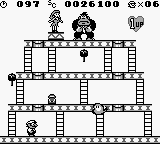
The first four stages of DK ’94 are simplified recreations of the 1981 Donkey Kong arcade classic. They serve as a love letter to the arcade original — a complete game-within-a-game before the real puzzle adventure begins.


The Arcade Heritage
- 25m: The classic ramp-and-barrels stage. Mario must climb to the top while DK rolls barrels down at him. The opening level of the original arcade game
- 50m: The conveyor belt stage with cement pies and fireballs. Mario navigates moving belts and platform gaps
- 75m: The elevator stage with springs. Mario rides moving elevators and times jumps onto springboards
- 100m: The rivet stage. Mario must pull out all the rivets supporting DK’s platform, causing the ape to fall. The classic finale of the original arcade game
Mini-Games
Throughout the puzzle stages, Mario can collect three special items that unlock bonus mini-games after completing the stage.
The Three Bonus Items
If Mario collects all three of these items within the same level, he gets to play a bonus mini-game after the level is finished:
- Parasol — a colorful umbrella
- Hat — Pauline’s elegant headwear
- Bag — a small handbag (also Pauline’s)
Collecting all three triggers one of two mini-games:


Enemies
DK ’94 features enemies from the original arcade game plus many original enemies unique to this game. The roster largely does not overlap with mainline Super Mario enemies — the one exception is Spark, which appeared in Super Mario Bros. 2. Many enemies share behavior but have different sprites depending on the world.
Returning Arcade Enemies
- Fireball — The classic arcade flames that chase Mario. Spawned from oil drums that catch fire. Burns Mario on touch. Defeatable with the hammer
- Fire — Larger fireball variants that spawn from the sides of the screen. Same behavior, deadly on touch, hammer-vulnerable
- Oil — A flame emitting from a can labeled “Oil”. Floats up and down in place — doesn’t actively chase, but touching it is fatal. Hammer-vulnerable
New DK ’94 Enemies
- Spark — The one mainline Super Mario series enemy (debuted in SMB 2). Travels along platform edges in a fixed circuit
- Many world-specific enemies — each themed world introduces new enemies that match the visual theme: forest creatures in Forest, sailors in Ship, jungle wildlife in Jungle, desert critters in Desert, aviation foes in Airplane, ice creatures in Iceberg, rocky beasts in Rocky-Valley, tower guards in Tower
- Boss DK — Donkey Kong himself is fought at the end of each of the 10 worlds. Throws barrels, jacks, and other projectiles. Defeated by various methods specific to each fight
- Donkey Kong Jr. — Not a boss, but an active interferer. Flips switches to disrupt Mario’s path and throws poisonous mushrooms that shrink Mario to half-size
Items
Mario can collect or interact with various items throughout the 101 stages — some are defensive, some offensive, some essential to progression.
Core Items
- Hammer — The classic DK arcade hammer. Mario swings it back and forth automatically, defeating any enemy in his path. Cannot jump while holding it. Can be thrown upward and caught on a higher platform. Disappears after a time, then respawns at the original location
- Parasol, Hat, & Bag — Collect all three in the same level to trigger a bonus mini-game after completing the stage (Wheel of Fortune or Slot Machine)
- 1UP Heart — Grants Mario an extra life when collected
- Key — The central puzzle item. Mario must take the key to the locked door to advance. Can be picked up and thrown (defeats enemies in the throw’s path). If Mario loses it, it disappears after a few seconds and respawns at the original location
- Trash Can — Mario can stand on Trash Cans to reach higher areas, or pick them up and throw them to defeat enemies. Multi-purpose
- Poisonous Mushroom — Thrown by Donkey Kong Jr. on the puzzle stages. If Mario touches it, he shrinks to half his size, complicating tight passages
Characters
DK ’94’s cast is small but iconic — the principal Donkey Kong family alongside Mario and Pauline.

Mario
The hero. Pursues DK across 10 worlds with his new acrobatic moveset. The defining game for Mario’s handstand-and-backflip skill set.

Pauline
Mario’s “lady friend” from the arcade era — the damsel-in-distress abducted by Donkey Kong. Returns to a starring role here for the first time in over a decade.

Donkey Kong
The antagonist. Kidnaps Pauline at the start and refuses to stay defeated — always recovering and escaping to the next world. The final form, Giant DK, looms massive in the Tower finale.
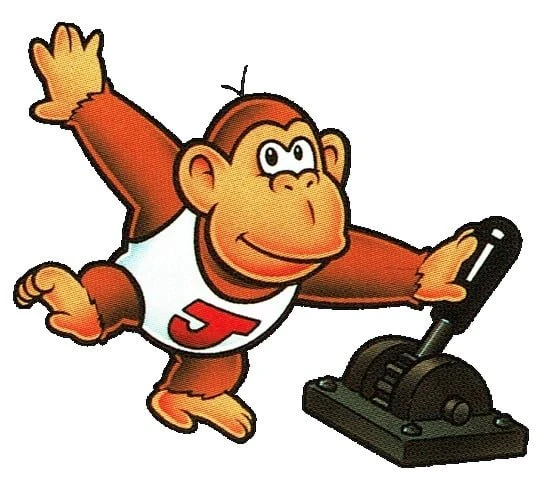
Donkey Kong Jr.
DK’s son and active accomplice. Doesn’t fight Mario directly but actively sabotages his puzzle stages — flipping switches, throwing poisonous mushrooms. A returning character from Donkey Kong Jr. (1982 arcade)
Super Game Boy Enhancements

DK ’94 is the first Super Mario franchise game with specialized Super Game Boy support — an industry first for the SGB platform. When played on the Super Game Boy peripheral for the Super Famicom / Super Nintendo, the game gets a substantial upgrade.
Super Game Boy Enhancements
- Colored graphics — every world gets its own color palette, transforming the originally monochrome Game Boy game into a colorful experience. Forest is green, Desert is sandy, Iceberg is icy blue, Tower is dramatic
- Arcade cabinet border — the game’s Super Game Boy border resembles the actual Donkey Kong arcade cabinet — a fitting tribute to the 1981 original
- Pauline voice samples — the Super Famicom’s sound chip supports voice samples, and the game uses this to make Pauline’s distress cry sound like an actual cry for help rather than a Game Boy beep. A landmark for early voice work in 1994 console gaming
- Enhanced credits music — the end credits music gets additional audio enhancement on the SGB
SGB Box Art Bundle
The Super Game Boy Bundle packaging features Donkey Kong’s box art alongside the Super Game Boy peripheral artwork — explicitly positioning DK ’94 as the showcase title for the SGB hardware.
Videos & Promotion
Archived gameplay and the original 1994 TV commercial for Donkey Kong on Game Boy.
Development Staff
Donkey Kong (Game Boy) was developed by Nintendo EAD — Nintendo Entertainment Analysis & Development, the legendary first-party studio behind Super Mario Bros., The Legend of Zelda, and most flagship Nintendo IP of the era.
- Developer: Nintendo EAD
- Publisher: Nintendo
- Platform: Game Boy (Super Game Boy enhanced)
- Genre: Puzzle-Platformer
- Predecessor: Donkey Kong (Arcade, 1981) and Donkey Kong Jr. (Arcade, 1982)
- Direct Successor: Mario vs. Donkey Kong series (GBA 2004 onwards)
Reception & Legacy
Donkey Kong (Game Boy) received strong positive reviews on release and is now widely regarded as one of the best Game Boy games ever made.
Critical Scores
- Nintendojo: 9/10 — named it one of the best Game Boy games ever made. Praised the “innovative gameplay” and the “seamless fusion” of the original arcade game with puzzle elements
- Nintendo Life (Marcel van Duyn): 9/10 — “First impressions can be misleading. With 101 stages, Donkey Kong has impressive longevity…”
- Video Games magazine (Germany): 90% — said the game “belongs into every Game Boy collection” for its “love of detail and elaborate platform levels.” Praised the surprises in each new world keeping the player at a high degree of motivation, and the battery save
- IGN: praised the game for taking the “classic design to new heights with fresh action and puzzle elements that faithfully retained the Donkey Kong arcade game’s look and feel.” Called it a “classic and amazingly fun” Game Boy game
What Critics Praised
- Seamless fusion of arcade and puzzle. The opening 4 arcade stages flow naturally into the 97 puzzle stages — critics universally praised this design choice
- 101 stages of content. Massive for a 1994 Game Boy game. Unmatched longevity in the era
- The Twist. DK getting up and escaping after the arcade stages was widely cited as one of the most surprising moments in Game Boy gaming
- Mario’s acrobatic moveset. The handstand, backflip, and spin moves were highlighted as innovative additions to Mario’s repertoire
- Super Game Boy enhancements. Colored graphics, voice samples for Pauline, and the arcade cabinet border were treated as showcase features
- Battery save. Rare for the era — played a role in the German Video Games magazine’s 90% rating
- Variety across 10 worlds. Each world introduced new mechanics rather than recycling the same gameplay
Legacy
- Spiritual predecessor to Mario vs. Donkey Kong (GBA, 2004). The puzzle-platforming structure, the key-and-door mechanics, the Mario acrobatic moveset, the chase-Donkey-Kong premise — all transferred forward into the entire Mario vs. DK series
- Nintendo 3DS Virtual Console re-release in 2011 made the game accessible on modern handheld hardware
- Nintendo Switch Online — Game Boy classics service added the game in 2023
- One of the best-regarded Game Boy puzzle-platformers ever made. Frequently cited on “best of Game Boy” lists alongside Tetris, Super Mario Land 2, and Link’s Awakening
SLB User Reviews
Donkey Kong (Game Boy) has yet to receive a community review on Super Luigi Bros.
If you’ve played Donkey Kong ’94 and would like to submit a review, please get in touch.
Regional Box Art & Iconic Screens
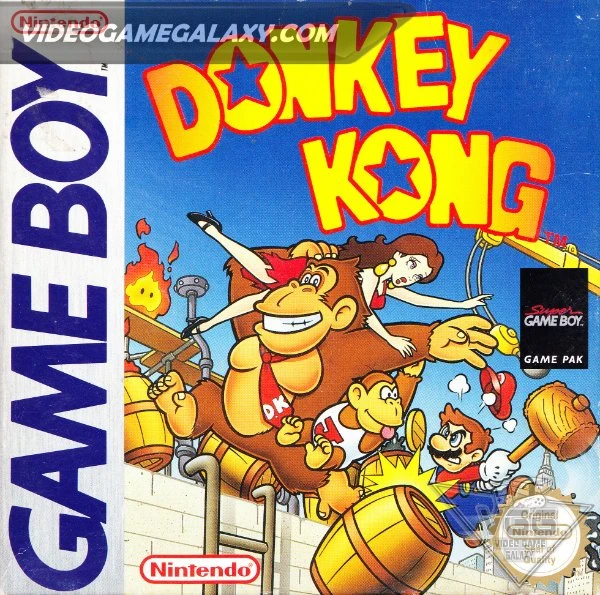
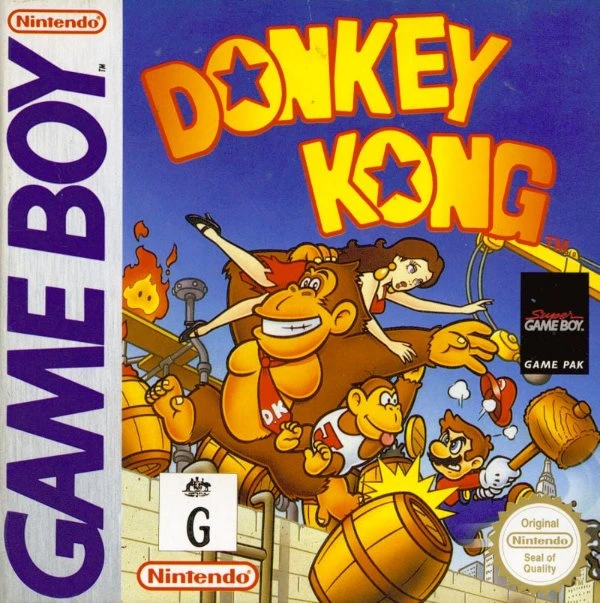
DK ’94 shipped with extensive regional box art variants — reflecting its globally significant launch as a flagship Super Game Boy showcase title.
North American Variants


International






Iconic Screens


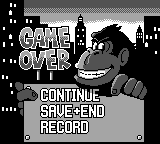

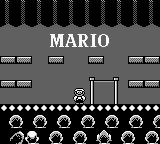
Trivia & Facts
- Known as “DK ’94” / “Donkey Kong ’94” in pre-release coverage. The “94” suffix has stuck in fan communities to distinguish this game from the 1981 arcade original
- The first Super Mario franchise game with Super Game Boy support. An industry first. Other titles followed, but DK ’94 was Nintendo’s flagship SGB demo
- Pauline’s voice samples. The Super Famicom’s sound chip enabled actual voice samples for Pauline’s distress cry — a hardware first for the SGB platform and one of the earliest uses of voice work in handheld-derived gaming
- The Arcade Cabinet Border. The Super Game Boy border for DK ’94 resembles the actual Donkey Kong arcade cabinet — a fitting visual tribute
- 101 stages total. 4 original arcade stages + 97 brand new puzzle stages across 9 new themed worlds
- Mario’s defining acrobatic moveset debuts here. Handstand, Handstand Jump, Handstand Double Jump, Backflip, and Spin from wire all originated in this game. The moveset would carry over directly into Mario vs. Donkey Kong (2004) and the entire MvDK series
- The Handstand Double Jump is rare in Mario history. Most Mario games use single or wall jumps; DK ’94 is unusual for including a specific timed Double Jump chained from a Handstand Jump
- The Twist. Beating “Donkey Kong” at 100m doesn’t end the game — DK gets up, recaptures Pauline, and escapes. The reveal that the arcade ending was just the prologue is one of the great surprise moments in Game Boy history
- The Giant DK final form. The Tower world finale features a Giant Donkey Kong boss — visually impressive on the Super Game Boy with full color
- Spark is the only mainline Super Mario enemy. Spark (from Super Mario Bros. 2) is the only enemy that crosses over from a mainline Mario game
- Donkey Kong Jr. returns from his own 1982 arcade game. Here he’s not the protagonist but actively interferes with Mario’s puzzles by flipping switches and throwing poisonous mushrooms
- The Pauline / Donkey Kong family ending. Mario, Pauline, DK, and DK Jr. all reunite peacefully in the ending portrait — a heartwarming resolution unique to this game
- The Hammer disappears and respawns. Unlike most Mario power-ups, the hammer cycles — it disappears after a time and respawns at its original location
- Parasol, Hat, and Bag. The three bonus items — collect all three in one level to trigger a bonus mini-game (Wheel of Fortune or Slot Machine)
- Battery save data. The Game Boy cartridge has internal save storage — rare for the era. The German Video Games magazine specifically praised this
- 3DS Virtual Console re-release in 2011
- Nintendo Switch Online — Game Boy classics service added the game in 2023
- Mario vs. Donkey Kong DNA. The puzzle-platforming structure, key-and-door mechanics, Mario acrobatic moveset, and chase-Donkey-Kong premise all directly inform the MvDK series (GBA 2004, DS 2006, Switch 2024, etc.)
- Nintendojo placed it among the best Game Boy games ever. 9/10 rating with high praise for the “seamless fusion” of arcade and puzzle
- 10 worlds, 9 boss fights against DK. The chase escalates through Big-City, Forest, Ship, Jungle, Desert, Airplane, Iceberg, Rocky-Valley, and Tower — each ending in a boss fight with DK
- Working titles included “DK” and “Donkey Kong ’94”. Pre-release materials used both names; the retail title was just Donkey Kong
- Critical and commercial success. Unlike Alleyway, which was a mixed-reception title, DK ’94 sold very well and received a Player’s Choice budget re-issue in North America
Reference / Information
Sub-pages and guides for Donkey Kong (Game Boy).
Media / Downloads
Galleries and screenshots.