
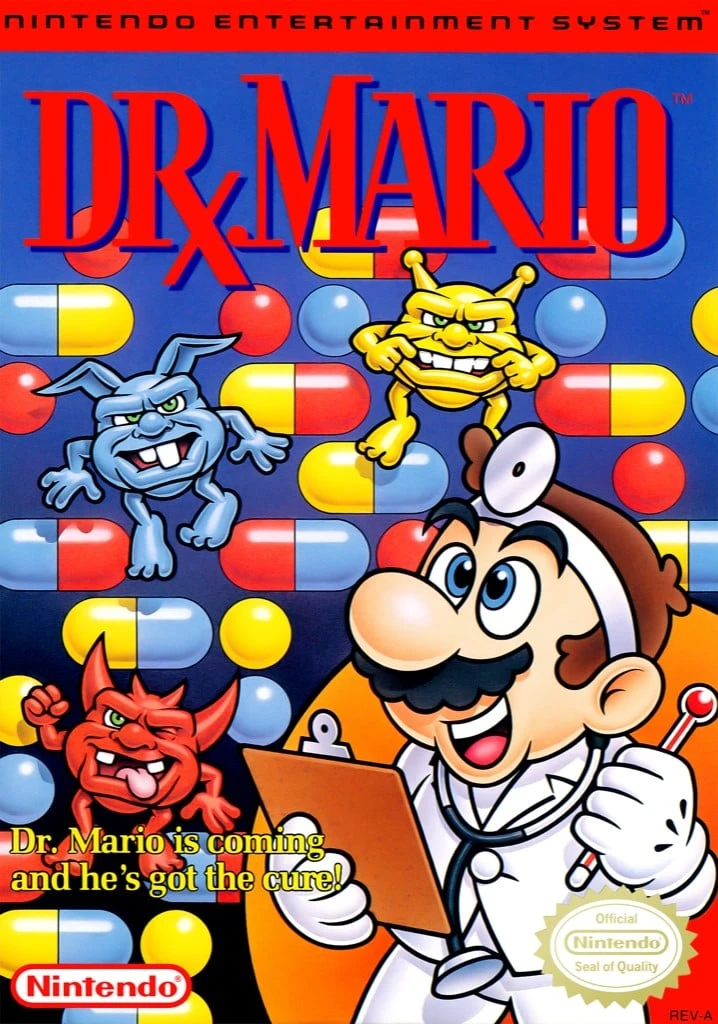
Dr. Mario Series
Mario swaps his plumber’s overalls for a white coat in this iconic puzzle series. Stack and match colourful capsules to wipe out the three deadly viruses — Fever, Chill and Weird. From a humble NES debut in 1990 through to a full four-player adventure on Nintendo 64, Dr. Mario is one of Nintendo’s most enduring puzzle franchises.
The Viruses
Three deadly viruses are the enemies in every Dr. Mario game. They appear randomly on the board at the start of each stage and must all be eliminated for Dr. Mario to win. Each virus has a distinct colour — your capsules must match their colour to destroy them. They also each have a unique personality in the game’s lore and cutscenes.

🔴 Fever
The red virus causes a burning temperature in its victims. The most common of the three viruses and the toughest to eliminate in larger numbers. Red capsule halves destroy it — create a line of four matching reds in any direction.

🔵 Chill
The blue virus inflicts a nasty chill on its victims. Often positioned in the most awkward spots on the board. Blue capsule halves are needed to create a matching row of four and wipe it out.

🟡 Weird
The yellow virus is as bizarre as its name suggests — it causes its victims to transform into strange shapes and sometimes different species entirely. Yellow capsule halves defeat it. The rarest colour in early levels.
How to Play
 The classic NES single-player field — the virus bottle fills with viruses and capsules fall from above
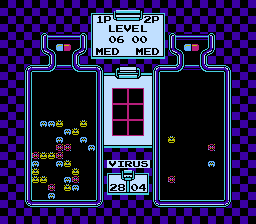 Two-player split-screen on NES — clear rows to drop garbage capsules onto your opponent’s board
 The tutorial lesson screen explaining how capsules and viruses interact
Dr. Mario is a falling-piece puzzle game in the Tetris tradition, but with its own distinctive twist. Instead of shaped tetrominoes, Dr. Mario drops two-coloured capsules (Megavitamins) that can be rotated and moved as they fall. The playing field is a giant pill bottle viewed from the front — 8 tiles wide and 16 tiles tall. Viruses are scattered around the bottle at the start of each stage.
To destroy a virus, you need to create a horizontal or vertical line of four capsule halves of the same colour that includes the virus itself. The virus and the four capsule halves disappear. Clear every virus from the bottle and you win the stage. If capsules pile up to the top of the bottle, it’s game over.
| Mechanic | How it works |
|---|---|
| Megavitamins | Two-coloured capsule pieces that fall from above. Each half is independently coloured red, blue or yellow. Rotate them with a button press before they land. |
| Matching | Align 4 or more of the same colour in a horizontal or vertical line (including the virus) to destroy them. Larger combos score more points. |
| Chain reactions | When pieces above a cleared row fall down and create new matches, a chain reaction fires — essential for high scoring and versus play. |
| Speed levels | Low, Medium and High speed. As you progress through virus levels (0–20), the speed may increase automatically. |
| Virus count | Each level has a specific virus count: Level × 4 + 4 = viruses. Level 0 = 4 viruses. Level 20 = 84 viruses. |
| 2-Player Battle | Each player has their own board. Clear rows to send garbage capsule halves onto your opponent’s board. First to eliminate all viruses (or force the opponent to top out) wins. |
Dr. Mario
NES version — the iconic virus bottle with falling Megavitamins Game Boy version title screen — portable Dr. Mario wherever you go
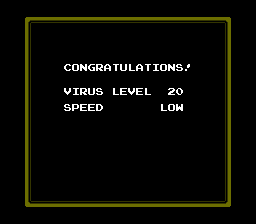 NES cutscene reward — completing virus levels unlocks short animated sequences
The original Dr. Mario debuted simultaneously on the NES and Game Boy in 1990, developed by Nintendo R&D1. It introduced the Megavitamin formula that defined the series — match four of the same colour to eliminate viruses, race to clear the board before it overflows.
| NES | Game Boy | |
|---|---|---|
| Japan release | July 27, 1990 | July 27, 1990 |
| N. America | October 23, 1990 | December 12, 1990 |
| Europe | June 27, 1991 | April 30, 1991 |
| Developer | Nintendo R&D1 | |
| Players | 1–2 (split screen) | 1–2 (Link Cable) |
| Levels | 0–20 | 0–20 |
| Speed modes | Low / Med / High | Low / Med / High |
The NES version features full split-screen two-player simultaneous battles — a landmark for puzzle game multiplayer at the time. The Game Boy version required a Link Cable for multiplayer. Both versions feature the iconic Fever and Chill music tracks, among the most recognised themes in Nintendo history. The NES version also includes short animated cutscenes unlocked at specific level/speed combinations — a charming reward for determined players.
| Version | Unique feature |
|---|---|
| NES | Split-screen 2-player · Animated cutscene rewards · VS. Dr. Mario arcade version |
| Game Boy | Portable play · Link Cable multiplayer · Monochrome display |
Dr. Mario (SNES)
The SNES version of Dr. Mario was released exclusively as part of the Tetris & Dr. Mario dual-game cartridge in 1994 — a clever bundle combining two of gaming’s greatest puzzle titles. Developed by Newcom, it added enhanced 16-bit visuals and audio but kept the core gameplay identical to the NES version.
| Details | |
|---|---|
| N. America | December 12, 1994 |
| Europe | July 25, 1995 |
| Developer | Newcom |
| Players | 1–4 |
| Bundled with | Tetris |
The SNES package introduced a Mixed Match mode unique to the bundle — players switch between Dr. Mario and Tetris gameplay in the same match, alternating between the two games. This was the most multiplayer-focused Dr. Mario release to that point, supporting up to four players.
Dr. Mario & Puzzle League
The GBA entry arrived in 2005 as a dual-game cartridge pairing Dr. Mario with Puzzle League (Panel de Pon). Developed by Intelligent Systems, it featured enhanced graphics and audio plus wireless multiplayer via the GBA Link Cable.
| Details | |
|---|---|
| Japan | September 13, 2005 |
| N. America | November 28, 2005 |
| Europe | November 25, 2005 |
| Developer | Intelligent Systems / NSPD |
| Players | Single player · Multiplayer via Link Cable |
The GBA version kept Dr. Mario’s core gameplay faithful while adding refreshed sprite art and improved audio. Wireless multiplayer added a competitive dimension to portable play. The pairing with Puzzle League made this the most content-rich portable Dr. Mario release to date.

Dr. Mario 64
 Dr. Mario 64 official artwork — the biggest and most ambitious entry in the series
 Four-player split-screen virus-clearing action on Nintendo 64
 The 13 default playable characters — the biggest roster in any Dr. Mario game
Dr. Mario 64 is the most ambitious entry in the series — a full Nintendo 64 game wrapping the classic Megavitamin formula in a proper Story Mode, 15 characters, and 4-player simultaneous multiplayer. Released in North America in April 2001 (Japan two years later), it remains the most feature-rich Dr. Mario game ever made.
Story — Dr. Mario and the Cold Caper
Flu season has struck! Dr. Mario is busier than ever with his miraculous Megavitamins — but Wario and the sinister Mad Scienstein are plotting to steal the entire supply. Who is Mad Scienstein really working for? Dr. Mario must defeat every challenger to recover his medicine and unravel the conspiracy. Two full story paths available: play as Dr. Mario or Wario.
Game Modes
| Mode | Description |
|---|---|
| Story Mode | Single-player narrative with cutscenes. Two story paths (Dr. Mario / Wario). Progress through increasingly tough virus battles against the full cast. |
| Classic 1-Player | Traditional Dr. Mario — choose level (0–20), speed, and clear all viruses. |
| Vs. Computer | Battle a CPU opponent — choose any character, set difficulty. |
| 2-Player Battle | Head-to-head versus. Clear rows to dump garbage capsules on your opponent. |
| 3 & 4-Player Battle | Series first! Three or four simultaneous players in free-for-all or Team Battle (2v2). |
| Team Battle (2v2) | Two players share one board — each controls a different colour on the same field. Tight co-ordination required. |
Playable Characters
15 characters — 13 from the start, 2 unlockable by completing Story Mode.
 Dr. Mario
 Wario
Wario Spearhead
 Webber
 Silky
Silky Appleby
Jellybob
Octo
Helio
Lumpy
Hammerbot
Mad Scienstein
Rudy the Clown
Metal Mario 🔒
Vampire Wario 🔒
🔒 = Unlock by completing Story Mode
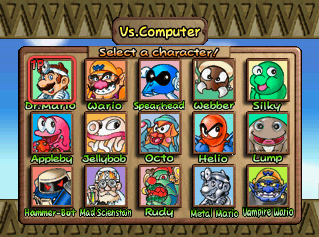 The complete 15-character lineup — including unlockable Metal Mario and Vampire Wario
Controls (N64)
| Input | Action |
|---|---|
| Control Stick ←/→ | Move capsule horizontally |
| Control Stick ↓ | Drop capsule faster |
| A Button | Rotate clockwise |
| B Button | Rotate counter-clockwise |
| Start | Pause |
Reception
Mixed to positive reviews. The four-player battle mode was universally praised as the standout feature. Story Mode was welcomed as a genuine addition to the puzzle game formula. The core gameplay — unchanged from 1990 — drew some criticism for lack of evolution but was appreciated by fans of the original.
Videos
Dr. Mario 64 — Gameplay
Dr. Mario 64 — Intro
Trivia
- The Fever and Chill music from the 1990 NES original are among Nintendo most recognised compositions — remixed in every sequel and multiple Super Smash Bros. games.
- Dr. Mario was designed by Gunpei Yokoi — the Nintendo legend behind the Game Boy, Metroid and Kid Icarus.
- The game was controversial at launch — some critics worried about pills in a game aimed at children.
- Dr. Mario 64 was one of the last N64 games in North America (April 2001), just months before the GameCube.
- Wario makes his first playable Dr. Mario appearance in DM64 with his own story path.
- Rudy the Clown, the final boss of DM64, previously appeared as the villain in Wario Land II (GB, 1998).
- The VS. Dr. Mario arcade (1990) was one of Nintendo earliest dedicated multiplayer arcade cabinets.