
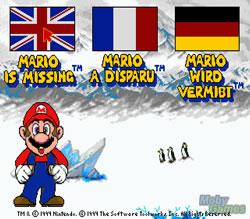

Mario is Missing!
A once in a lifetime (hopefully) edutainment journey
Overview
Mario is Missing! is an educational video game developed and produced for multiple systems and platforms (PC, NES and SNES). The PC and SNES versions were released in 1992 and made by Software Toolworks, while the NES version was released in 1993 and developed by Radical Entertainment. French publisher Mindscape published the first two versions; the NES version was published by Nintendo. The PC version was released on floppy disk, with a CD-ROM Deluxe edition following the next year.
This is a geography-learning game and also the first game where Luigi became a starring character. However, based on overall reception from players and critics, it was a very bad debut for Mario’s brother. Despite elements from Super Mario Bros. 3 and Super Mario World being present, it failed to attract many players and its gameplay was widely criticised. The only things that stood out were the remixes of popular themes from Super Mario World, which received mostly positive comments.
The only real highlight? Remixes of Super Mario World music — considered the best thing about an otherwise comprehensive failure.

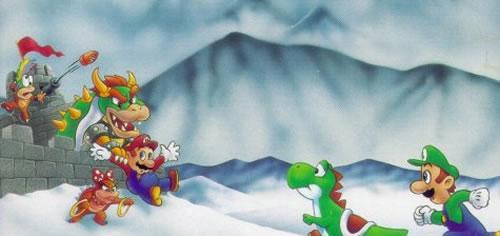
A two page fold out advertising the SNES version of Mario is Missing.
Release information
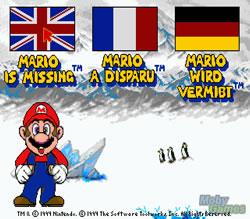

Story
Bowser returns and this time wants to flood the entire Earth by melting Antarctica with hairdryers from Hafta Havit Mail-Order. To fund this he sends Koopa Troopas to steal famous landmarks worldwide. Mario, Luigi and Yoshi travel to Antarctica to stop him — but Bowser captures Mario, leaving Luigi to save the day alone.
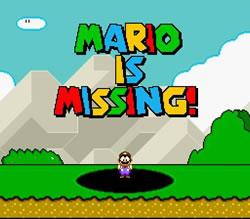
The method of Mario’s capture differs across versions. In the PC version Luigi is too scared to enter the castle, so Mario enters alone and is tricked by a butler (Bowser in disguise) and scooped into a net. In the SNES version a pit opens beneath them and swallows Mario. In the NES version a Koopa throws a bag over him.
Check out the official story overview from the manual below:
Bowser’s Plot
Oh no! Bowser and his bad boys are back to a life of crime. This time, it’s not Mario World — it’s your world! From his Antarctic castle, Bowser hustles his cold-blooded crew of cantankerous Koopas into his powerful Passcode Operated Remote Transport And Larceny System (PORTALS). The twisted turtles transport themselves throughout the globe, where celebrated cities suffer shocking crime waves, as turtles trash landmarks and loot ancient artefacts. With dough from his slimy sales, Bowser hoards hair dryers from the Hafta-Havit Hotline. His plot? Melt Antarctica and flood the planet! Whoa!
Mario’s Fate
Will the brave brothers from Brooklyn permit this abominable snow plan? The boys say “Not!” Mario, Luigi and Yoshi trek across ice and snow to shellac the shelled ones’ schemes. But Bowser’s slick; in one last trick, he takes the dearest thing of all… Mario is Missing!
Luigi’s Mission
Luigi must stop the Koopas, foil Bowser’s plan, and find Mario. Sneaking into each Portal, Luigi is transported to a city in trouble. There, Luigi needs to nab each Koopa, grab its loot, and return the artefact to its proper landmark. Along the way, Luigi explores the city, chats with the locals, reads the maps, and solves puzzles. Help him do this before time runs out! Once he figures out where he is on the globe, Luigi must use the “Globulator” to call Yoshi. Only after Yoshi scares Pokey away, can Luigi return to Bowser’s castle and lock the Portal for that city.
Mario is captured — the starting point of Luigi’s adventure.
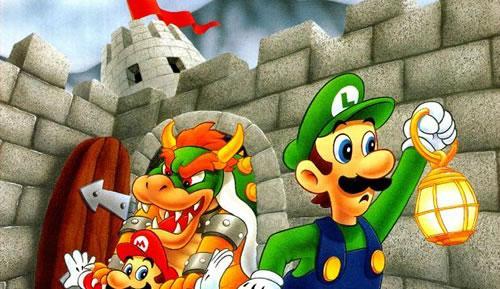
The deluxe version of Mario’s kidnap.
Gameplay & Controls
This game has a slightly different gameplay than usual games from the Mario franchise (it is an educational game after all). Luigi is the lead character you control throughout. To beat each level you need to retrieve several stolen artefacts and return them to their rightful places by confronting and stomping Bowser’s Koopa Troopa minions. Before the artefacts are returned you must take a quiz and answer trivia questions about the landmarks themselves. Some claim the woman who appears in the kiosks in the SNES version is Princess Daisy herself, though this has never been confirmed.
The PC version has a videophone aspect — you call a help number to stay in touch with friends, answer questions, retrieve the artefact, and receive a money award. The mayor contacts Luigi on arrival and again when the city is saved. Mario also phones Luigi with hints. The PC version also has a Taxi feature: collect taxi coins scattered across the city and exchange them for rides. The SNES version replaces taxis with elevator-pipes for faster transportation.
You also need to identify which city you are in to use the Globulator and call Yoshi. You cannot beat the level without Yoshi, since a large Pokey guards the last elevator-pipe. Yoshi gobbles him up in the PC version, while in the SNES version Pokey is merely scared away by Yoshi’s presence.

The map as it appears when viewed through the Globulator on the SNES version. Look familiar? It’s in the exact same style as the Super Mario World map!

Mario, Luigi and Yoshi as depicted in the CD-ROM Deluxe version.
Once all cities on a floor are secured, the PC version requires collecting a Fire Flower power-up while the SNES version has a small boss fight. Crucially, none of the bosses can hurt you — they are easily defeated by stomping several times. In the console versions Koopa Troopas are only defeated when soundly stomped, not merely knocked out.
After the original PC version, an enhanced CD-ROM Deluxe edition was released with full voice acting (Kathy Fitzgerald, Bob Sorenson, Rob Wallace, David Giller and Nicholas Glaeser), real photographs and video sequences replacing the original garish cartoon artwork of landmarks, and additional graphical improvements.
Locations
PC Version — 25 cities
Floor 1
Floor 2
Floor 3
Floor 4
Floor 5
SNES Version — 15 cities
Floor 1
Floor 2
Floor 3
NES Version — 14 cities
Rooms 1–2
Rooms 3–4
Rooms 5–7
Videos
Reception & Sales
The game received mostly negative reception and is considered one of the worst Mario games of all time. Common criticisms: “not fun”, “confusing”, “unbalanced”, “pointless”. The gameplay bore the brunt — authors stated that while being educational doesn’t preclude being fun, this game fails to deliver any entertainment whatsoever, with confusing mechanics and completely bland gameplay. The music remixes from Super Mario World were the sole element to receive praise.
Many popular gaming websites didn’t bother with a full review. IGN has no editorial review, though readers rated it 5.9/10. GameSpot similarly only has user reviews. Classic Game Room’s reviewer delivered sarcastic remarks including: “Mario is Missing… man, good for him” and “this game is sooooo boring… it just might eat your soul.” His conclusion: “Mario is missing because this game is awful… man, poor Luigi.”
“The Mario saga hit rock bottom with this game.”
“Simple and dull — with small redemption from the classic Mario control style.”
“Sooooo boring. It just might eat your soul.”
“The SNES version didn’t get off any better.”
Despite the critical drubbing, Software Toolworks’ August 1993 press release announced that console sales exceeded $7,000,000 for the fiscal quarter, calling it an important factor in boosting the company’s revenues.
References to other Mario games
- Super Mario Bros. — Koopa Troopas in the PC version closely resemble those from the original game, but move differently — using skateboards and parachutes rather than simply walking back and forth.
- Super Mario Bros. 3 — Similar sprites from this game appear in Mario is Missing.
- Super Mario World — Almost identical sprites appear in this release, and several musical themes are shared between both games.
Trivia & facts
- One of the first “edutainment” titles — designed specifically to teach basic geography
- Luigi’s first ever starring role across any Mario title
- In a rare twist, Mario is the one captured by Bowser — not Princess Peach
- The game is impossible to lose — there is no death mechanic of any kind
- Set entirely in the real world, not the Mushroom Kingdom
- Released on NES, SNES and PC (MS-DOS); the PC version also had a CD-ROM Deluxe edition
- Every Koopa Kid appears across all three versions except Morton and Lemmy
- In the MS-DOS version, Luigi refers to Mario only as “M” throughout
- Some players believe the woman in the SNES kiosks is Princess Daisy — this has never been confirmed
Reference & downloads
Articles & guides