
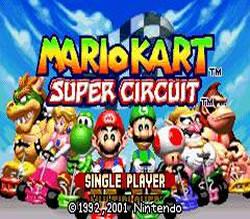

Mario Kart: Super Circuit
Overview
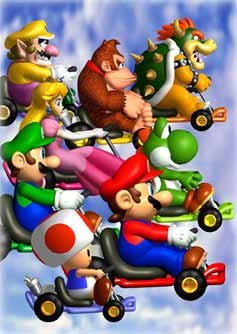
Mario Kart: Super Circuit is the third entry in the Mario Kart series and the first Mario Kart on a handheld console. Developed by Intelligent Systems (with Nintendo EAD’s support) and published by Nintendo, it released in Japan on 21 July 2001, North America on 27 August 2001, and Europe on 14 September 2001. The game was a major moment for the franchise — bringing Mario Kart to the Game Boy Advance proved the kart-racing format could thrive on portable hardware.
The game returns 8 playable characters from Mario Kart 64, refines the kart-racing formula introduced in Super Mario Kart, and — most famously — includes all 20 tracks from the original Super Mario Kart (SNES) as unlockable Extra tracks. This was the first time Mario Kart introduced “retro tracks”, a feature that would become a series staple from Mario Kart DS onwards.
Critical reception was outstanding. Metacritic 93/100 based on 24 reviews. IGN gave it 9.5/10, calling it “a GBA game with very few flaws — it’s a shame that it didn’t quite make the system launch, but the extra wait did the game wonders.” Eurogamer awarded 9/10, calling it “a vast, improved conversion of Super Mario Kart onto the Game Boy Advance.” Re-released on the Wii U Virtual Console in 2014.
Gameplay

Mario Kart: Super Circuit preserves the kart-racing fundamentals of Mario Kart 64 with a portable refinement. Players race on themed tracks, collect items from Item Boxes, and aim to either finish first in races or earn the most coins along the way.
Core Racing Mechanics
- Item Boxes: rainbow-colored boxes scattered across the track. Drive through to receive a random item (better items for lower-ranked drivers)
- Coins: the second Mario Kart to include coins (after Super Mario Kart). Coins boost kart top speed; lose coins when hit. Maximum 10 coins held
- Power slide: hop and turn for a controlled drift; gives a speed boost when executed correctly
- Rocket Start: tap accelerator at the right moment during the 3-2-1 countdown for a Mario Kart launch boost
- Spin-out: hit by Banana, Green Shell, or another driver — lose all coins, brief stop
- Star invincibility: while Star-empowered, ram opponents to knock them off-track
- Lakitu: appears on the right side of the screen with the start signal and lap count, MK64-style
Engine Classes
- 50cc: slowest speed; ideal for beginners
- 100cc: medium speed; standard difficulty
- 150cc: fastest speed; toughest AI
Unlockable Rewards
Controls
Mario Kart: Super Circuit’s controls are tuned for the Game Boy Advance’s button layout.
Race Controls
| Input | Action |
|---|---|
| D-Pad | Steer left/right (and accelerate/brake on some menus) |
| A button | Accelerate |
| B button | Brake / Reverse |
| R trigger | Hop / start a Power Slide |
| L trigger | Use Item |
| Start | Pause / open Pause menu |
| Select | Look behind |
Menu Controls
- D-Pad: navigate menus
- A button: confirm
- B button: cancel / back out
The 5 Game Modes
Mario Kart: Super Circuit offers 5 distinct game modes, each with its own focus.
| Mode | Players | Description |
|---|---|---|
| Grand Prix | 1–2 | The flagship mode. Pick a cup and play through its 4 courses, earning points based on finishing position. Earn enough points to win the cup. 5th place or lower forces a restart — you have 3 race flags (lives). Run out and you must restart the cup. |
| Time Trial | 1 | Race against your own ghost data. Each Time Trial provides one Triple Mushroom at the start. The challenge is improving your best times. Ghost data saves automatically for each course. |
| Quick Run | 1 | Free-play mode. Pick any unlocked course and customize the number of laps. No CPU, no time pressure — a practice / casual mode. |
| VS | 2–4 | Multiplayer racing via Game Link Cable. With a single cartridge, all players race as Yoshi (in different colors). |
| Battle | 2–4 | Multiplayer arena combat in one of 4 battle courses. Each player starts with 3 balloons; pop your opponents’ balloons with items to win. |
Grand Prix Ranking
At the end of each cup, players earn a ranking from E (lowest) up to ★★★ (triple-star). The rank is based on overall performance — finishing position, coin collection, item use, and lap times. Triple-star on every Super Circuit cup unlocks the night-time title screen.
Single Cartridge Multiplayer
The 8 Drivers
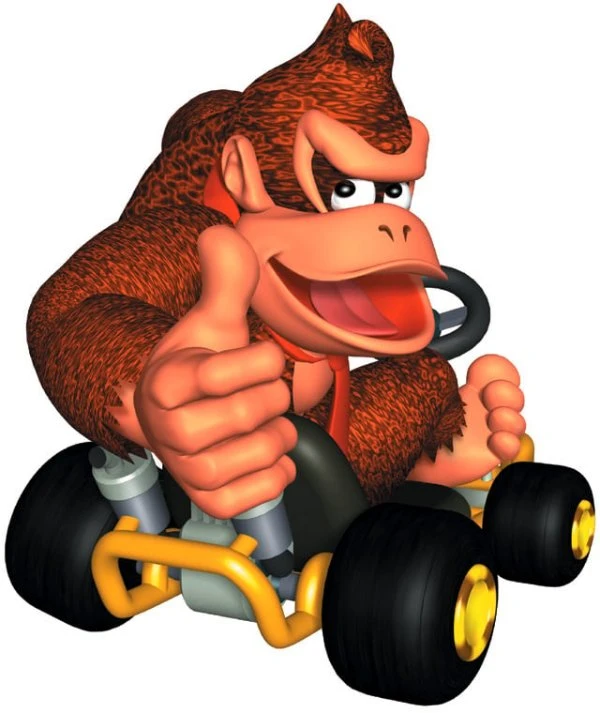
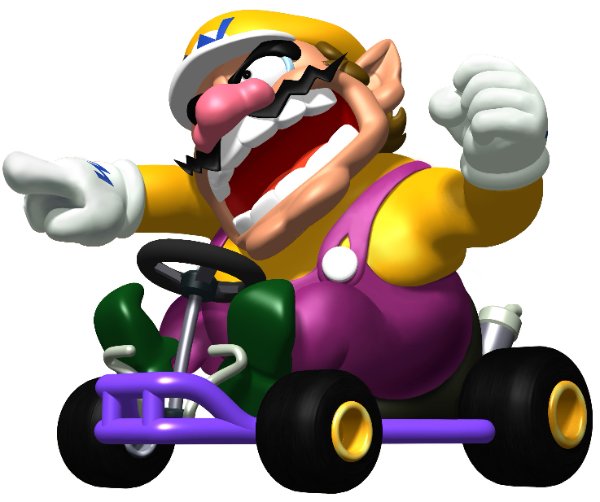
Mario Kart: Super Circuit’s playable cast is the 8 drivers from Mario Kart 64, returning unchanged. Each falls into one of three weight classes — lightweight, middleweight, or heavyweight — with different acceleration, top speed, and handling.



Weight Classes
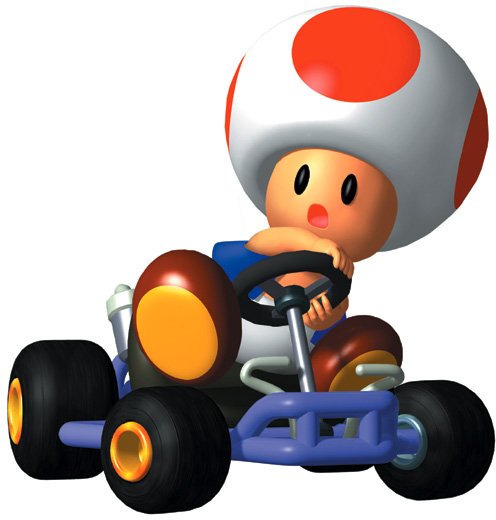
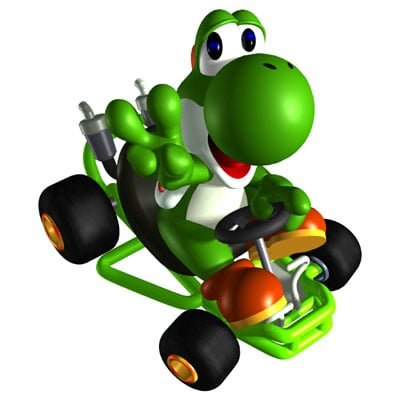
- Lightweights (Peach, Toad, Yoshi): highest acceleration, lowest top speed; easier to knock around; skid more easily. Peach and Toad share identical stats as the highest acceleration in the game
- Middleweights (Mario, Luigi): balanced — average acceleration and top speed across all metrics. The most beginner-friendly options
- Heavyweights (DK, Wario, Bowser): highest top speed, lowest acceleration; harder to knock around; tougher to slide. DK and Wario share identical stats; Bowser has slightly higher top speed
Multiplayer-Only Colored Yoshis
In single-cartridge VS multiplayer, all players race as Yoshi in different colors (Yoshi’s standard green, plus blue, red, and yellow variants). These colored Yoshis are essentially palette-swapped Yoshis with identical stats — they exist purely to give each player a visually distinct racer.
The 11 Items
Mario Kart: Super Circuit features 11 items — all returning from Mario Kart 64, with no new items introduced. This and Mario Kart Live: Home Circuit are the only Mario Kart games to add no new items. Items are obtained from Item Boxes and are weighted by your race position (better items for lower-ranked drivers).


Item Distribution
Item probability is weighted by race position. Low-ranked drivers get better items (Stars, Lightning, Triple Shells) while high-ranked drivers get defensive items (Bananas, Green Shells). This is the same catch-up mechanic introduced in Mario Kart 64 and now standard across the series.
Triple Items
The Triple Mushroom, Triple Green Shells, and Triple Red Shells orbit around the kart when held, providing both a visual indicator and a defensive shield. Triple Mushroom is exclusive to Time Trial and Versus modes.
The 14-vs-11 Trivia
The 20 Super Circuit Tracks
The Super Circuit Tracks are 20 brand-new courses, organized into 5 cups of 4 tracks each. Races are 3 laps on each track, with Lakitu appearing on the right side of the screen holding the start signal and lap counters — the same presentation as Mario Kart 64.





Notable Super Circuit Tracks
- Peach Circuit — the first track players race. Wide, gentle turns; ideal opener
- Shy Guy Beach — with Shy Guys firing cannonballs at the track. The first Mario Kart course to feature Shy Guys as the main hazard
- Sunset Wilds — famously features a time-of-day mechanic. The lighting darkens with each lap, going from sunset to night by the final lap. A first for the series
- Sky Garden — features tightrope-thin platforms in the sky with no railings. Fall off and Lakitu fishes you back — punishing for the unwary
- Cheese Land — the entire track is made of yellow cheese, complete with holes that swallow karts. Quirkiest themed track in the game
- Ribbon Road — a floating ribbon course that re-appeared in Mario Kart 8 Deluxe as a Booster Course Pass track
- Sunset Wilds has a different Japanese-version icon (Shy Guy variant) than the international one
- Bowser Castle 1-4 form the recurring castle gauntlet — each cup ends with a Bowser Castle
- Rainbow Road — the climactic Special Cup finale. Edges of the track are open; falling means Lakitu reset and lost time
The 20 SNES Retro Tracks
Mario Kart: Super Circuit’s most historic feature is the inclusion of all 20 tracks from the original Super Mario Kart (SNES, 1992) as Extra tracks. This was the first time Mario Kart introduced retro tracks, kicking off a tradition that every Mario Kart from DS onwards continues.
- 5 laps instead of 3 (same as the original SNES)
- Most obstacles removed — the iconic Pipes, Piranha Plants, and Thwomps from the SNES versions are gone (except Ghost Valley breaking blocks and Vanilla Lake breaking blocks, and Koopa Beach deep water)
- 50 coins per track — coin locations adjusted for consistency. All retro tracks now have exactly 50 coins
- Updated visuals with GBA-style sprites
- Unlocked by collecting all 100 coins in the matching Super Circuit cup
Extra Cups (20 Retro Tracks)
| Track | Original SNES Cup |
|---|---|
| Mario Circuit 1 | Mushroom Cup |
| Donut Plains 1 | Mushroom Cup |
| Ghost Valley 1 | Mushroom Cup |
| Bowser Castle 1 | Mushroom Cup |
| Track | Original SNES Cup |
|---|---|
| Mario Circuit 2 | Flower Cup |
| Choco Island 1 | Flower Cup |
| Ghost Valley 2 | Flower Cup |
| Donut Plains 2 | Flower Cup |
| Track | Original SNES Cup |
|---|---|
| Bowser Castle 2 | Flower Cup |
| Mario Circuit 3 | Star Cup |
| Koopa Beach 1 | Star Cup |
| Choco Island 2 | Star Cup |
| Track | Original SNES Cup |
|---|---|
| Vanilla Lake 1 | Star Cup |
| Bowser Castle 3 | Star Cup |
| Mario Circuit 4 | Special Cup |
| Donut Plains 3 | Special Cup |
| Track | Original SNES Cup |
|---|---|
| Koopa Beach 2 | Special Cup |
| Ghost Valley 3 | Special Cup |
| Vanilla Lake 2 | Special Cup |
| Rainbow Road (SNES) | Special Cup |
Two Rainbow Roads in One Game
Super Circuit is famously the only Mario Kart with two Rainbow Roads as gameplay tracks: the new GBA Rainbow Road in the Super Circuit Special Cup, and the SNES Rainbow Road in the Extra Special Cup. Both deliver the classic outer-space rainbow track — but with very different layouts and music.
The 4 Battle Courses
Mario Kart: Super Circuit features 4 brand-new battle courses — none of the original Super Mario Kart battle courses return as default play options, though all 4 SNES battle courses exist in the game’s code and are reachable through hacking.


Battle Mode Rules
- 2–4 players via Game Link Cable
- Each player starts with 3 balloons
- Hit an opponent with an item to pop a balloon
- Lose all 3 balloons and you’re eliminated
- The last player with balloons remaining wins
Battle Course 2 has a notable difference between the Japanese and international versions — the layout differs slightly between regions.
Glitches & Shortcuts
Several notable glitches and shortcuts have been documented in Mario Kart: Super Circuit. None are necessary for normal play, but they’re part of the speedrun toolkit.
CPU Glitch (Rainbow Road)
- Select Rainbow Road in 100cc or 150cc Grand Prix mode
- Obtain a Banana early in the race
- Place the Banana on the very corner of the curb leading to the famous shortcut
- Drive backwards until you’re between the shortcut and the other side, then park on the middle of the track
- When a CPU racer hits the Banana, it may fall off-track. When restored to the track by Lakitu, it will drive toward the shortcut but keep falling — stuck in an endless loop
Koopa Beach 1 Glitch Shortcut
On Koopa Beach 1 (SNES retro), if the player spindrifts after crossing the finish line and aims behind it correctly, then triggers a mushroom while hopping behind the finish line, the lap can register as completed — effectively a major shortcut that skips most of the track.
Cheese Land Glitch Shortcut
On Cheese Land, if the player spindrifts 270° right going behind the starting line, they can perform a glitch that lets them use a mushroom and clip through the start area for a massive shortcut.
Promotion & Videos
Two contemporary TV commercials from the 2001 launch — the English and Japanese versions.
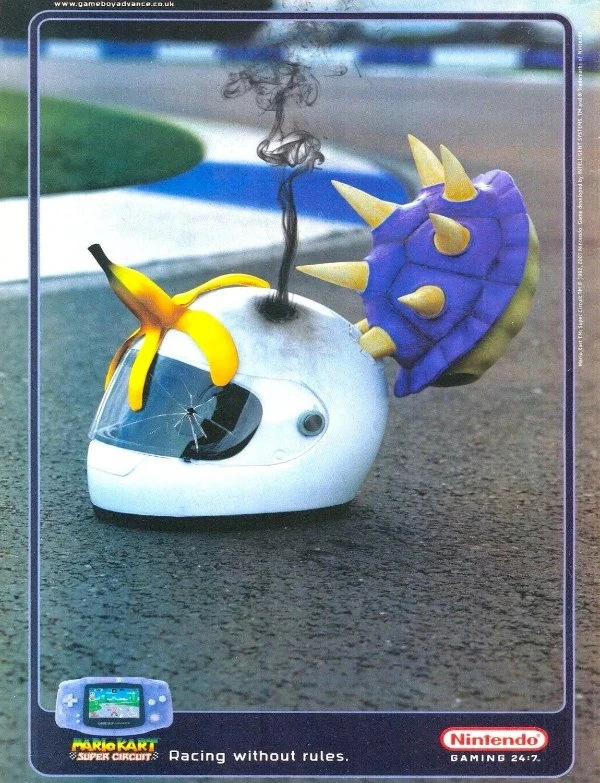
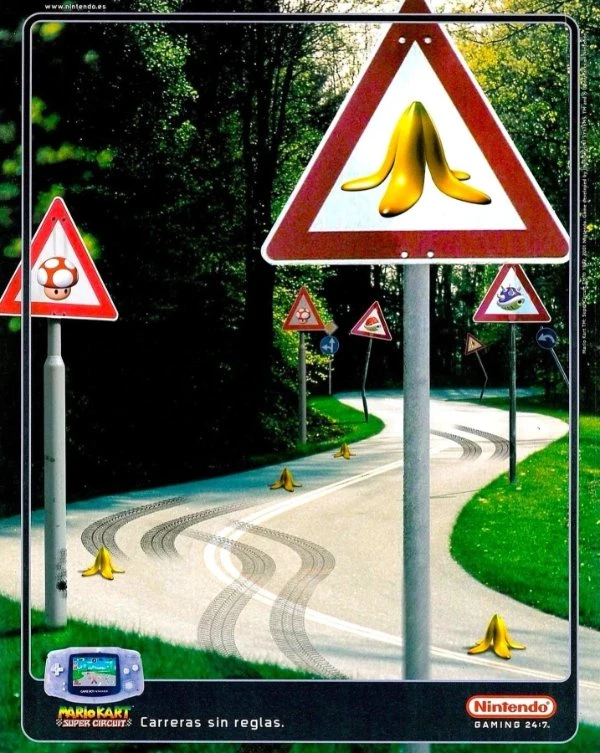
Print Advertising


Strategy Guide

Development Staff
Mario Kart: Super Circuit was developed by Intelligent Systems with support from Nintendo EAD, and published by Nintendo.
- Developer: Intelligent Systems (with Nintendo EAD support)
- Publisher: Nintendo
- Platform: Game Boy Advance
- Series Entry: 3rd Mario Kart (first portable)
- Predecessor: Mario Kart 64 (N64, 1996)
- Successor: Mario Kart: Double Dash!! (GCN, 2003)
- Producer: Shigeru Miyamoto
- Director: Hideki Konno
- Composer: Kenta Nagata (returned from Mario Kart 64)
- Genre: Kart racing
Intelligent Systems brought their portable-game expertise (Fire Emblem, Advance Wars) to bear on the Mario Kart formula, with Nintendo EAD providing the design guidance from the home-console Mario Kart team.
Reception & Legacy
Mario Kart: Super Circuit received critical acclaim at launch. It scored an average of 91.54% on GameRankings (39 reviews) and an average of 93/100 on Metacritic (24 reviews). It became one of the highest-rated GBA games of all time.
It’s a GBA game with very few flaws — it’s a shame that it didn’t quite make the system launch, but the extra wait did the game wonders. — Craig Harris, IGN (9.5/10)
Critical Scores
- Metacritic: 93/100 (24 reviews) — universal acclaim
- GameRankings: 91.54% (39 reviews)
- IGN (Craig Harris): 9.5/10 — “A GBA game with very few flaws… the extra wait did the game wonders, and it shouldn’t be missed.”
- Eurogamer (Tom Bramwell): 9/10 — “A vast, improved conversion of Super Mario Kart onto the Game Boy Advance.” Praised replay value but criticized the original GBA’s lack of backlighting and the pick-up Lakitu system
What Critics Praised
- The 20 + 20 = 40 total tracks — nearly double the content of any prior Mario Kart
- The SNES retro track inclusion — a brilliant gift to long-time fans of the original Super Mario Kart
- The smooth Mode 7-style portable kart racing on the GBA hardware
- The 3-engine class system giving depth across difficulty levels
- The Link Cable multiplayer — functional and competitive for the era
- The extra polish compared to Mario Kart 64 — IGN specifically noted the “extra wait paid off”
Common Criticisms
- Lack of GBA backlight made the screen dim in low-light conditions (a hardware issue, not the game’s fault)
- Lakitu pickup system when falling off-track was sometimes slow
- Strict 4th-place qualification in Grand Prix was unforgiving for new players
- Some critics noted that the Extra tracks lacked the obstacles from the SNES original, making them less varied than expected
Sales & Legacy
- One of the best-selling GBA games at launch
- Re-released on Wii U Virtual Console in 2014
- Established the retro tracks tradition followed by every Mario Kart from DS onwards
- Ribbon Road was later revived as a DLC track in Mario Kart 8 Deluxe (Booster Course Pass)
- Several other Super Circuit tracks returned in Mario Kart Wii (Sky Garden) and Mario Kart 8 (Cheese Land, Sky Garden)
- The first Mario Kart to prove the franchise worked on handhelds — paving the way for Mario Kart DS, Mario Kart 7, and Mario Kart 8 Deluxe
SLB User Reviews
Mario Kart: Super Circuit has yet to receive a community review on Super Luigi Bros.
If you’ve played Mario Kart: Super Circuit and would like to submit a review, please get in touch.
Regional Logos, Box Art & Title Screens
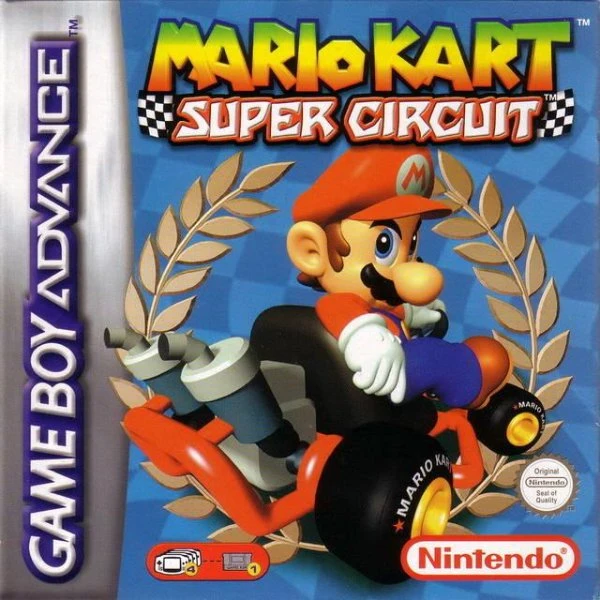
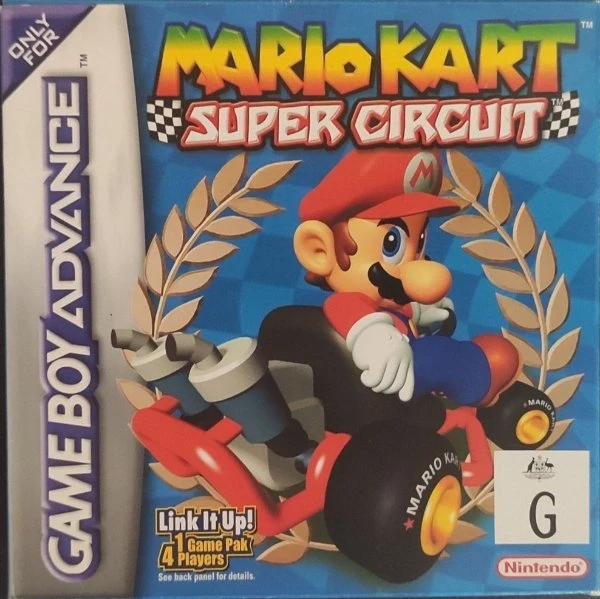
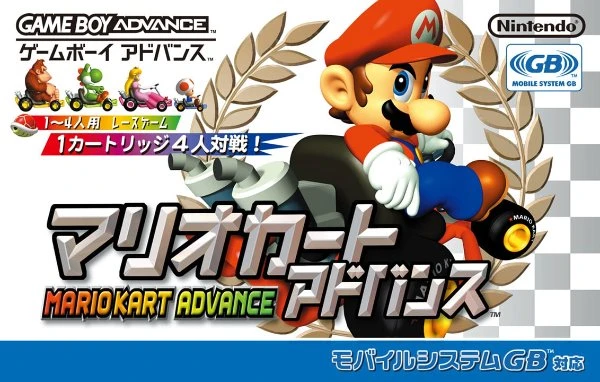
Mario Kart: Super Circuit shipped with distinct regional box art across all four regions, plus a North American Player’s Choice budget re-release.
Regional Logos



Box Art

The Three Title Screens
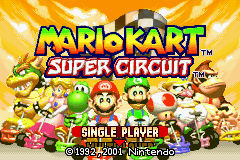
One of Mario Kart: Super Circuit’s most charming details: the title screen changes based on player achievement.


Character Select

Trivia & Facts
- First Mario Kart on a handheld. Super Circuit pioneered portable kart racing. Every Mario Kart on DS, 3DS, and Switch handhelds builds on what Super Circuit established
- The retro tracks tradition started here. Including all 20 Super Mario Kart courses as Extra tracks established the “retro tracks” concept that every Mario Kart from MKDS (2005) onwards continues
- 40 total tracks was record-breaking. 20 new + 20 retro is more than Mario Kart 64’s 16 tracks and far more than Super Mario Kart’s 20 tracks
- Mario Kart Advance in Japan. The Japanese release is titled Mario Kart Advance, dropping the “Super Circuit” subtitle entirely. The Western title was chosen for the alliterative match with Super Mario Kart
- Two Rainbow Roads. Super Circuit is the only Mario Kart with two Rainbow Roads as gameplay tracks — the new GBA Rainbow Road in the Super Circuit Special Cup and the SNES Rainbow Road in the Extra Special Cup
- Zero new items. One of only two Mario Kart games to introduce no new items (the other being Mario Kart Live: Home Circuit). All 11 items return from Mario Kart 64. The cut items were the Fake Item Box, Banana Bunch, and Double Bananas
- Sunset Wilds time-of-day mechanic. Sunset Wilds features lighting that gets darker with each lap — a first for the Mario Kart series
- Three unlockable title screens. Daytime is default. Win a gold trophy and the screen shifts to sunset. Triple-star all Super Circuit cups for the night-time title screen with a new musical theme
- Ribbon Road returned 22 years later. The Ribbon Road track was added to Mario Kart 8 Deluxe via the Booster Course Pass DLC — a beautiful piece of Super Circuit legacy
- Sky Garden returned too. Sky Garden appeared in Mario Kart Wii and Mario Kart 8’s DLC, making it one of the most frequently revived Super Circuit tracks
- Cheese Land returned in Mario Kart 8. The Cheese Land track from Super Circuit is a featured retro track in Mario Kart 8 Deluxe’s DLC
- SNES Battle Courses hidden in the code. All 4 original Super Mario Kart battle courses exist in Super Circuit’s code but were dropped from the final release. They’re fully playable through ROM hacking
- iQue Chinese localization prototype. A Chinese version of Mario Kart: Super Circuit (titled in Chinese script) was prototyped for the iQue platform but never officially released
- The 4th place podium-crush. If you finish a Grand Prix ranked 4th or lower, your character drives in front of the 3 winning drivers and gets crushed by the podium — a hilarious loss animation unique to Super Circuit
- Single-cartridge Yoshi rainbow. In Single-Cartridge VS Mode via Link Cable, all 4 players race as differently colored Yoshis — the only way to see green/blue/red/yellow Yoshi in the game
- 3 documented glitches including the famous CPU Glitch on Rainbow Road where AI racers can be locked in a falling loop
- Re-released on Wii U Virtual Console in 2014, making it accessible on modern Nintendo hardware
- Battle Course 2 has different layouts between the Japanese and international versions — a quirky regional difference
Reference / Information
Sub-pages and guides for Mario Kart: Super Circuit.
Media / Downloads
Galleries and screenshots.