
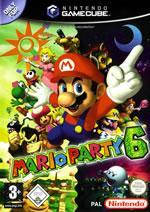
Mario Party 6
Overview

Mario Party 6 is the sixth main entry in the Mario Party series and the third on the Nintendo GameCube, releasing in Japan on 18 November 2004 and in North America on 6 December 2004. Following MP4 (2002) and MP5 (2003), this entry continues Hudson Soft’s annual Mario Party release cadence on GameCube.
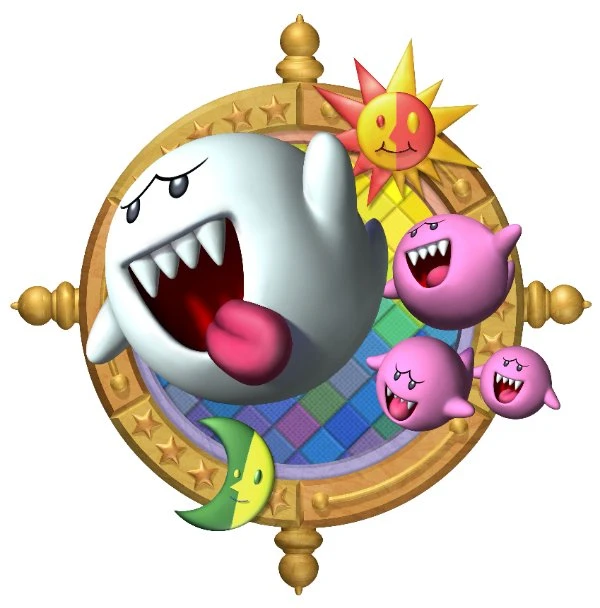
The headline new mechanic for MP6 is the day/night cycle. Every board and many mini-games transform dramatically between day and night, with different paths opening up, different Star prices, different events, and even different characters appearing. The two new hosts — the sun-deity Brighton and the moon-deity Twila — govern the cycle and bicker with each other over who’s more impressive.
The other major MP6 first is the Nintendo GameCube Microphone, bundled with the game in most retail copies. The Mic enables a dedicated Mic Mode with voice-controlled mini-games, plus optional voice-recognition features in the standard Party Mode — say a character’s name out loud and they’ll react.
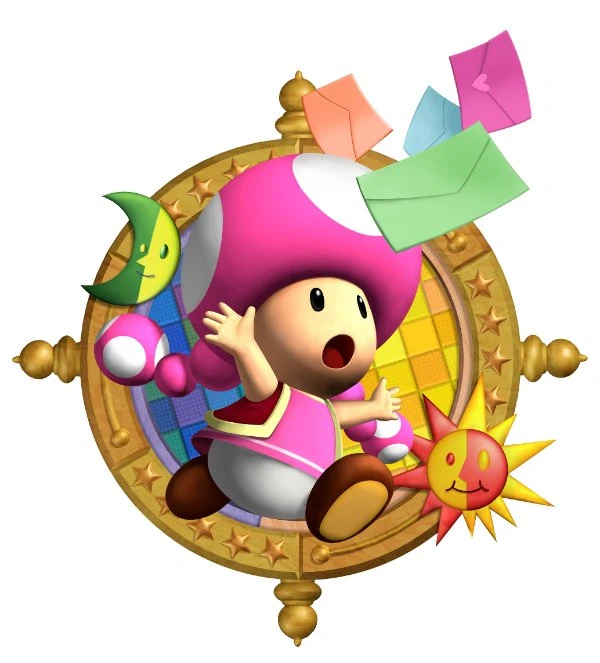
The cast grows to 11 playable characters with the debut of Toadette as the franchise’s newest playable face (unlocked by spending 30 Stars in the new Star Bank meta-system). The Orb mechanic from MP5’s Capsules is overhauled into colour-coded Green / Red / Yellow / Blue Orbs across four event categories.
Story
“Brighton and Twila — the sun and the moon — watch over Mario Party World from the sky and host the best parties. The two celestial party animals have always been good friends. That is, until the day Brighton asked Twila: Who's more impressive, you or me?”
Brighton and Twila argued furiously over who was more popular and impressive. The sky thundered with the fury of their cataclysmic squabble. Mario and his friends tried to mediate, but nothing they said could settle the spat in the sky.
That’s when Mario came up with a brilliant plan: harness the power of the Stars to end the feud. They decided to throw a massive Mario Party to collect Stars and fill the great Star Bank. The collected Stars would be powerful enough to reconcile the celestial hosts.
…But will the power of the Stars be enough? The cast competes across the six dream-and-reality boards — some daylit and sunny under Brighton’s watch, others moonlit and mystical under Twila’s glow — to collect Stars for the Star Bank and resolve the cosmic argument.
The Day & Night System
The defining new mechanic of Mario Party 6. Every board and many mini-games transform completely based on the time-of-day cycle.
How the cycle works
- Turns alternate between day and night — typically every 2-3 turns the cycle shifts, though the exact pacing varies by board and game length
- Brighton hosts daytime — warm visuals, certain paths open, sunshine-themed events. The cast is more visible.
- Twila hosts nighttime — moonlit visuals, different paths open, mystical-themed events. Hidden characters appear (Bowser, Toadette in some sequences).
- Board paths physically change — bridges appear or disappear, water levels rise/fall, shortcuts open or close. The same board feels completely different at night versus day.
- Star prices change — some boards have variable Star prices that depend on the time of day
- Mini-game variants — many mini-games have day and night versions with different visuals or rules
Why it matters strategically
The cycle creates a new layer of timing strategy: when do you commit to a Star purchase? Wait for night when the price drops, or strike during day when the path is shorter? Use a Mushroom Orb to roll high during day to grab a beneficial Happening Space before night transforms it? MP6’s strategic depth comes largely from reading the day/night flow.
Brighton & Twila — The Cosmic Hosts
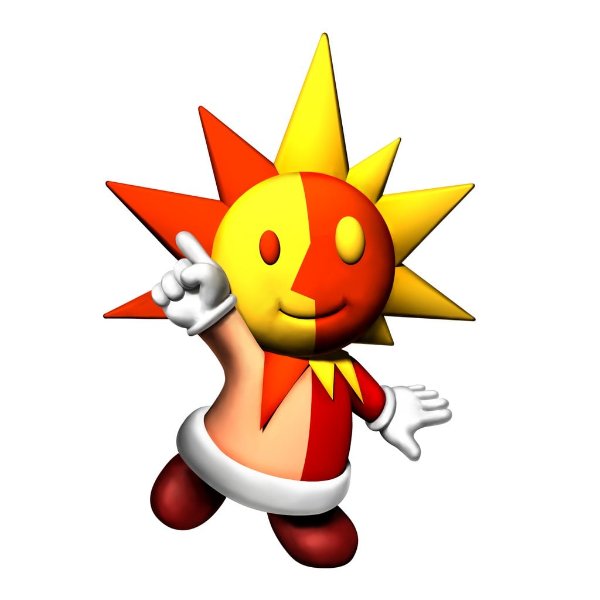
Brighton is the personification of the sun and the daytime host of Mario Party 6. He’s warm, charismatic, and a touch egotistical — his argument with Twila kicks off the whole game’s plot. During daytime turns he hosts boards, comments on player moves, and introduces day-themed events.
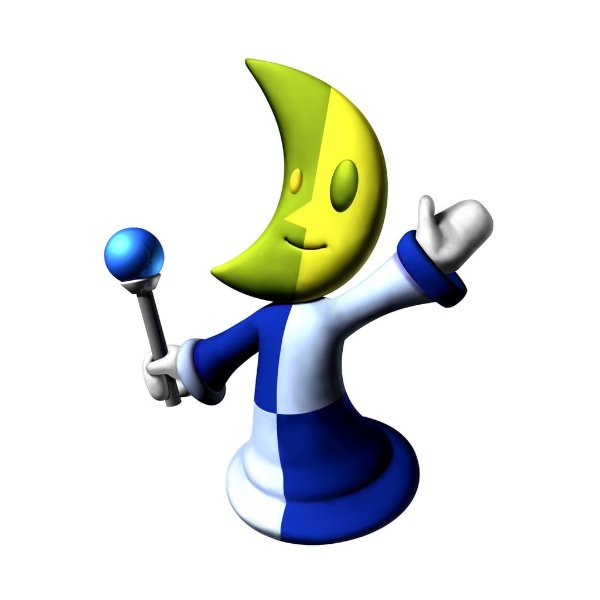
Twila is the personification of the moon and the nighttime host. She’s mystical, regal and equally proud — hosting boards through nighttime turns with cooler, more dramatic energy. Her arguments with Brighton anchor the story.
The pair are exclusive to Mario Party 6 — they have never reappeared in any later Mario Party game or elsewhere in the Mario franchise. They’re the most narratively distinctive Mario Party hosts ever created and tie directly into the game’s day/night gimmick.
Gameplay
Mario Party 6 retains the established Mario Party board-game-plus-mini-game loop with several MP6-specific layers:
- Roll the Dice Block — tap A to stop a 1-10 roll. Move that many spaces.
- Orb Huts — pay coins to buy Orbs (replaces MP5’s free capsule machines). Each player holds up to 3 Orbs.
- Throw Orbs onto board spaces to set traps/buffs (cost-free placement), or activate immediately on yourself for the listed coin cost
- Day/night transitions — the board’s state changes every 2-3 turns. Paths, prices and events shift
- Buy a Star — 20 coins is standard, but some boards have day-vs-night variable prices
- Mini-game at end of turn — type determined by space-colour split (4-player / 1-vs-3 / 2-vs-2 / Bowser)
- End of game — Bonus Stars (Coin, Happening, Orb, Mini-game) award before final standings
- Star Bank meta-system — collected Stars across all your games go into a persistent Star Bank used to unlock characters (Toadette = 30 Stars) and bonus content
The Star Bank is a new persistence layer for Mario Party 6 — Stars you collect across multiple sessions accumulate, giving the game a meta-progression motivation absent from earlier entries.
Game Modes
Mario Party 6 has seven modes accessed from the main menu (modes on the left are hosted by Brighton, modes on the right by Twila, modes in the center by both).
Party Mode
Represented by a house. Hosted by both Brighton and Twila. Up to 4 players (CPU fills in). Standard 4-player Mario Party rules with the new day/night cycle, all 6 Party Mode boards available. Difficulty Easy/Normal/Hard/Expert.
Solo Mode
Single-player campaign. Play across separate Solo Mode boards with simplified rules. Earn Solo Mode bonuses based on completion criteria (no Bowser Spaces hit, max coin streak, perfect mini-game record, etc.).
Mic Mode
Represented by a castle. Hosted by Brighton. The new GameCube Microphone mode. Three sub-options: Speak Up (voice-controlled quiz show), Star Sprint (single-player voice obstacle dash), and Mic Mini-Games (five 1-vs-3 minigames with voice-controlled solo player).
Mini-Game Mode
Pure mini-game playground. Free Play, Battle, Endurance Alley (survival), and the new Mini-Game Coaster (linear roguelike runs through randomised minigames).
Star Bank
The new persistent meta-progression system. Stars collected across all games are stored here. Spend Stars to unlock characters (Toadette costs 30), purchase desktop wallpapers, view records, and access bonus content.
Option Mode
Game settings. Toggle the microphone, adjust sound levels, customize controls.
Mic Mode & the GameCube Microphone
The Nintendo GameCube Microphone is the headline new accessory of Mario Party 6, bundled with the game in most retail copies (in a special two-disc-style cardboard box). The microphone plugs directly into a memory card slot.
Speak Up
A quiz-show-style game where players answer trivia questions verbally. The microphone uses voice recognition to detect simple answer words (“Mario”, “coin”, “Star”, etc.). Requires at least 2 players.
Star Sprint
Single-player obstacle course. The player uses verbal commands to guide a Star to the goal while avoiding hazards. Move left/right/jump are voice-controlled.
Mic Mini-Games (5 total)
Five 1-vs-3 mini-games where the “1” player uses the microphone while the other three use controllers. If the mic is enabled in Options, these Mic Mini-Games appear in regular Party and Solo Modes as well — a permanent injection of voice mechanics into the standard play.
Background voice features
With the mic enabled in Options, players can say a character’s name aloud in the main menu to make that character react. The feature is fundamentally an Easter egg but speaks to how much Hudson wanted to lean into voice. Voice features were generally received mixed-to-positively by critics — a fun novelty that didn’t always work reliably.
Characters
Mario Party 6 features 11 playable characters, all returning from Mario Party 5 plus the franchise debut of Toadette as the sole newcomer.


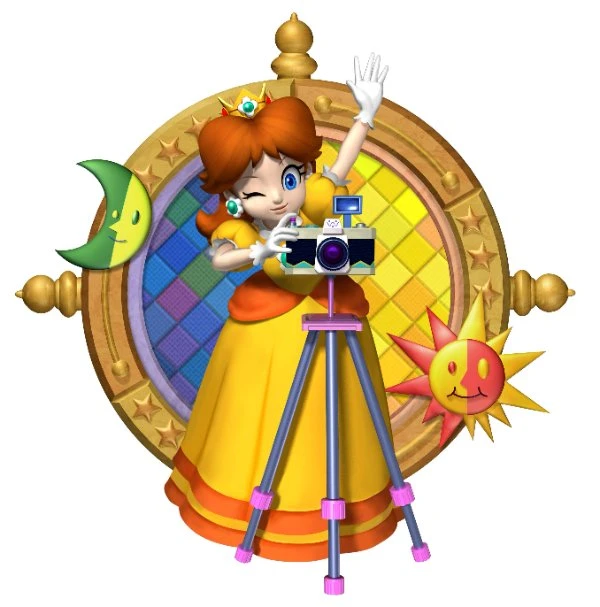



Toadette’s Mario Party Debut
Toadette makes her overall Mario Party franchise debut in MP6 — her first ever appearance in a Mario Party board game. She had been a playable character in Mario Kart: Double Dash!! (2003) and Mario Tennis (Mario Power Tennis, 2004), but this is her first inclusion in the Mario Party roster.
She’s the only unlockable playable character in MP6 and requires the player to spend 30 Stars in the Star Bank to unlock her. This is the first time the Star Bank meta-system gates character access — a model that would persist into MP7.
Other Recurring Characters
Donkey Kong returns as the host of DK Spaces and the “DK Donkey Kong” rivalry character on the Castaway Bay board. He is not playable in standard board modes (though he can be selected in some sub-modes).
Team Names
Mario Party 6 brings back Mario Party 5’s team-battle mechanic, but with all-new team names. With 11 playable characters, the matrix of all possible two-character pairings yields well over 50 unique team names — some are puns, some are character-relationship gags, some are simply descriptions.
Examples of Team Names
| Pair | Team Name |
|---|---|
| Mario & Luigi | Mario Bros. |
| Mario & Peach | Cutest Couple |
| Mario & Yoshi | Famous Combo |
| Mario & Wario | Alter Egos |
| Mario & Toadette | Princely Pair |
| Luigi & Daisy | Sweethearts |
| Peach & Daisy | Royal Maidens |
| Wario & Waluigi | Sleazy Stars |
| Toad & Toadette | Mushroom Crew |
| Yoshi & Birdo | (Birdo is not playable in MP6) |
| Boo & Koopa Kid | Bad Boys |
The full matrix of team names is one of the most charming Easter eggs in Mario Party history — each pairing is hand-named to reflect the character relationship. Many team names became fan-canon labels for those Mario character relationships.
Boards
Six boards in Party Mode, all featuring the day/night transformation cycle. Each handles Stars and movement differently.
| Board | Day & Night Theme | Signature Mechanic |
|---|---|---|
| Towering Treetop | Giant treetop in a forest. Day: warm leaves. Night: glowing fireflies. | Star appears in a random spot, costs 20 coins, then relocates. Path lengths change with day/night. |
| E. Gadd’s Garage | Professor E. Gadd’s workshop full of mechanical gadgets. Day: bright workshop. Night: glowing machinery. | Stars work like Towering Treetop, but the board has machine gadgets that activate via Happening Spaces. Paths shift by time of day. |
| Faire Square | A festive carnival. Day: cheerful festival. Night: lantern-lit. | Star Space is at one fixed location. Up to 5 Stars can be bought there. At night, Twila rolls a dice and Star prices become 5, 10, 30 or 40 coins — the most dramatic price swing in the game. |
| Snowflake Lake | A frozen lake under cold skies. Day: bright snow. Night: aurora. | Every player begins with 5 Stars. Stars are stolen, not bought — ride Chain Chomps to steal Stars from opponents. A radical departure from standard rules. |
| Castaway Bay | Tropical island in the Pacific. Day: sunny beach. Night: moonlit shore. | Buy a Star from Donkey Kong at the end of the board (DK is the friendly Star vendor). At night, Bowser swaps DK out — reaching Bowser loses you a Star. Day/night is critical timing. |
| Clockwork Castle | A castle with massive moving clock gears. Day and night control gear directions. | The board’s entire path is on enormous rotating clock gears. The direction of board movement reverses between day and night. Highly dynamic. |
Solo Mode Boards
Solo Mode uses simplified, modified versions of the Party Mode boards optimised for single-player Mario Party experience. The Solo Mode story progresses through these boards with reduced complexity and time-constrained challenges.
Spaces
Party Mode Spaces
| Space | Effect |
|---|---|
| Blue Space | Gain 3 coins (doubles on the last 5 turns via Bonus Roulette) |
| Red Space | Lose 3 coins (may double in the last 5 turns) |
| Happening Space (!) | Triggers a board-specific event — a gadget activates, paths shift, weather changes, etc. |
| ? Space | Triggers a random event hosted by Brighton or Twila |
| Bowser Space | Triggers a Bowser event (Revolution, Mini-game, Shuffle, Phone, etc.) — punishment for the lander or all players |
| DK Space | Triggers a positive Donkey Kong event — coins, items, or a beneficial mini-game |
| Star Space | Exchange coins for Stars. Price varies by board and (on Faire Square) by day/night |
| Orb Space | An Orb has been placed here by a player. Lander triggers the Orb’s effect. |
| Duel Space | Triggers a 1-vs-1 duel mini-game |
Solo Mode Spaces
Solo Mode uses simpler colored spaces (originally Hudson Soft kept them as simple colored spaces, matching the prerelease design they’d planned for the whole game). The final Party Mode introduced 4-Player / 1-Vs-3 / 2-Vs-2 spaces that the Solo Mode didn’t carry over.
The Orb System
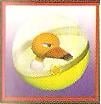
The MP5 Capsule system is refined into a four-colour Orb system in MP6. Players buy Orbs from Orb Huts (Koopa Troopa’s shops) for coins. Each Orb costs a base price, with hut markups varying. Each player holds up to 3 Orbs at a time.
How They Work
Each Orb falls into one of four event categories, distinguished by colour:
- Green Orbs — affect the player or Dice Block (Mushroom, Super Mushroom, Cursed Mushroom, Sluggish, Metal, etc.)
- Red Orbs — trapping orbs that can be thrown onto board spaces to attack opponents
- Yellow Orbs — coin-related events (steal, gift, transfer)
- Blue Orbs — capsule/orb-system meta-events (swap, steal an opponent’s orbs)







Key Orb Highlights
- Mushroom Orb (5 coins) — roll 2 dice blocks. Matching numbers = bonus coins
- Super ’Shroom Orb (15 coins) — roll 3 dice blocks. Triple match = 30 coins (50 for triple 9s)
- Metal Mushroom Orb (10 coins) — immune to opponents’ traps for the turn
- Bullet Bill Orb (20 coins, E. Gadd’s Garage / Faire Square only) — ride a Bullet Bill, overtake an opponent, steal 20 coins
- Flutter Orb (30 coins, Towering Treetop / E. Gadd’s Garage) — fly directly to the Star Space
- Warp Pipe Orb (10 coins) — swap positions with another player
- Zap Orb — Red Orb. Electrocutes the lander, halts their movement
- Tweester Orb — teleports the lander to a random board location
- Klepto Orb — steals coins from the lander
Orbs are board-restricted: not every orb is available on every board. Hut inventories vary, reflecting board themes. Some orbs only exist in Solo Mode (Cursed Mushroom).
Mini-Games
Mario Party 6 features over 75 brand-new mini-games — a step up from MP5’s 60+. The Day and Night system means many minigames have visual variants depending on cycle state. Categories:
- 4-Player Mini-Games — free-for-all chaos. Examples: Snow Brawl (Mario's signature), Snow Whirled (Luigi), Stamp by Me (Yoshi), Conveyor Bolt (Wario).
- 1-vs-3 Mini-Games — one player against three. Examples: Odd Card Out (Peach), Insectiride (Koopa Kid), Lunar-tics (Toad).
- 2-vs-2 Mini-Games — team play. Examples: Freeze Frame (Daisy), Clean Team (Waluigi), Catch You Letter (Toadette’s signature).
- Battle Mini-Games — ante-into-pot, winner takes all.
- Bowser Mini-Games — punishment games triggered by Bowser spaces.
- DK Mini-Games — positive Donkey Kong games triggered by DK Spaces.
- Duel Mini-Games — one-on-one games.
- Mic Mini-Games (5 exclusive) — voice-controlled 1-vs-3 challenges using the GameCube Microphone.
- Boonanza! Mini-Game — Boo’s signature, used in his board events.
Notable Mini-Games
- Catch You Letter — Toadette’s signature mini-game and one of the most beloved in the entry
- Cashapult — launch yourself for coins on a flexible platform
- Astaroad Rage — racing on a track of asteroids in space
- Mowtown — lawn-mower 4-player mini-game
- Endurance Alley — the survival sub-mode where you play randomly-chosen minigames in a row until elimination
Development Staff
Mario Party 6 was developed by Hudson Soft, the primary developer of every mainline Mario Party from MP1 through MP9. The directorial baton passed to Shuichiro Nishiya, who had been a planning advisor on MP5 under Kenji Kikuchi.
- Developer: Hudson Soft
- Publisher: Nintendo
- Director: Shuichiro Nishiya — his first time as director. He would direct all subsequent home-console Mario Party entries (excluding the handheld Mario Party: Star Rush)
- Composers: Hironobu Yahata and Shinya Outouge — their first Mario Party scoring credits. Both would return for MP7’s soundtrack
- Voice Cast: Charles Martinet (Mario/Luigi/Wario/Waluigi), Jen Taylor (Peach/Daisy), Kazumi Totaka (Yoshi). Brighton and Twila have no English voices — they were given Japanese-only vocalisations
Nishiya’s directorial debut here represents the formal transition of Mario Party leadership from the original Kikuchi era (MP1-5) to the Nishiya era (MP6-8+). The new compositional team also gave MP6’s soundtrack a slightly different texture from MP5’s Aya Tanaka orchestral feel — leaning more synth-electronic.
Reception & Sales
Mario Party 6 received generally positive to mixed reviews, scoring 71/100 on Metacritic (33 reviews) and 73.41% on GameRankings (36 reviews). Critics consistently flagged the franchise formula’s similarity to previous entries, but praised the mini-game depth and the new mechanics.
Critical Reactions
- Most criticism focused on franchise familiarity — MP4, MP5 and MP6 in three consecutive years had become a fatiguing cadence for some reviewers
- The single-player Solo Mode drew the weakest reviews — considered lackluster compared to multiplayer
- Microphone voice recognition was a divisive feature — some critics found it unreliable, others praised the novelty
- Reviewers consistently praised the 75+ all-new mini-games, the day/night transformation system as a genuine fresh idea, and the bundled GameCube Mic as a charming addition
- Brighton and Twila as new hosts were received warmly — their narrative role and design got particular praise
Sales
Mario Party 6 sold approximately 2.5 million copies worldwide over its lifetime — comparable to MP4 (2.7M) and MP5 (2.6M). The GameCube Mario Party trilogy together comfortably crossed 7 million combined sales, cementing the brand on the platform.
Regional Differences
Several differences between regional releases:
- Brighton and Twila have no voice acting in Western releases — they speak in the Japanese original via vocalised tones (Brighton high-pitched, Twila lower) but have no English voice work. Western players hear them silently in cutscenes
- German release: Brighton and Twila genders are switched. Brighton becomes “Sonnja” (female, derived from a German given name); Twila becomes “Raimond” (male). This reflects German grammatical gender: the sun (die Sonne) is feminine, the moon (der Mond) is masculine. A genuinely elegant localization decision
- The Japanese mini-game announcer voice is the female one from MP4 and MP5 (used again in the Japanese MP7). Western releases used a different announcer
- The Garden Grab mini-game features a daikon (Japanese radish) in the Japanese version, replaced by a carrot in non-Japanese versions
- The PAL version removes 4 mini-games from the Endurance Alley sub-mode: Trap Ease Artist, Same Is Lame, Pitifall, and Trick or Tree — all luck-based games. They’re still playable in Mini-Game Mode
- Time limits are adjusted in some PAL versions: Fruit Talktail has a longer time limit in PAL than NTSC
- Koopa Kid is renamed Mini Bowser in PAL regions (matching MP4/MP5 PAL naming)
Pre-release & Cut Content
Several pre-release and cut content findings:
- Early Solo Mode used simple coloured spaces (not the 4-Player / 1-Vs-3 / 2-Vs-2 colour-coded space system of the final Party Mode). The final Solo Mode retained that simpler design while Party Mode got the colour-coded version
- Unused Barrel Orb — an unused Orb (ID 20) called the Barrel Orb exists in the game’s data. It would protect players from dueling for one turn. There are no unique orb graphics for it and no activation text — it was clearly cut late in development. The orb is likely the namesake of MP7’s Barrel Orb concept
- Various orbs in the game data are flagged for events/debugging that don’t happen in retail play
- Debug menus and unused minigame prototypes have been data-mined from the retail ROM
- An early prerelease build had Brighton and Twila with different visual designs and slightly different character voices in beta footage
Trivia
- Toadette’s Mario Party debut — first appearance in the franchise. She unlocks by spending 30 Stars in the Star Bank meta-system.
- Nintendo GameCube Microphone bundled with the game — the first time Nintendo packaged a peripheral with a Mario Party title. The mic plugs into the memory card slot.
- The day/night transformation system is unique to MP6. No other Mario Party game uses this mechanic to such an extent — boards and minigames physically change state.
- Brighton and Twila are exclusive to MP6. No other Mario Party features them, and they’ve never returned anywhere in the Mario franchise. Their designs are some of the most distinctive Mario Party originals
- The Star Bank meta-system is a Mario Party first — Stars persist across all your games, with unlock costs tied to your cumulative total. MP7 would refine this system further
- The Orb system evolves from MP5’s Capsules into a four-colour categorisation (Green/Red/Yellow/Blue) with board-restricted availability
- Shuichiro Nishiya’s directorial debut — he had been planning advisor on MP5 under Kenji Kikuchi. He would direct every subsequent home-console Mario Party game
- The German “Sonnja” / “Raimond” localization swap of Brighton and Twila’s genders is one of the cleverest Mario localization decisions ever — respecting German grammatical gender of sun and moon
- The Mic features included voice recognition for character names — say “Mario” aloud at the main menu and Mario reacts on screen. A novelty that didn’t always work but charmed many players
- The pre-release version of Solo Mode used simple colored spaces; the colored 4-Player/1v3/2v2 space system was added later for Party Mode only
- The MP6 soundtrack composers Hironobu Yahata and Shinya Outouge would return for MP7, establishing a new compositional duo for the franchise
- Castaway Bay’s day/night Bowser-DK swap is a uniquely punishing design — buy a Star from DK during day, lose a Star to Bowser at night. Timing matters more here than anywhere else
- Faire Square’s variable Star price (5, 10, 30, or 40 coins) is the most extreme Star pricing in Mario Party history
- The 11-character roster is the largest in mainline Mario Party until the much later entries
Videos
The original North American TV commercial — the 2004 GameCube marketing push for Mario Party 6, emphasising the new microphone and day/night system.
Reference / Information
Sub-pages and guides for Mario Party 6.
Media / Downloads
Box art gallery and screenshots for Mario Party 6.