
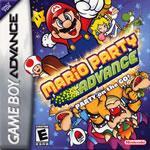

Mario Party Advance
Overview

Mario Party Advance is the seventh main entry in the Mario Party series and the only Game Boy Advance entry in the franchise. Developed by Mario Party stalwart Hudson Soft and published by Nintendo, it released January 2005 in Japan, March 2005 in North America, June 2005 in Europe, and September 2005 in Australia.
Rather than recreating the home-console Mario Party formula on a handheld, Mario Party Advance takes a radically different approach: instead of a turn-based board game where 4 friends compete for stars, the game is fundamentally a single-player adventure set in Shroom City. Players take control of Mario, Luigi, Princess Peach, or Yoshi and travel through the city completing over 60 Quests — small character-driven challenges — across themed regions (Town, Desert, Seaside, Horror, Snow, Jungle, and the final Bowser area). Completing quests unlocks minigames and Gaddgets (the game’s name for microgames) that can then be played in the other game modes.
Critical reception was mixed. The single-player content, variety, and personality of the characters were praised, but the multiplayer suffered: 4-player mode required either four Game Link Cables or all players to share one GBA. Many of the minigames were also seen as bland. Even so, the game has its devoted fans — particularly for the quirky Shroom City setting and its dozens of memorable supporting characters.
The Story

The story is preserved in the game’s opening sequence:
It is a normal day in Party World when the player first arrives there. Toad greets the player shortly before Bowser, with Koopa Kid at his side, falls onto Toad. Bowser then disperses all of the mini-games and Gaddgets towards various parts of Shroom City. When Bowser and Koopa Kid leave, and the flattened Toad adjusts back to his normal form, Toad motivates the player to travel all over Shroom City, gather every mini-game and Gaddget, and restore peace to Party World.
The Setup
The story is famously slapstick. Toad greets Mario/Luigi/Peach/Yoshi at the start of the game with a welcome to Party World. Just then, Bowser falls out of the sky with Koopa Kid at his side — landing directly on Toad and flattening him. Bowser then proceeds to scatter all the minigames and Gaddgets across Shroom City, ruining the party. Once Bowser and Koopa Kid leave (and Toad recovers his normal shape), Toad asks the player to head out into the city, find every scattered minigame and Gaddget, and restore peace to Party World.
The Adventure
From here, the game becomes an exploration of Shroom City. Players visit different areas of the city, talk to the various residents (Goombob, Big Bob-omb, Chain Chomp, Bob-omba, Flutter, Fly Guy, Toady, Goomba, Mr. E, the Shroomlocks, and many more), and help them with their personal quests. Each completed quest unlocks a minigame or Gaddget, gradually rebuilding the party.
The Finale
The journey leads eventually to a confrontation with Bowser himself in the Bowser Quests region, where the player must outsmart Bowser and reclaim the final stolen items to fully restore Party World.
Gameplay

Mario Party Advance fundamentally reframes the Mario Party formula for a handheld setting. The flagship feature is the Shroom City exploration mode, which functions as a single-player adventure rather than a turn-based board game.
Core Loop
- Explore Shroom City by moving your character through its various themed neighbourhoods
- Talk to NPCs — each has a quest, often a small problem to solve or a microgame to play
- Complete quests to earn minigames and Gaddgets as rewards
- Unlock new areas as you progress, opening up Desert, Seaside, Horror, Snow, Jungle, and finally Bowser zones
- Use Gaddgets (small toy-like microgames) for fun anywhere in the game
- Reach the Bowser zone for the final confrontation
The 4 Modes
- Shroom City — the main story mode, available from game start
- Play Land — free play with unlocked minigames and Gaddgets
- Party Land — multiplayer mode for 2–4 players (requires Link Cable or shared GBA)
- Challenge Land — single-player coin challenges including Mini-Game Attack, Game Room, Duel Dash, and Bowser Land
Multiplayer Constraints
- 2–4 players supported via Game Boy Advance Game Link Cable
- Multiplayer also playable via pass-the-GBA mode (single GBA shared between players)
- The link-cable requirement was a major contemporary criticism — most players didn’t have 4 cables and 4 GBAs available
Playable Characters
Four classic Mario series characters return as the playable cast. Each starts in a different area of Shroom City, providing a slightly different opening experience.
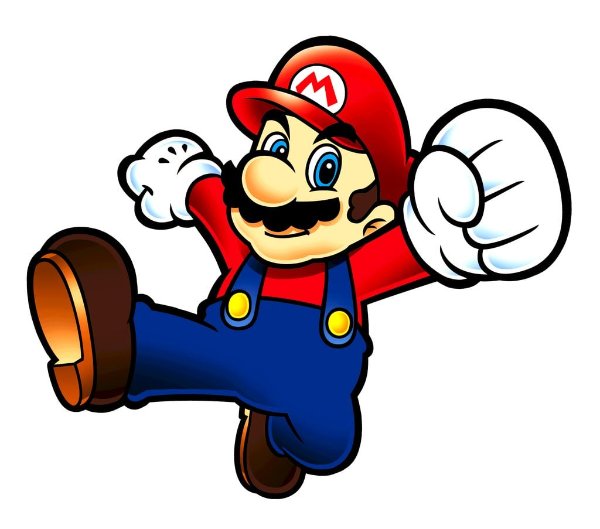


Mario — Town Starter
The classic plumber begins his adventure in the Town area. Town is the most beginner-friendly opening section with straightforward NPC interactions and gentle quests.
Luigi — Seaside Starter
Mario’s younger brother starts in the Seaside area. The Seaside neighbourhood has water-themed quests featuring residents like the Cheep Cheeps and various beach-side NPCs.
Princess Peach — Jungle Starter
The Mushroom Kingdom princess begins in the Jungle area — the most exotic starting zone, full of jungle-themed minigames and tropical NPCs.
Yoshi — Horror Starter
The friendly dinosaur lands in the Horror area, a spooky neighbourhood populated by Boos and other ghostly residents. Yoshi’s starting zone is the most thematically distinct opening of the four.
All four characters can ultimately visit every area in Shroom City — the starting location only changes the opening narrative.
Hosts & Shroom City Residents
Shroom City is populated by an enormous cast of host characters, supporting NPCs, and quest-givers. Many are classic Mario characters with twists; others are entirely new for Mario Party Advance.
The Hosts


Notable Shroom City Residents


The Toad Crew
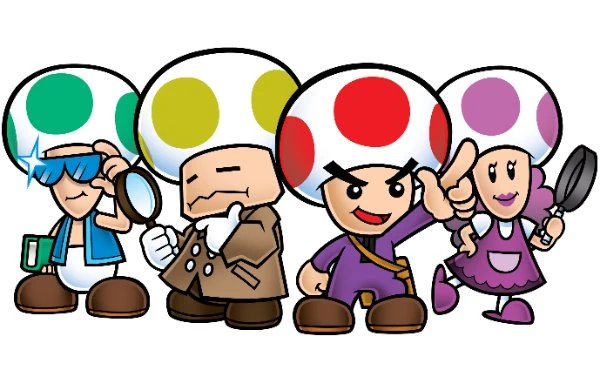
The Shroom City quest cast also includes Goombob, Goombetty, Big Bob-omb, Chain Chomp, Bob-omba, Flutter, Fly Guy, Toady, and dozens more named characters — each with their own personality and at least one Quest associated with them.
Bowser & the Koopa Kids
Mario Party Advance’s antagonists are Bowser and the three Koopa Kids — the same trio of mischief-makers from earlier home-console Mario Party games.

Bowser
Throughout Shroom City — Main Antagonist
The king of the Koopas himself is the chief troublemaker. The story opens with Bowser falling out of the sky and landing on Toad before scattering all the minigames and Gaddgets across Shroom City. He stays involved throughout the adventure, with the Bowser Quests region serving as the final showdown zone. The throne artwork shows him in his usual menacing fashion.

Bowser (Throne Pose)
Bowser Quests region
A second piece of Bowser artwork showing him in his throne pose. Used in the Bowser Quests region and Challenge Land’s Bowser Land sub-mode — the most challenging coin-grinding gauntlet in the game.
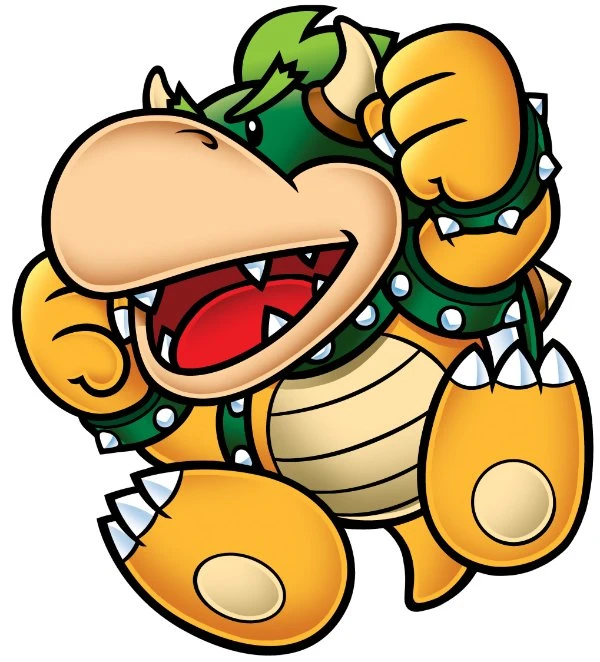
Green Koopa Kid
Various Shroom City minigames — Sidekick
The green-shelled Koopa Kid serves as one of Bowser’s three sidekicks. Appears in various minigames trying to throw off the player. Distinguished from his siblings by his green shell colour.

Blue Koopa Kid
Various Shroom City minigames — Sidekick
The blue-shelled Koopa Kid is the second of the trio. Also appears in various minigames to make them harder. The blue Koopa Kid is the most commonly seen in the intro alongside Bowser when they fall on Toad.

Red Koopa Kid
Various Shroom City minigames — Sidekick
The red-shelled Koopa Kid completes the trio. Together, the three Koopa Kids represent the recurring Mario Party Advance antagonists alongside Bowser himself. The trio of green/blue/red Koopa Kids is a Mario Party series tradition.
The 4 Game Modes
Mario Party Advance offers four main game modes, each hosted by different Mario series characters.
Shroom City
Hosted by Tumble
The main mode of the game and the only one playable from the start. Players take control of Mario, Luigi, Peach, or Yoshi and travel around Shroom City, beating the Quests and collecting minigames and Gaddgets to play in the other modes. The story-driven heart of the game and where the bulk of the content lives.
Play Land
Hosted by Toad and Professor E. Gadd
A free-play mode where players can either play the minigames they’ve unlocked, give minigames to other players, play with their Gaddgets (the small toy-like microgames invented by E. Gadd), or trade Gaddgets with friends via Link Cable. Effectively the sandbox mode for unlocked content.
Party Land
Hosted by Toad and Toadette
The dedicated multiplayer mode. Multiple players can join via Link Cable for duel minigames, a secret battle, a Koopa Kid battle, a 100-player battle, or a 100-player attack. The contemporary multiplayer hub of the game.
Challenge Land
Hosted by Toadette
A single-player coin challenge mode with several sub-modes: Mini-Game Attack, Game Room, Duel Dash, and Bowser Land. Players earn coins by completing increasingly difficult challenges. The game’s replayable post-game content lives here.
Challenge Land Sub-Modes
- Mini-Game Attack: Play through 15 minigames in sequence with harder win conditions than Shroom City. 5 wins earns 1,000 coins, 10 wins earns 10,000 coins, all 15 wins earns a massive 100,000 coins. Lose a game and you forfeit everything accumulated
- Game Room: Free-play of any unlocked minigame for coins
- Duel Dash: A series of 1-on-1 duel minigames — succeed for bonus coins
- Bowser Land: The hardest sub-mode in the game, themed around Bowser’s minigames with the toughest opponents
The Quests

The Quests are the heart of Mario Party Advance’s single-player content. Shroom City is divided into themed regions, and each region has its own set of quests — generally short interactive micro-stories where the player helps an NPC with a problem.
The 7 Themed Quest Regions
| Region | Setting | Notable Quests |
|---|---|---|
| Town Quests | Urban Shroom City | Accessorize! (Goombob), Kind Goomba, Find the Password, Hearts A-Flutter, Hey UFO! |
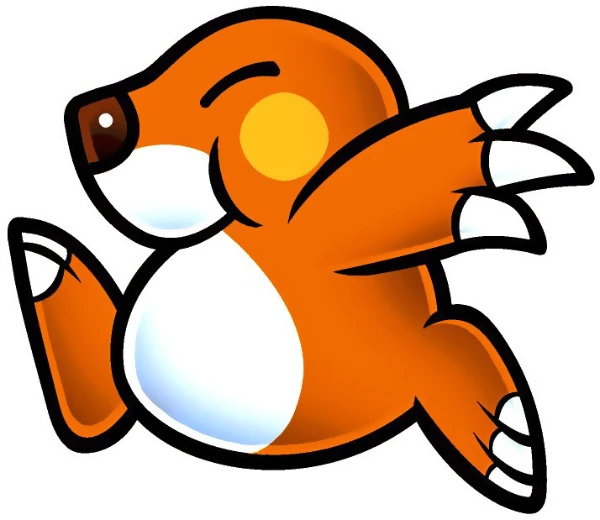
| Desert Quests | Arid southern Shroom City | Pokey/Monty Mole-themed quests with treasure hunting |
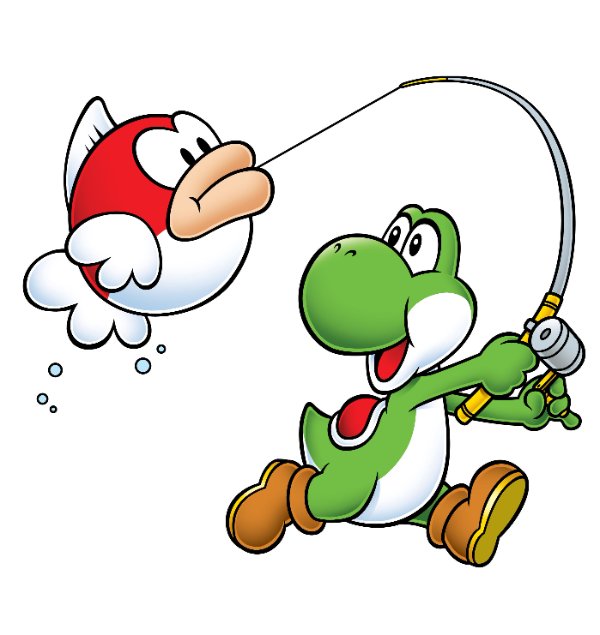
| Seaside Quests | Beach & coastal areas | Cheep Cheep quests, fishing-themed challenges (Yoshi Fishing) |
| Horror Quests | Spooky neighbourhood | Boo and ghost-themed mysteries with the Shroomlock detective duo |
| Snow Quests | Wintry mountain region | Cold-weather challenges and ice-themed minigames |
| Jungle Quests | Tropical jungle region | Vine swinging, jungle-themed exploration, Flutter quests |
| Bowser Quests | Bowser’s territory — FINAL | Final confrontations with Bowser and Koopa Kids; reclaim the last stolen Gaddgets |
Sample Town Quest — “Accessorize!”
Sample Quests Across the City
- Big Boss Bob-omb (Mushroom Condo Basement) — Big Bob-omb challenges the player to a dice game
- Chomper Stomper — Chain Chomp duels you in the Chain Saw minigame
- Hey, UFO! (Mushroom Condo Roof) — Mr. E wants to see a UFO; you summon one with Fly Guy
- Kamek Krew Live! — The band needs a gig venue; Toady asks you to find one
- Find the Password (Bob-omb Avenue) — Discover the secret password for the Bob-omb group
- Flowers Are a Blast! — Bob-omba wants a healthy flower as a gift
- Hearts A-Flutter (3rd Floor) — Flutter has a crush but is too shy to say so
- Kind Goomba — Goomba asks you to buy a train ticket for them
The quests are character-driven first, mechanically second — the appeal isn’t the difficulty but the personalities of Shroom City’s residents.
Minigames & Gaddgets
Mario Party Advance offers 50+ traditional minigames plus a parallel system of toy-like microgames called Gaddgets (a portmanteau of “Gadget” and “E. Gadd”).
Regular Minigames
Standard Mario Party-style minigames featuring button-mashing, timing, and reflex challenges. Most are unlocked through Shroom City Quests. Categories include:
- Action — reflex and timing-based challenges
- Button-Masher — rapid-press competitions
- Puzzle — problem-solving minigames
- Duel — 1-on-1 head-to-head matches
- Bowser-themed — the toughest gauntlet, used in Bowser Land
Notable Minigame Characters




Gaddgets
Gaddgets are Mario Party Advance’s second class of mini-content — toy-like microgames invented by Professor E. Gadd. Examples include:
- Compat-I-Com — a compatibility checker (Mario and Peach famously hold one in the artwork)
- Fortune-telling Gaddgets — small predictive games
- Sound-effect Gaddgets — toy musical instruments
- Animation/Stunt Gaddgets — short visual gags
- Mini-games-within-Gaddgets — button-tap toys
The Gaddget concept blurred the line between “minigame” and “digital toy.” They’re unlockable rewards from Quests just like minigames, and many are used as accessories in the physical Bonus Board.
The Bonus Board
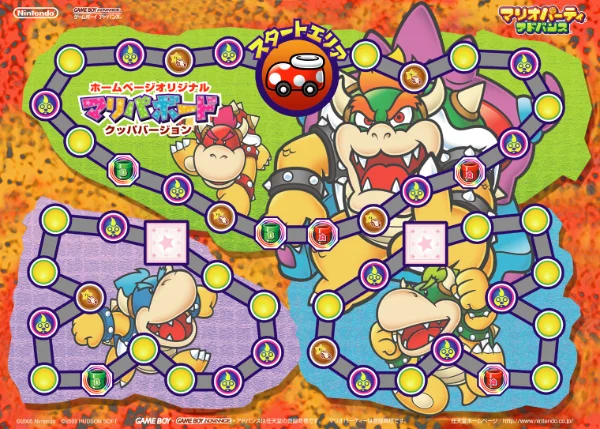
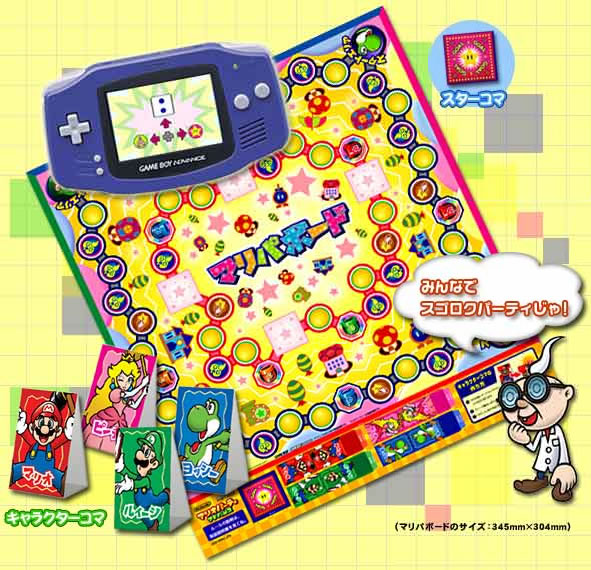
The Bonus Board is Mario Party Advance’s most singular feature — a physical board game shipped in the box with the cartridge. It’s effectively a tabletop hybrid Mario Party that uses the Game Boy Advance and the cartridge as accessories.
What’s In The Box
- A printed paper game mat showing the Mario Party board layout
- Punch-out character and Star pieces that players assemble
- The Game Boy Advance cartridge itself, which serves as a digital die and minigame device
How It Plays
- Players sit around the printed board, with the cartridge running
- On each turn, the player uses the GBA to roll a die and move their token the appropriate spaces
- Depending on the space landed on, the GBA prompts the player to play a minigame, use a Gaddget, or earn coins
- Standard Mario Party rules apply for spaces — some give coins, some take coins, some trigger battles
- The game ends when any player collects a Star — same victory condition as home-console Mario Party
Bonus Board Pieces



Promotion & Videos
Four contemporary promotional videos capture Mario Party Advance at its 2005 launch and the Wii U Virtual Console re-release.
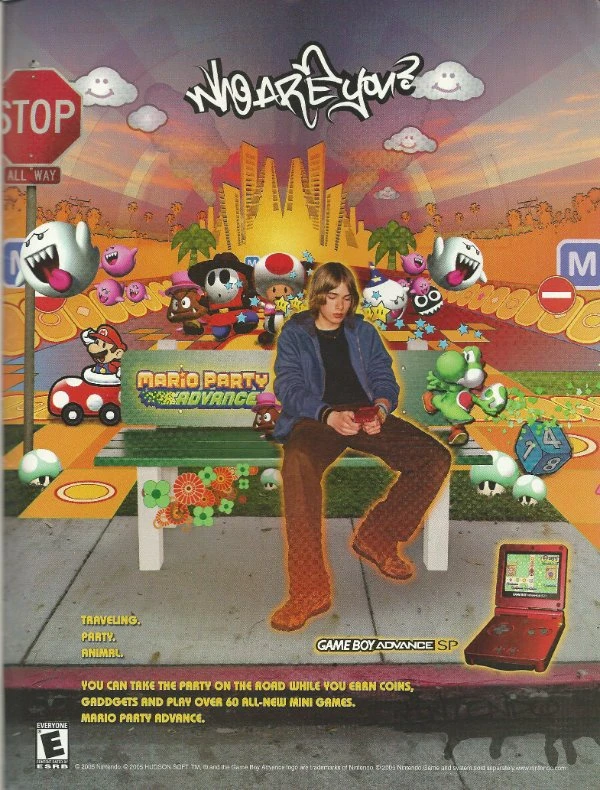
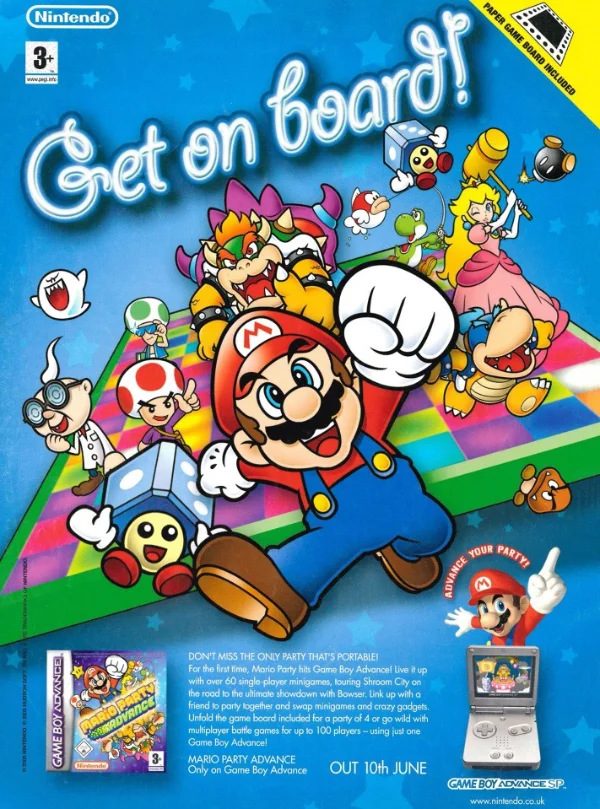
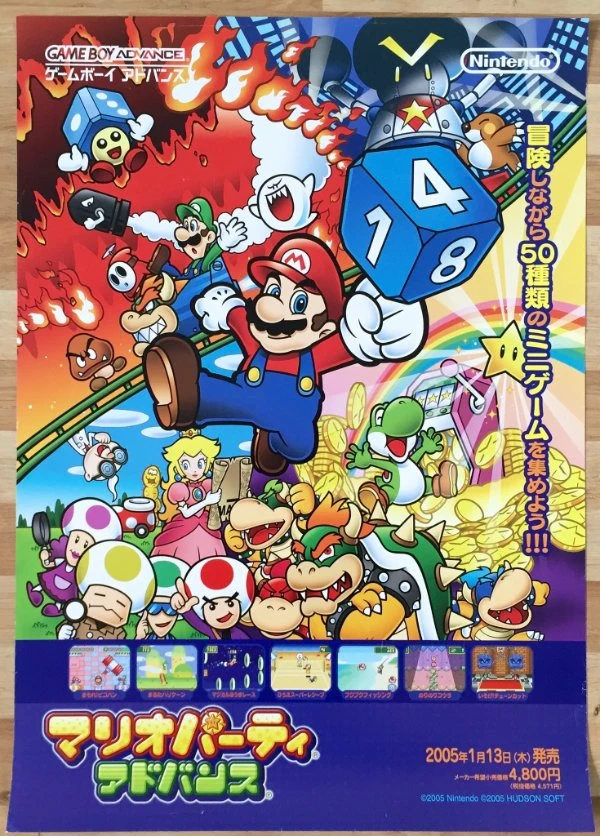
Print Advertising

Development Staff
Mario Party Advance was developed by Hudson Soft — the long-time Mario Party developer responsible for every entry in the series from the original Nintendo 64 game through Mario Party 8 — and published by Nintendo.
- Developer: Hudson Soft
- Publisher: Nintendo
- Platform: Game Boy Advance
- Genre: Party / Minigame collection / Adventure hybrid
- Series Entry: 7th main Mario Party (after Mario Party 6, before Mario Party 7)
- First Portable: The first portable Mario Party game (Mario Party DS would follow in 2007)
- Predecessor: Mario Party 6 (GameCube, 2004)
- Successor: Mario Party 7 (GameCube, 2005)
Reception & Legacy
Mario Party Advance received mixed reviews. The game’s focus on single-player over multiplayer was panned by critics, with criticism directed at its lack of multiplayer options. The story mode and variety, however, received some praise.
The single-player campaign was generally praised, offering a large amount of variety and unique characters. The lack of substantial multiplayer was a common complaint, as it required players to either use multiple Game Link Cables or make every player use the same Game Boy Advance.
What Critics Praised
- The Shroom City exploration mode and its character-driven Quests
- The large cast of unique characters — the new NPCs like Shroomlock, Mr. E, Mushbert, and Tumble brought personality the home-console Mario Party games sometimes lacked
- The variety and uniqueness of the single-player campaign
- The Bonus Board physical board game pack-in — a genuinely novel idea
- The portability factor of bringing Mario Party to a handheld for the first time
- Some reviewers praised the Gaddgets as creative toy-like microgames
Common Criticisms
- Awkward multiplayer. Required either four Game Link Cables or shared single-GBA play — a major obstacle for the party game genre
- Inconsistent minigames. Reviewers split on the quality — some found them charming, others found them bland or uninteresting
- Complexity. The mode-within-mode structure (Shroom City → Quest → minigame; Challenge Land → sub-mode → minigame) was seen as needlessly intricate
- Departure from the formula. Mario Party fans expecting a turn-based board game found a single-player adventure instead, which divided long-time fans
- Some Gaddgets were considered fluff and not real games
Retrospective & Legacy
- Retrospective critics often rank it low among Mario Party games due to its single-player focus and multiplayer awkwardness
- However, many fans defend the game as the most unique entry in the series and a creative experiment
- Re-released on Wii U Virtual Console in 2014, giving it a second life
- The Bonus Board concept remains a singular Nintendo experiment never repeated
- The Shroom City cast (Shroomlock, Mr. E, Tumble, Mushbert) became a fan-favourite set of supporting characters
- The next portable Mario Party would be Mario Party DS in 2007, which returned to a more traditional board-game format
SLB User Reviews
Mario Party Advance has yet to receive a community review on Super Luigi Bros.
If you’ve played Mario Party Advance and would like to submit a review, please get in touch.
Regional Logos, Box Art & Title Screens
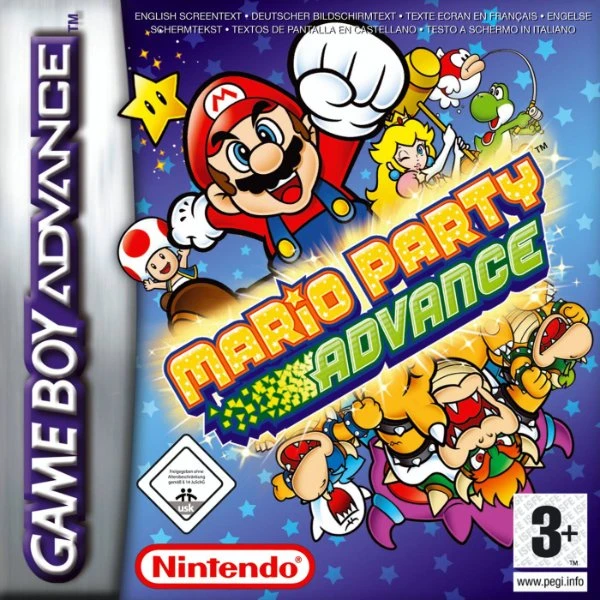
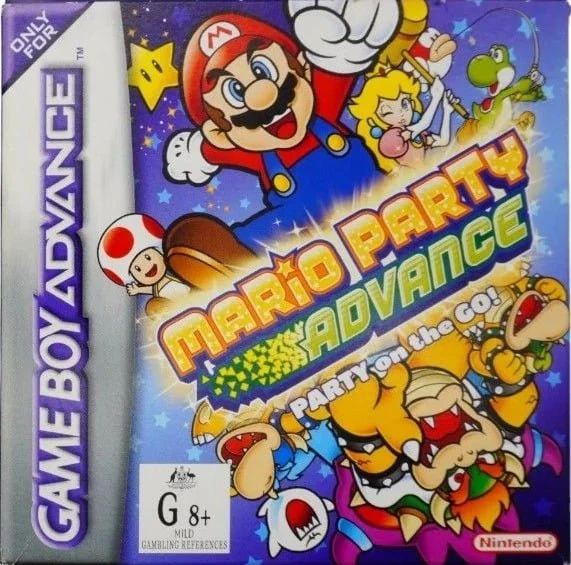
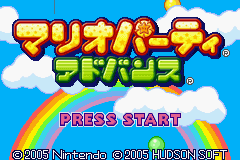
Mario Party Advance shipped with distinct regional box art across all four regions.
Regional Logos


Box Art

Iconic In-Game Screens


Trivia & Facts
- The only Game Boy Advance Mario Party game. The first portable Mario Party. Mario Party would not return to a handheld until Mario Party DS in 2007
- The 7th main Mario Party. Numerically follows Mario Party 6 (GCN, 2004); the next home-console title would be Mario Party 7 later in 2005
- Bowser literally falls on Toad. The intro famously has Bowser and Koopa Kid dropping out of the sky and squashing Toad flat. Toad pops back to shape moments later — a classic Mario Party slapstick
- Bonus Board pack-in. Mario Party Advance is one of very few video games to ship with a real-world physical board game in the box. Paper mat + punch-out tokens + GBA-as-die. A genuinely unique design
- 4 starting locations. Mario starts in Town, Luigi in Seaside, Peach in Jungle, Yoshi in Horror. The four starting zones give each character a distinct opening narrative
- The Shroomlock family. Detective Shroomlock and Mrs. Shroomlock are obvious parodies of Sherlock and Mrs. Hudson — a rare deep-cut literary reference in a Mario game
- Mr. E. The name “Mr. E” is a pun on “mystery” — fitting given his obsession with UFOs and unexplained phenomena
- The Gaddgets concept. Professor E. Gadd (the inventor from Luigi’s Mansion) invented the Gaddgets in-universe. The name itself is a play on “Gadget” + “E. Gadd”
- 4-Way Link Cable required. Full 4-player multiplayer required four Game Boy Advances and four Link Cables — an unrealistic hardware requirement that hurt the game’s party-game credentials
- Tumble returns. The Shroom City host Tumble is the same dice-themed character from Mario Party 6, where he was that game’s host
- Hudson Soft’s last decade with Mario Party. Hudson developed every Mario Party from 1 through 8, then NDcube took over starting with Mario Party DS (2007) and onwards. Mario Party Advance is one of the last few Hudson-developed entries
- The Kamek Krew Live! quest. A band needing a gig is named the Kamek Krew — a fun nod to Bowser’s wizardly minion
- Wii U Virtual Console release. Re-released in 2014, making it accessible on modern Nintendo hardware
- Bowser falling on Toad is the entire inciting incident. There’s no kidnapping, no stolen princess, no world-ending threat — just Bowser scattering the party stuff out of pure spite
- 50+ minigames + 30+ Gaddgets. Total content (minigame + Gaddget) is one of the largest collections in any Mario Party
- Shroom City is named after Mushroom City — a clear naming homage to the wider Mushroom Kingdom while also distinguishing this specific location as the unique setting for Mario Party Advance
- The Compat-I-Com Gaddget (a compatibility checker, like a fortune-telling app) is featured in the game’s artwork held by Mario and Peach — a sly suggestion that the game itself was Nintendo’s attempt to test compatibility between physical and digital play
Promotional Wallpapers
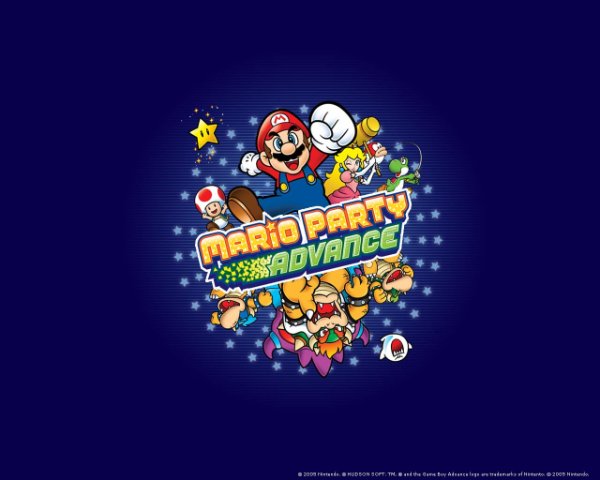
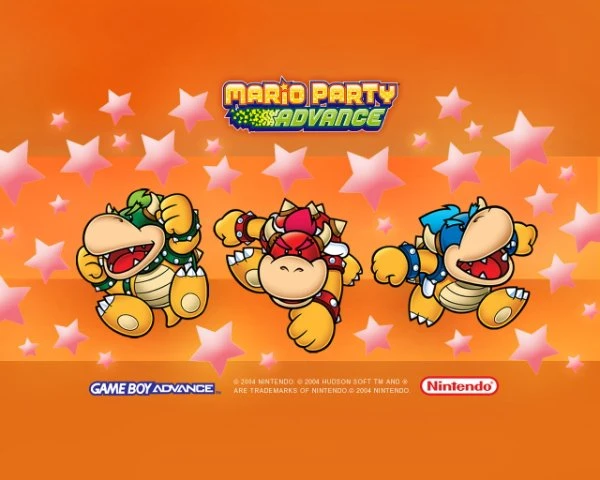
Three official desktop wallpapers were released to promote Mario Party Advance.

Reference / Information
Sub-pages and guides for Mario Party Advance.
Media / Downloads
Galleries, wallpapers, and screenshots.