

Mario Teaches Typing 2 (1996)
The sequel to the game that gave Mario his voice. Released October 31, 1996 for Windows and Mac, Mario Teaches Typing 2 is the last educational Mario game ever made — Shigeru Miyamoto personally ended the Interplay partnership after its release. More of a deluxe re-release than a true sequel, it adds a fuller story mode, animated cutscenes, colour-coded keyboard, personalised lesson plans and Charles Martinet’s now-established voice throughout.
Overview
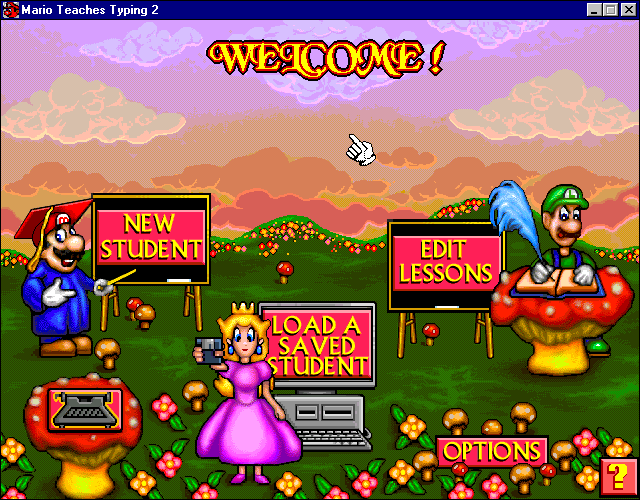
Mario Teaches Typing 2 is the direct sequel to the 1992 original — though “sequel” is perhaps a generous term. MarioWiki describes it accurately as “more of a polished re-release of the CD-ROM Windows/Mac version of Mario Teaches Typing, with some key differences.” The four typing gameplay modes (Smash & Dash, Wet World Challenge, Tunnel of Doom, Expert Express) are essentially the same as before, with the same underlying mechanics.
What genuinely changed is everything around the typing. MTT2 has a fuller, properly animated story told through cutscenes between levels.
The main menu has been overhauled with a blue colour scheme (replacing the original’s purple). A brand new mode called Mario’s Magical Keyboard was added — a colour-coded interactive keyboard where each key triggers a unique character animation, acting as both a learning tool and an entertaining toy.
And the practice experience was completely rebuilt with customisable lesson plans and a personalised certificate of achievement.
Charles Martinet is the sole voice of Mario in this version — there’s no Ronald Ruben here. By 1996 Martinet’s voice was firmly established (Super Mario 64 launched the same year), and his performance in MTT2 is accordingly more polished and playful, with a wider variety of quips and reactions.
🚫 The last educational Mario game ever made
After Mario Teaches Typing 2, Shigeru Miyamoto told Brian Fargo directly that Interplay would no longer be permitted to use the Mario character for educational games. No further Super Mario edutainment titles were produced by Interplay or any other studio. MTT2 is the final entry in a line that began with Mario is Missing! (1992) and ended here.
Story

Mario and Luigi are walking by Bowser’s Castle when a mysterious typewriter appears in front of them. To their amazement it starts typing by itself.
When it finishes, Mario pulls out the paper — which transforms into a scroll. The scroll reads: “The Magical Typewriter is the key to beating Bowser.
You must type the magic words onto the scroll to cast the spell which will destroy Bowser’s Castle. Be forewarned, however, that if the magic words are not typed exactly, the Magical Typewriter will self-destruct into pieces.”
Mario pockets the scroll and confidently begins typing: “Koooppa tTrupa pparraTroopaa Bbow…” The typewriter explodes into three pieces. One lands in a nearby river, one stays on Mario and Luigi’s side, and the last lands on the far side near Bowser’s Castle.
As the brothers retrieve the first piece from a dim Koopa Troopa, a Red Koopa detonates the river bridge with TNT and takes another piece back to Bowser’s Castle. Mario dons a snorkel and dives into the river with Luigi, finding the second piece aboard a sunken ship — guarded by a sleeping octopus who wakes up and chases them out through the portholes. Finally they walk up to Bowser’s Castle, knock on the door, and are swallowed by the castle itself. They navigate Thwomps and falling traps until they find Koopa Troopas playing poker for the final piece. They escape, Mario reassembles the typewriter, and types the spell correctly: “Koopa Troopa paratroopa Bowser’s Castle go kablooka!” A giant typewriter falls from the sky and destroys Bowser’s Castle. Mario and Luigi celebrate.
This is a significantly more developed story than the original CD-ROM version’s brief framing, with dedicated animated cutscenes for each beat rather than simple title cards.
Typing Levels
 Main menu (blue scheme)
 Character select
 Lesson plan select (new)
 Outdoor World — gameplay
 Underwater World — gameplay
 Tunnel of Doom — gameplay
 Main menu
 Koopas playing poker (cutscene)
 End of level results
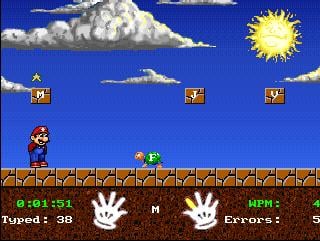
The four core typing modes return unchanged in structure but with updated presentation: Mario’s Smash & Dash (beginner — type letters on Koopas and blocks), Mario’s Wet World Challenge (intermediate — underwater typing with Bloopers and Boss Bass chasing you), Mario’s Tunnel of Doom (advanced — full sentences through an underground castle with Thwomps), and Mario’s Expert Express (expert practice mode).
The key addition is the customisable lesson plan system. Where the original let you only choose keyboard zones (Home Row, Top Row etc.), MTT2 allows proper lesson planning — you can set target WPM goals per session, adjust difficulty curves, and track progress across multiple lessons in a more structured way.
Mario’s Magical Keyboard
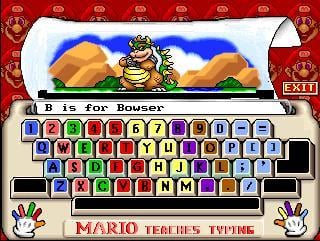
The most distinctive new feature of MTT2. Accessible from the typewriter on the main menu, the Magical Keyboard displays a colour-coded keyboard layout — each region colour-coded to show which finger is used to type each key. Typing any letter, number, or punctuation mark triggers a unique character animation. It’s part vocabulary aid, part entertainment, and part proper touch-typing reference tool. The full A-Z list:
Punctuation and numbers also each trigger unique animations. The keyboard layout itself uses colour-coding to show finger placement — a practical teaching aid that the original completely lacked.
Animated Cutscenes
One of the clearest improvements over the original. MTT2 has a full set of story cutscenes between levels, each depicting a scene from the Magical Typewriter story. The animation quality is charming for a 1996 educational PC title — these are proper cel-shaded scenes rather than static illustrations.
Mario finds the Magical Typewriter Red Koopa builds the bomb
 Bridge destroyed with TNT
 Mario swims into the river
 Koopa gets stomped
 Thwomps inside Bowser’s Castle
 The sunken ship in the river
 The sleeping octopus guardian
The Koopas playing poker scene inside Bowser’s Castle is a deliberate reference to the famous “Dogs Playing Poker” painting series. Mario’s “I’m a videogame!” routine — where he bounces across the screen making simplistic sound effects imitating Pong — is one of the most fondly remembered Mario voice lines of the Martinet era.
Mario Teaches Typing 1 vs 2 — Full Comparison
MTT2 markets itself as a sequel but functions more like a director’s cut of the 1994 CD-ROM version. Here’s how the two compare across every major aspect:
| Feature | MTT1 (1992/1994 CD) | MTT2 (1996) |
|---|---|---|
| Voice of Mario | Floppy: Ronald B. Ruben CD: Charles Martinet |
Charles Martinet only — more lines, more variety |
| Mario’s voice first appearance | Floppy 1992 = Mario’s first ever spoken game | Martinet already established by 1996 |
| Main menu colour scheme | Purple | Blue — cleaner, less dated-looking |
| Story mode | CD: brief typewriter framing only | Full animated story with multiple cutscenes |
| Cutscenes | None (floppy) / minimal (CD) | 8+ fully animated story cutscenes |
| Typing modes | 4 modes — Outdoor, Underwater, Underground, Expert Express | Same 4 modes — no new typing scenarios added |
| Keyboard teaching tool | On-screen hand guides only | Mario’s Magical Keyboard — colour-coded, A-Z + punctuation animations |
| Lesson plans | Basic keyboard zone selection only | Fully customisable lesson plans with WPM targeting |
| Certificate | Basic ASCII art certificate | Customisable personalised certificate |
| Mario’s floating 3D head | CD version: introduced via VActor tech | Larger, more expressive, used throughout |
| Playable characters | Mario, Luigi, Princess Peach | Mario, Luigi, Princess Peach (unchanged) |
| Music | Sampled from Super Mario World | Similar Super Mario World-era themes |
| Historical significance | First game where Mario ever speaks; Martinet’s first credited role | Last educational Mario game ever made |
| Educational depth | Limited — better for total beginners only | More structured thanks to lesson plans |
| Bug: error counter overflow | Expert Express bug above 1,000 errors | Fixed |
| Windows compatibility | Works on modern systems via DOSBox | Broken on 64-bit Windows Vista+; requires 32-bit XP/Win7 or emulator |
| Verdict | More historically important; simpler experience | Better as an actual typing tutor; richer presentation |
Legacy — The End of an Era
Mario Teaches Typing 2 holds the distinction of being the last educational Mario game ever produced. After its release, Shigeru Miyamoto made it clear to Brian Fargo, CEO of Interplay, that the company would no longer be permitted to use the Mario character for edutainment. This ended a run of games that had started with Mario is Missing! in 1992 and included Mario’s Time Machine, the Mario’s Early Years series, Mario’s Game Gallery, and both Mario Teaches Typing titles.
Miyamoto’s reasoning has never been stated explicitly, but the general narrative — supported by authors Wesley and Barczak in their 2010 book — is that the volume of third-party Mario games in the 1990s had diluted the brand and created quality control concerns. Mario Teaches Typing 2, despite being a reasonable product, was collateral damage in a necessary cleanup.
Interplay maintained its relationship with Nintendo in other ways — the company had already shipped Mario’s Game Gallery in 1995 and had built a solid working relationship. But the educational games line was over.
“As the Super Mario-themed educational titles were regarded as being of lower quality compared to main series titles, Shigeru Miyamoto made it clear to Brian Fargo that the company would no longer be permitted to use the Mario character for the edutainment genre; from then on, no further Super Mario games in the genre were produced by Interplay or any other studio.” — MarioWiki
For Charles Martinet, MTT2 was a milestone in the other direction — by 1996 Super Mario 64 had launched and his voice was now globally famous. The same voice that debuted in the original Mario Teaches Typing in 1994 was now recognisable to millions of players worldwide. MTT2 sits right at that inflection point: the closing of one chapter as another, far larger, was opening.
Promotional Artwork
 Mario at the computer
 Mario on a train
 Luigi with report card
 Mario, Luigi & Peach with key
Trivia & Facts
- Mario Teaches Typing 2 is the last educational game in the Super Mario franchise. Shigeru Miyamoto personally told Interplay’s Brian Fargo that no further edutainment Mario titles would be permitted after this release.
- The Koopas playing poker scene inside Bowser’s Castle is a direct reference to “Dogs Playing Poker” — the famous 1903 series of oil paintings by C.M. Coolidge.
- Mario’s “I’m a videogame!” routine has him bouncing between the sides of the screen making simple electronic sounds, imitating the Atari game Pong. It’s widely considered one of the funniest Martinet ad-lib moments of the era.
- Mario sings a parody of the classic Italian song “That’s Amore” at one point, with the second line modified to: “When an eel lunges out, and he takes a bite of your snout, that’s a moray!” — a reference to the book The Callahan Touch by Spider Robinson.
- Mario also references a LifeCall commercial (“I’ve fallen and I can’t get up!”) — one of several pop culture references scattered through the voice script.
- The Windows version works on 32-bit versions of Windows up to XP/Server 2003. All 64-bit versions of Windows (Vista onwards) are incompatible, as they lack the NTVDM subsystem needed to run 16-bit applications. Windows 11 (64-bit only) makes it completely unplayable without emulation.
- Mac users can run MTT2 under Mac OS System 7 through Mac OS 9. Modern Mac users need SheepShaver or Basilisk II to emulate the required environment.
- The game was released on Halloween — October 31, 1996. Whether this was intentional given the slightly unsettling nature of Mario’s giant floating head is unknown.
- MTT2 was co-developed by Brainstorm Entertainment alongside Interplay — the same Brainstorm that also helped produce Mario’s FUNdamentals (the re-release of Mario’s Game Gallery) in 1997.
- Super Mario 64 launched in June 1996 in Japan and September 1996 in North America — just weeks before MTT2’s October 31 release date. Players who bought MTT2 were doing so in a world where they could already hear Martinet’s fully established Mario voice in one of the greatest games ever made.