

Mario’s Game Gallery (1995)
Five classic board and card games — Checkers, Go Fish, Dominoes, Backgammon and Yacht — all played against a fully voiced Mario. A genuine curiosity in the Mario library: the first game ever to feature Charles Martinet as Mario’s voice, over a year before Super Mario 64.
Overview
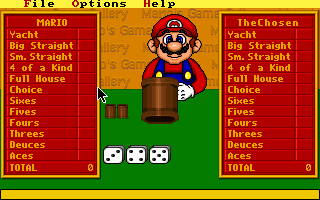
Mario’s Game Gallery is one of the most genuinely obscure titles in the entire Mario franchise — and one of the most historically significant. Released in February 1995 exclusively in North America for MS-DOS, it is a compilation of five traditional board and card games: Checkers, Go Fish, Dominoes, Backgammon, and Yacht (a Yahtzee variant — renamed to avoid trademark issues). You play all five games against Mario himself, who talks to you throughout, reacts to your moves, offers encouragement, complains when you take too long, and generally acts like a friend you’re playing a rainy afternoon game with.
The game was developed by Presage Software and published by Interplay Entertainment — yes, the same Interplay behind Fallout. Nintendo licensed the Mario brand to Interplay for this title, one of several third-party PC Mario games produced in the 1990s without direct Nintendo supervision. The result is something unusual: a Mario game designed purely for the home computer market, with no arcade heritage and no platform-jumping — just five ancient parlour games dressed up in Mario theming and brought to life by an extraordinarily charming and chatty virtual host.
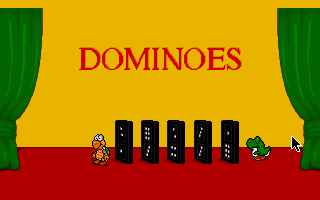
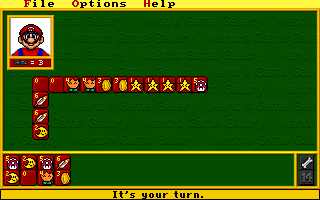
Each game’s pieces are re-skinned with Super Mario characters and items: checkers uses Yoshis and Koopas, dominoes feature Super Stars and Fire Flowers, Go Fish uses a cast including Bob-ombs, Boos, Piranha Plants and Goombas. None of it changes the underlying games — a game of Go Fish is still Go Fish — but the presentation is bright, friendly, and very clearly aimed at introducing younger players to classic games they might not have encountered.

“Your family will love playing with Mario in these easy-to-play games for kids of all ages. Using digitized voice, Mario actually talks you through each game with friendly and encouraging assistance.” — Original box copy
The game was re-released in 1998 as Mario’s FUNdamentals under Mindscape (Windows) and Stepping Stone (Mac), with updated graphics, additional voice lines, and a few bug fixes — but the five games and the core experience remained identical.
Charles Martinet — Mario’s Voice Debuts Here
🎙️ Historical significance
Mario’s Game Gallery is the first commercially released video game to feature Charles Martinet as the voice of Mario — predating Super Mario 64 by over a year. Most people first heard Martinet’s voice as Mario in Super Mario 64 (1996), but the actual debut was right here in this quiet little PC board game collection.
Charles Martinet got the role of Mario in 1991 after crashing an audition at the last minute — the casting directors were packing up when he walked in. He was told Mario was “an Italian plumber from Brooklyn” and, rather than going with a gruff New York accent, softened the voice into something warm and child-friendly. The voice was so memorable that the tape was sent straight to Nintendo. For the next several years, Martinet voiced Mario at Nintendo trade show events through the “Mario in Real Time” system — an early motion capture setup where his facial movements drove a 3D Mario head on screen, letting him hold live conversations with passersby.
His first actual video game release was Mario Teaches Typing (1994 CD version), but Mario’s Game Gallery — released in February 1995 — was the title where Martinet truly settled into the role, delivering extended, fully scripted dialogue throughout five different games. He talks constantly: encouraging you when you play well, groaning when he loses a piece, cracking knock-knock jokes while waiting for you to take your turn, calling out to the fish in Go Fish (“Come here, fishy-fishy!”), and getting impatient if you leave him waiting.
Martinet himself has said that Mario Teaches Typing was the game that most shaped his portrayal of Mario — particularly when he pushed back against lines like “You failed” and “That wasn’t very good”, replacing them with encouraging alternatives. But it was in the interactive back-and-forth of Game Gallery that the voice truly came alive as a personality.
Official Nintendo Magazine later noted in a “Rare Mario Games” article that while Game Gallery featured Martinet first, most players associate Super Mario 64 as his introduction — a reflection of how completely overlooked this PC title was in the Nintendo community at the time.
The Five Games
All five games follow their real-world counterparts faithfully, with Mario-themed pieces and a fully voiced Mario as your only opponent. There is no difficulty setting — Mario plays at a fixed level, and by general consensus he plays rather well. Player reviews from the era and beyond frequently describe him as “rigged” or “a cheating bastard”, particularly in Go Fish, where Mario demonstrably knows what you just drew from the deck.
 Intro screen
 Gameplay
 Intro screen
 Gameplay
 Intro screen
 Gameplay
 Intro screen
 Gameplay
 Yacht scoresheet
Mario & Characters
Mario is the star of the show in every sense — he’s your opponent, your host, your cheerleader and occasionally your heckler. Charles Martinet’s performance is the reason this game has any legacy at all; without it, you’d have five perfectly ordinary PC board games. Mario talks constantly: he encourages you, reacts to good and bad plays, cracks knock-knock jokes when waiting, sweats visibly if you take too long, and becomes audibly impatient if you ignore him for extended periods.
In this game, Mario’s grasp of English is noticeably more tentative than in later titles — he frequently says “I’m-a” where he should say “I” (“I’m-a like-a this game!”), and his Italian accent is considerably more exaggerated. This version of Mario is wide-eyed and warm rather than polished, which adds to the charm. He also refers to Toad using the nickname “Little Toadie” — a term that actually originates from Nintendo of America’s 1993 internal Character Guide, not something invented for the game.
The Go Fish deck features 13 character types: Goombas, Koopas, Rip Van Fish, Little Toadies (Toads), Bob-ombs, Rexes, Piranha Plants, Big Boos, Yoshis, Marios, Luigis, Princesses and Bowsers (misspelled “Bowzers”). The dominoes use six item icons — Super Star, 3-Up Moon, Coin, Fire Flower, Super Mushroom, Cape Feather — all from the Super Mario World era, the most recent mainline game at the time of development.
The title screen shows Mario in a suit reminiscent of his Super Mario All-Stars box art appearance, which TV Tropes notes as a deliberate continuity nod. He taps his foot on the title screen while waiting. During Checkers and Go Fish he sweats visibly if you delay. The animation quality — for a 1995 DOS game — is genuinely impressive, and it was noted by contemporary reviews as a strong point of the package.
Mario’s Voice Lines — Selected Quotes
Versions
MS-DOS box art (1995)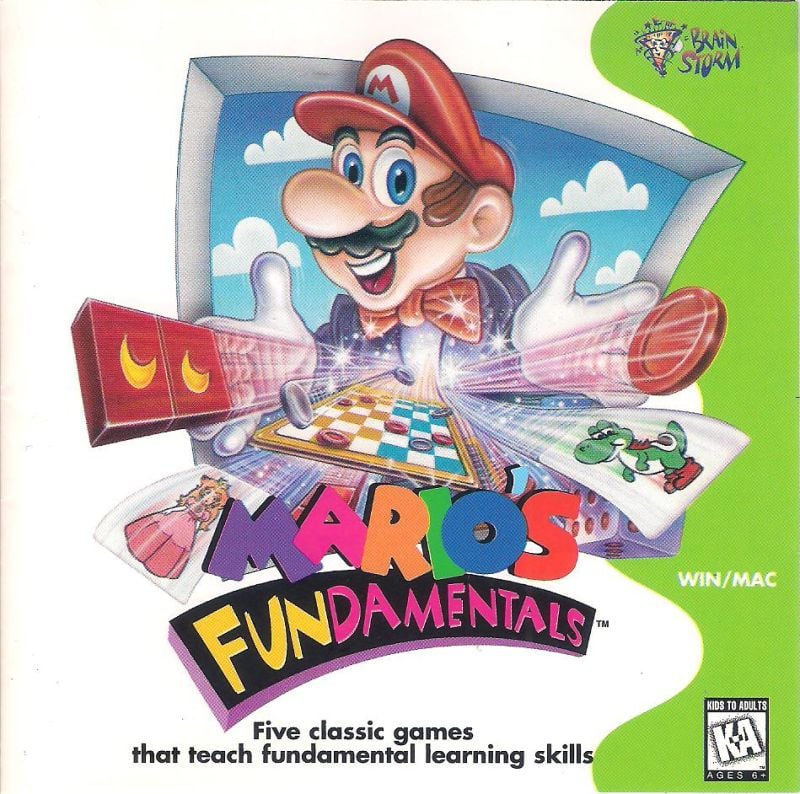 FUNdamentals box (1998)
 FUNdamentals Windows title screen
| Version | Year | Platform | Publisher | Notes |
|---|---|---|---|---|
| Mario’s Game Gallery | Feb 23, 1995 | MS-DOS | Interplay Entertainment | Original release. Floppy disc (3.5″) and CD-ROM. US only. |
| Mario’s Game Gallery | 1995 | Macintosh | Interplay / MacPlay | Mac port of original, simultaneous release. |
| Mario’s FUNdamentals | 1996 (Mac) / Jan 1997 (PC) | Windows / Mac | Mindscape (PC) · Stepping Stone (Mac) | Retitled re-release. Updated graphics, new voice lines, bug fixes. Also credited to Brainstorm Entertainment. |
A Super Nintendo port was reportedly in development under the Mario’s Game Gallery name but was cancelled — no prototype or further documentation has surfaced. Europe and Japan never received any version of either release.
Reception
Contemporary reviews were generally warm. The State called it “excellent” and praised it as “fun for the whole family.” The Miami Herald highlighted its “sharp graphics” and “fun animations”, describing the music as based on the Mario series, and also called it family fun — though they noted the difficulty could frustrate younger players. The Advocate singled out Charles Martinet’s performance specifically, predicting small children would “giggle with delight.” The Los Angeles Times featured it in a roundup of educational games for younger gamers.
The criticism came from two main angles. First: Mario is very hard to beat. Multiple period reviews and countless player reviews on the Internet Archive download page note that the AI feels rigged — particularly in Go Fish, where the game demonstrably knows what you drew from the deck, and in Checkers, where Mario plays with a strategic depth that seems wildly out of proportion for a children’s title. There is no difficulty setting in any version.
Second: later critical retrospectives were unkind. Authors David Wesley and Gloria Barczak, writing in 2010’s Innovation and Marketing in the Video Game Industry, labelled Mario’s Game Gallery as part of a “flood of ill-conceived Mario spin-offs” produced without Nintendo’s supervision that nearly destroyed the Super Mario brand. ScrewAttack ranked it the sixth worst Mario game of all time, concluding there was “nothing fun about FUNdamentals.”
The modern cult following is largely built around Martinet’s performance rather than the games themselves. The Internet Archive hosts playable versions, and the reviews there — enthusiastic, nostalgic, frequently all-caps — paint a picture of a game whose voice acting transcends its content. One reviewer summed it up perfectly: “This lackluster DOS compilation is the Dark Souls of board games. Mario compliments you and lulls you into a false sense of security before he CRUSHES YOU LIKE A GRAPE.”
Trivia & Facts
- Mario’s Game Gallery is the first commercially released video game to feature Charles Martinet voicing Mario. He had voiced Mario at trade shows since 1991 and in Mario Teaches Typing (1994 CD), but this was his first proper debut in an at-retail game — over a year before Super Mario 64.
- Interplay Entertainment, who published this game, is the same developer/publisher responsible for the original Fallout series. It is one of the more unexpected entries in both companies’ catalogues.
- The game was only ever released in the United States. Europe and Japan never received Mario’s Game Gallery or Mario’s FUNdamentals in any form — making it one of the rarest genuine Mario releases for non-US fans.
- A SNES port of the game (under the Mario’s Game Gallery name) was reportedly in development before being cancelled. No prototype has ever surfaced.
- Mario refers to Toad as “Little Toadie” throughout the game. This nickname is not invented here — it comes directly from Nintendo of America’s 1993 internal Character Guide, distributed to licensing partners.
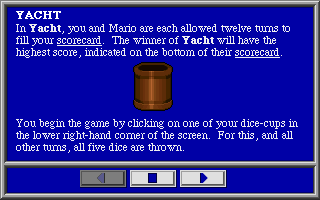
- Yacht is clearly Yahtzee, renamed because Yahtzee is a trademarked name belonging to Hasbro. Mario calls it “Yacht-ee” in a heavy Italian accent, which is either a clever trademark dodge or the most elaborate mispronunciation in board game history.
- Go Fish’s draw pile is represented as an actual pool of water, from which a dolphin leaps when you draw. It is completely unnecessary and entirely charming.
- Bowser is misspelled “Bowzers” on the Go Fish cards. This has never been acknowledged or explained.
- The domino tiles use Super Mario World-era item icons — the most recent mainline game at the time of development. The Fire Flower notably uses its Super Mario World design rather than the classic NES version.
- Mario’s suit on the title screen mirrors his appearance on the Super Mario All-Stars box art — a deliberate continuity nod noted by TV Tropes.
- The FUNdamentals re-release in 1998 added new voice lines and polished the graphics. This version is generally preferred by players, though both remain playable through DOSBox or on the Internet Archive.
- Official Nintendo Magazine’s Tom East, writing about “Rare Mario Games,” observed that although this game featured Martinet first, most people associate Super Mario 64 as his debut — a reflection of how thoroughly this PC title was overlooked by the Nintendo community.
Screenshots Gallery
Main Menu (MS-DOS)Checkers — introCheckers — gameplayGo Fish — introGo Fish — gameplay Go Fish — Rex card animationDominoes — introDominoes — gameplayBackgammon — introBackgammon — gameplayYacht — scoresheet
 Checkers — instructions
 Go Fish — instructionsFUNdamentals — Windows title screen
Video — Full Gameplay
A full playthrough of Mario’s Game Gallery, showcasing all five games and Charles Martinet’s voice performance throughout.
Reference & Downloads
Mario’s Game Gallery is considered abandonware and is freely available to play online or download.