

Mario’s Time Machine (PC / SNES / NES)
Bowser has stolen history’s greatest artefacts to fill his own museum — and only Mario can travel back through time to return them. An educational adventure across three very different versions, released between 1993 and 1994.
Overview
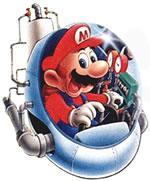
Mario’s Time Machine is an educational video game developed and produced for multiple platforms (MS-DOS, NES and SNES). It was originally released for MS-DOS and after that for the later two consoles. The Software Toolworks was in charge of the MS-DOS and SNES versions of the game (both published in 1993), while Radical Entertainment developed the NES version, with Nintendo itself as publisher (the game came out in 1994).
The MS-DOS version of the game was re-released in 1994 (some sources say 1996) under the name Mario’s Time Machine Deluxe. The PC version was distributed via floppy disks, while Mario’s Time Machine Deluxe came on CD-ROM, with voice acting added and a reference file featuring Bowser’s mother.
This was one of several Mario educational games released in the 1990s. Like the others in the Mario Discovery Series — Mario is Missing! and Mario’s Early Years — it received quite negative coverage from both the media and the gaming community. Educational games were an unpopular genre and even with the best efforts of the developers, it couldn’t escape the fate of other edutainment titles. It is often compared to the similar Carmen Sandiego series.
Story

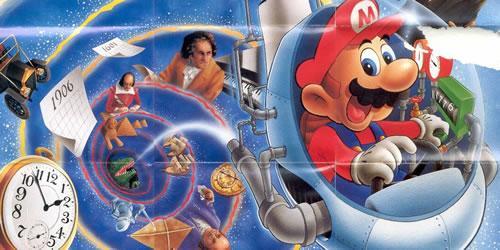
The storyline of the game is pretty basic and simple — Mario’s arch-nemesis Bowser is up to no good yet again, and this time with the help of a time machine that he has developed. He uses this time machine to travel back to different significant historical points in order to steal various artefacts and keep them in his own personal museum inside his castle.
Mario soon learns about his intentions and realises that history will change forever if he does nothing, so it is up to him to stop Bowser yet again.
There are some differences in the plot between different versions of the game. Both the NES and the SNES versions add that Bowser has intentions to destroy his time machine (referred to as the Timulator in the manuals), in order to permanently change history and send the world back to the Dark Ages.
In the NES version, Bowser’s Museum is already fully built and equipped with the greatest historical artefacts. Yoshi joins Mario in order to stop him, but gets captured while scouting ahead.
So, in addition to the original storyline, Mario also has to save Yoshi.
Official Story — SNES Instruction Booklet
“Better check your watch! Bowser’s out to turn back the clock. Not to Daylight Savings. No! To the Dark Ages! That terrible turtle is using a time machine, called a Timulator, to loot historical artefacts from the past. His twisted intent? To build Bowser’s Museum, fill it with historic booty, then destroy the time machine. This dastardly plan will turn time inside out, make the future bend over backwards, and change the course of history. Forever. This is no time to let bygones be bygones. Help Mario stop Bowser before he warps time and puts hiccups in history. If not, it’s back to stone tools and hieroglyphics! This quest is hot. If you’re too late, it’ll be lights out. Time’s up.”
The NES version of the instruction booklet contains the same story as above. As for the PC version, the manual doesn’t contain a conventional story — it was merely an insert in the jewel case telling you how to install the game. However, the opening dialogue of the Deluxe edition acts as the backstory for the PC version:
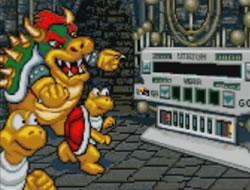

Bowser: “It’s time, my cunning koopas, to use the time machine and steal the most valuable artifacts that history has to offer…” / Bowser: “Mario, my collection is almost complete… and there’s not a thing that you can do to stop me!” / Mario: “Bowser’s museum is inside his castle. I have to get in there and return all the stolen artifacts before history is changed forever!” / Mario: “At last, Bowser’s castle! I’ll show that no good reptile! He can’t mess with history, as long as I’m around to set things right!” / Bowser: “The greatest collection of ALL time is nearly complete and it’s all mine! No one can stop me now! Not even Mario!”
 And so it begins.
Gameplay & Object of the Game
The objective of the game is to return the historical artefacts to their proper time periods — and this is mutual for all three versions. However, the overall gameplay varies significantly between the versions.
MS-DOS Version

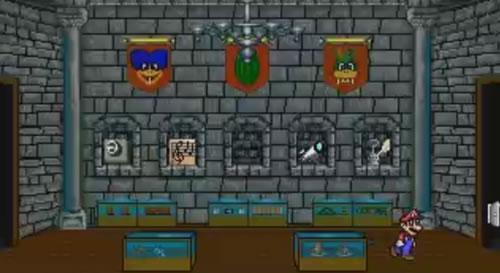
The central hub in this game is the museum inside Bowser’s castle. It has three floors and each of them has five artefacts to be found. You need to take the artefact from a pedestal, look at its date and location, and then add that information into the time machine in order to access the appropriate time period.
As soon as you enter a certain time period you need to explore and interact with various residents of the area in order to get more information about the artefact, the period itself, and the person connected to it. To do so, you must get items from certain residents and give them to others in order to satisfy their needs.
After you speak with everyone, you will automatically fill out a History answer sheet — a two-page biography about the person connected to the artefact and the time period, with some blanks replacing certain words. You must use the information you have acquired to correctly fill out the blanks.
If you miss the correct answer three times or more, you will return to the present and be forced to play through the same time period from the beginning.
A hidden checklist and a timer are both used in the game. How long you spend in each of the time periods, and the order in which you acquire the artefacts, all trigger one of three different endings.
If you spend too much time or return even one artefact in the wrong order, Bowser escapes to Paradise (a tropical island) or gets teleported to the Cretaceous period. If you meet both objective conditions, the time machine overloads and destroys itself, sending Bowser to the Cretaceous period where he gets stomped by a Tyrannosaurus Rex.
 Bowser’s Castle — all three museum floors (click for full size)
SNES Version
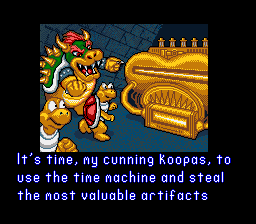 Bowser with the Timulator — SNES opening
 Mario in Orleans, returning Joan of Arc’s shield
As this is, basically, a port of the original game it has some notable changes. The amount of overall content is much lower, meaning a smaller number of time periods. There are also changes in terms of the overall design of the time machine. On time’s waves, you can move in all directions — not just forward — thanks to the SNES’s Mode 7, which is an improvement from the original game.
NES Version
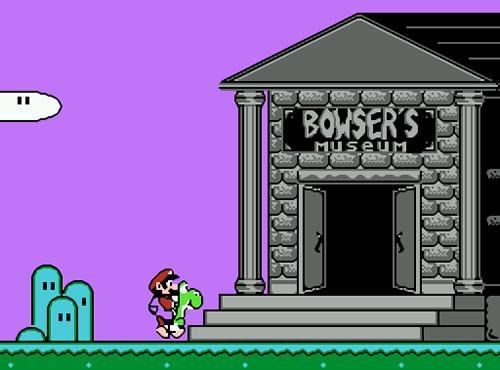 Bowser and his Koopas have built the greatest museum in history, but to do it they have stolen many important items from the past.
 Title screen
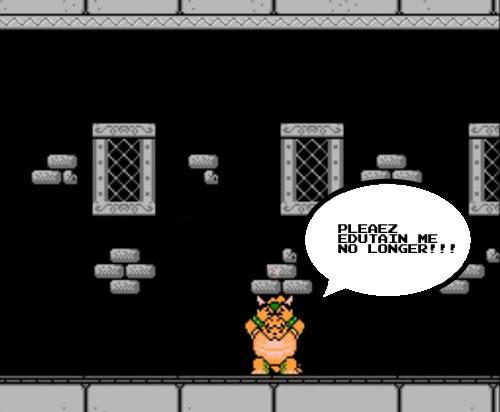
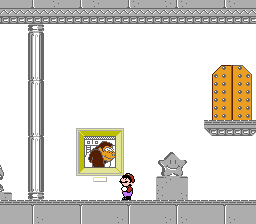 Museum interior — Donkey Kong Jr. painting visible
 Super Mario World sprites repurposed for NES
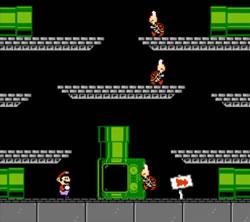 Mario Bros.-style arena in Bowser’s Museum
Time Periods — All Versions
As much as the gameplay varies between the three versions of this game, the time periods also differ significantly. The PC version is the most comprehensive at 25 periods; the SNES trims to 15; the NES takes its own path with 14 unique periods.
 Mainz, 1455 — Gutenberg’s time period (PC Deluxe)
 Novato, 1993/94 — the developers’ own office (PC Deluxe)
Version Comparison
| Feature | PC / DOS | PC Deluxe | SNES | NES |
|---|---|---|---|---|
| Release | Feb 1993 | 1994 | Dec 1993 | June 1994 |
| Developer | The Software Toolworks | Toolworks + Radical Entertainment | ||
| Publisher | The Software Toolworks / Mindscape | Nintendo | ||
| Time periods | 25 | 25 | 15 | 14 (mostly unique) |
| Gameplay style | Adventure / quiz / item trading | Platformer / quiz / Mario Bros arenas | ||
| Time surfing | Side-scrolling wave | Mode 7 wave (all directions) | Warp Pipe Timulator | |
| Voice acting | No | Full voice | No | No |
| Library / reference | No | Yes (+ Bowser’s mother) | No | No |
| Yoshi | No | No | No | Yes — kidnapped, must rescue |
| Dinosaur periods | No | No | No | Yes — 80M BC |
| Moon level | No | No | No | Yes — 1969 |
| Endings | 3 possible endings | Boss battle + single ending | ||
| Password system | Yes | No | ||
| Languages | English, French, German | English, German | English only | |
References to Other Mario Games
Even in an educational context, the developers packed in plenty of nods to the mainline Mario series:
Mario using a recoloured version of Bowser’s door sprites from Super Mario World, with the Bowser sprite from SMB3The full setup of the original Mario Bros. arena in Bowser’s Museum- Mario Bros. — A way of collecting objects in the NES version involves beating three Koopa Troopas in a similar manner to the style used in this game. Unlike in the original game, in this one Mario can enter the pipes, and they can also be used to access the main part of the museum.
- Super Mario Bros. 3 — The Bowser sprite from the NES version of the game is basically a modified version of the same sprite from SMB3.
- Super Mario World — Most of the sprites from the NES version (including Mario, Yoshi and the Koopas) are from this game, modified for an 8-bit system. The opening sequence where Mario and Yoshi walk up to Bowser’s museum is the same as the sequence before Mario enters a Ghost House or Castle in SMW, except Yoshi runs inside the museum after Mario gets off his back rather than waiting outside.
Reception & Sales
Since the game was officially released, it has received mixed reviews, although the negative ones dominate. It holds an aggregate score of 60.25% on GameRankings based on two reviews.
Needless to say, all of the Mario educational games received quite negative criticism from both the media and the gaming community. Educational games are a very unpopular genre for the industry, and even though developers gave their best effort into this game — as well as the other Mario educational games like Mario is Missing! and Mario’s Early Years! — it couldn’t escape the fate of other educational games: a collapse on the market.
GamePro praised its dialogues with various historical figures, stating that “the scenarios make flesh-and-blood human beings out of people who are usually just static pictures in textbooks.” Their criticism was focused on the Timulator controls, calling them “too confusing, especially for the game’s targeted age group,” but their summary was that the game was both educational and enjoyable at the same time. Nintendo Power gave it a mark of 2.65 out of 5, while Electronic Gaming Monthly liked the game better and gave it 6.75 out of 10.
Two reviewers from GameSpy (Brian Altano and Brian Miggels) stated that the ending of the game is one of the worst ever seen in a video game, criticising it for showing Bowser crying.
Another editor of GameSpy (Mike Drucker) described the whole game with a single line: “half-assed.” GameRadar concluded that those who like this game may as well like Night at the Museum: Battle of the Smithsonian, and added that it is an unpopular game that “five, maybe six people played the NES version.” ABC Good Game stated that the game is awful and added that its concept is “way too complicated for any school-aged youngster to understand.”
Nintendo of Canada included a sealed copy of the NES version as part of a charity auction, along with several other NES games. In the book Video Games: A Guide for Savvy Parents, author David Sheff stated that he liked the educational side but criticised the gameplay.
Andy Slaven, author of Video Game Bible, accused the game of ripping off elements from Where in Time is Carmen Sandiego? while adding that, although it isn’t a bad game, it is not a good educational one either. Authors Gloria Basczak and David Wesley associated it with the “flood of ill-conceived Mario spin-offs,” adding that these games almost destroyed the whole franchise.
Janet Swift of The Independent wrote about the game in her article about the latest generation of educational titles in 1994. She compared it to its prequel Mario is Missing! and stated it has educational value for children, praising its execution and calling it “special.” Brett Allan Weiss of Allgame called the action scenes “dreadfully dull” and the presentation “merely average.” He said that while he doesn’t have anything against educational games, they need to be both “entertaining and enlightening” to win the hearts of players.
IGN’s editor Levi Buchanan included it in his assessment of the “other Mario games,” calling the whole premise boring and the game lacking any real platform gameplay. He said it had “honourable intentions” but that the whole realisation was “decidedly shallow.”
He also complained about the idea of putting Mario in realistic historical time periods, saying that Mario “occupies the imagination, a place with Star Festivals and giant piranha plants.” The game is frequently considered one of the worst Mario games ever released, regularly appearing on top lists — on ScrewAttack’s “Top 10 Worst Mario Games,” it was placed at #4, summed up as: “Nintendo, please take this concept, re-do it and make it the way it should be done…not crappy!”
Historical Errors
For an educational game, Mario’s Time Machine contains a remarkable number of historical inaccuracies. Here are some highlights:
- Everyone speaks Modern English — including Plato in 369 BC, who wouldn’t have used a language that didn’t exist for another 800+ years. Presumably intentional so players could actually understand the dialogue.
- Julius Caesar claims he’s allergic to cats — no historical record of this exists. He also boasts about conquering Pompeii, which was taken by Roman general Sulla decades before Caesar held any power.
- Aristotle is depicted as an old man in 369 BC — he would have been 15 years old and hadn’t yet become Plato’s student.
- Edmund Halley says he tracked a comet in 1862 — this is a typo; Halley’s Comet passed in 1682, not 1862.
- Halley says “an apple a day keeps the doctor away” in 1687 — a proverb that wouldn’t exist for another 180 years.
- Calculus is attributed solely to Newton — Leibniz independently discovered calculus around the same time, leading to one of history’s most famous priority disputes.
- Newton’s Principia described as unpublished on Christmas Day 1687 — the book was actually published on 5 July 1687, several months earlier.
- Ptolemy’s numbers are wrong — Cleopatra’s father is called “Ptolemy XI” and her brother “Ptolemy XII,” but the correct numbers are XII and XIII respectively.
Trivia & Facts
- One of the first educational “Edutainment” titles in the Mario franchise.
- Intended to teach basic world history — covering everything from ancient Athens to 1994 Silicon Valley.
- Like in Mario is Missing!, Mario cannot die in this game.
- The game was released on NES, SNES, and PC for MS-DOS — making it one of the few Mario games to span all three platforms simultaneously.
- The final PC time period is 1993/94 in Novato, California — where The Software Toolworks was actually based. The artefact is a floppy disk belonging to a developer, essentially inserting the game’s own creation into history.
- The NES version was the last Super Mario title released for the Nintendo Entertainment System in North America — the final chapter of an eight-year run on the platform.
- The Deluxe CD-ROM version introduced Bowser’s mother as a character in the Library reference section — the only mainline Mario title to reference this character.
- The SNES version’s Mode 7 time-surfing sequence was specifically highlighted in marketing as a reason to favour the console version over the PC original.
- The game is often compared to Where in Time is Carmen Sandiego? — both are history-based educational games with similar exploration mechanics released around the same time.
Box Art Gallery


