
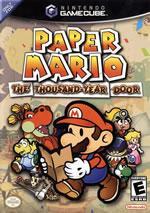

Paper Mario: The Thousand-Year Door
Overview

Paper Mario: The Thousand-Year Door arrived on the GameCube in October 2004 as the second entry in the Paper Mario subseries, following the much-loved Nintendo 64 original from 2000. Developed by long-time Mario RPG specialists Intelligent Systems with Ryota Kawade directing and Kensuke Tanabe producing alongside Shigeru Miyamoto, it’s widely held to be the high-water mark not just of Paper Mario, but of every Mario role-playing game across every generation.
Where the N64 game was a charming first attempt, this sequel feels like a confident artistic statement. The plot stretches across a prologue plus eight full chapters, each set in its own self-contained location with its own cast of supporting characters, its own central mystery and its own thematically appropriate boss battle. Together they form one of the most varied Mario adventures ever assembled: a haunted castle, a sentient great tree, a wrestling federation, a town under a transformation curse, a pirate cove, a luxury train, a moon-based alien fortress and a dead king’s shadow palace beneath the city.
Mario’s task: retrieve the seven Crystal Stars that have been scattered around the world, open the long-sealed Thousand-Year Door beneath the lawless port city of Rogueport, and find Princess Peach, who vanished after writing him a letter about a treasure map. Helping him is a roster of seven new party members — not the silent allies of most Mario games, but genuine companion characters with their own goals, fears, families, and arcs that span entire chapters. By the credits roll, the party is one of the most beloved supporting casts in the Mario canon.
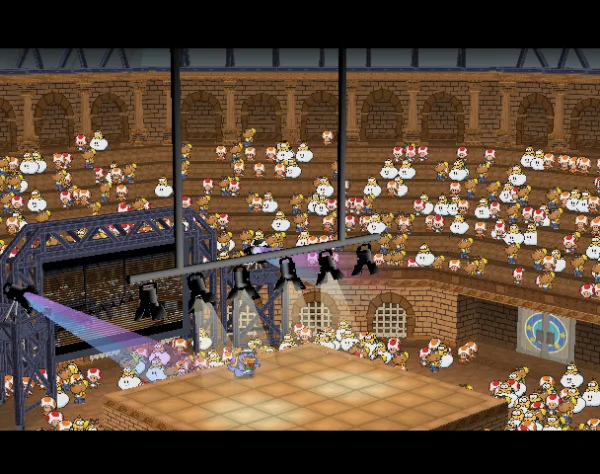
The combat is turn-based, but staged like theatre: Mario fights on a literal proscenium stage in front of an in-game audience whose attendance and cheering directly powers his special moves. Every attack and defence is gated behind a real-time Action Command — a button press, stick spin, or rhythmic tap timed to the animation. Hundreds of equippable Badges let players reshape Mario’s capabilities into wildly different builds. And once the credits roll, the endgame Pit of 100 Trials waits as one of the toughest optional dungeons Nintendo has ever shipped.
The Story — All 8 Chapters
The framing letter from Princess Peach sets the entire adventure in motion. While on holiday in a port city far from the Mushroom Kingdom, she has discovered an old merchant selling a mysterious treasure map — a legendary chart that supposedly points to a hidden treasure sealed behind a giant stone door. Peach writes to Mario asking him to come help her hunt for it, encloses the map, and promises to meet him on arrival.
When Mario reaches the port city — the lawless, criminal-overrun town of Rogueport — Peach is nowhere to be found. What he doesn’t yet know is that the treasure map he’s been handed isn’t just a treasure map. It’s the Magical Map, a living artefact tied to the Crystal Stars themselves, and the entire setup has been engineered. A shadowy organisation called the X-Nauts, led by the metallic supercomputer-wielding Sir Grodus, want the Crystal Stars too — not for treasure, but to break open the ancient seal beneath Rogueport and resurrect what’s buried beneath it. Peach was the bait. She’s already been kidnapped before Mario steps off the boat.
What follows is structured as eight escalating chapters, with brief intermissions between each one that cut away to show the player what Peach is doing in the X-Naut base on the moon, and what Bowser and Kammy Koopa are getting up to in their own clueless parallel quest to find the same treasure.

A Rogue’s Welcome
Mario arrives in Rogueport — a grimy port town whose every shop, alley and dockside is run by some flavour of small-time crook. Before he can find Peach, he stumbles onto an X-Naut commander named Lord Crump harassing a Goomba student called Goombella, who has the Magical Map’s sister piece in her possession. Mario steps in, takes down Crump in his first proper battle, and recruits Goombella as his first party member.
Toadsworth turns up moments later in a panic: Peach is missing. Goombella suggests they consult her old archaeology professor, Professor Frankly, who explains what the map actually is. The Thousand-Year Door lies beneath Rogueport, the legend says, and it can only be opened by gathering the seven Crystal Stars. The map will lead Mario to each of them. The adventure proper has begun.

Castle and Dragon
The map points to Petal Meadows, a pastel countryside reached through a pipe in Rogueport Sewers. The local Koopa village of Petalburg has been terrorised for years by Hooktail, a red dragon who eats the locals’ children and roosts in a ruined castle on the horizon.
To reach her, Mario must recover two stone keys from Shhwonk Fortress, where the optional sub-boss Gold Fuzzy ambushes him with a Fuzzy Horde. A young, shy Koopa named Koops joins the party here, motivated by a desire to avenge his father, who was eaten by Hooktail years earlier. The party fights through Hooktail’s Castle — encountering Dull Bones, Red Bones and the climbing puzzle-traps of an old fortress — and finally faces Hooktail herself. She is the chapter boss: 20 HP, 5 Attack, 1 Defence, and uniquely vulnerable to one specific Badge that the player has had ample opportunity to pick up. The fight also reveals that Hooktail eats opportunistically — including audience members. After her defeat, the party finds Koops’s father Koopley alive in her stomach. The Diamond Star is Mario’s.

The Great Boggly Tree
The second Star sits inside the Great Tree, ancestral home of the diminutive Punies, deep in the Boggly Woods. The X-Nauts have overrun the tree, allied with the Punies’ sworn enemies the Jabbies, and taken most of the Puni population captive. A Puni named Punio begs Mario for help and leads the party to the woods.
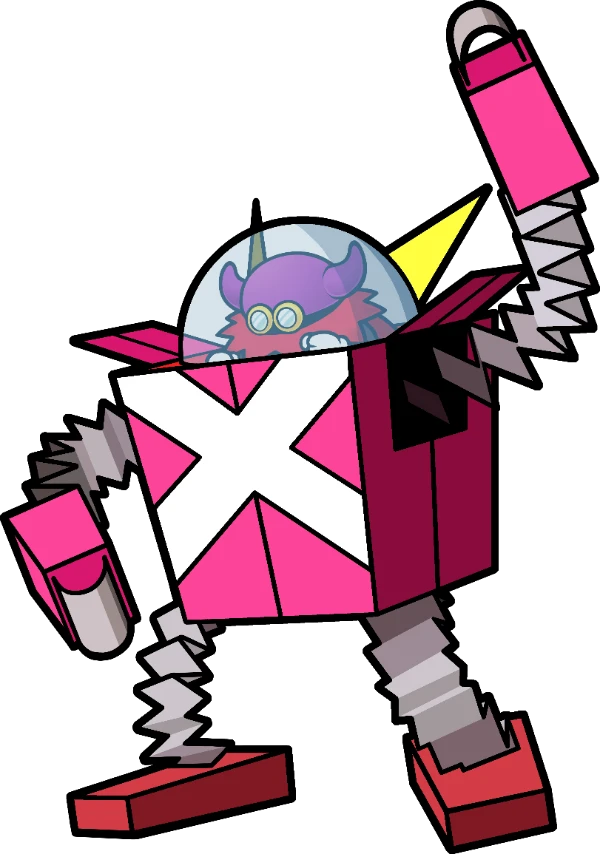
Locked out of the tree, Mario has to recruit the help of Madame Flurrie, a glamorous retired stage actress with the ability to blow gale-force winds — but first he must retrieve her treasured necklace, which the Shadow Sirens (Beldam, Marilyn and Vivian) have just stolen. Once Flurrie joins as the third party member, the assault on the Great Tree begins in earnest: rescuing 101 Punies, restoring the Puni Elder, navigating the tree’s elemental locks, and finally confronting Magnus von Grapple — a 30 HP X-Naut mech piloted by Lord Crump. The Emerald Star is recovered as the X-Nauts retreat.
Of Glitz and Glory
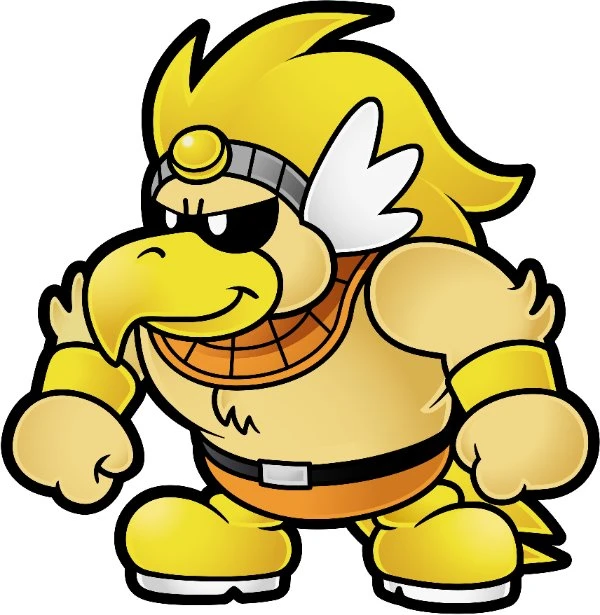
The third Star is mounted on the Champ’s Belt of Rawk Hawk, current champion of the Glitz Pit, a sports-entertainment fighting league housed on the floating city of Glitzville. To reach the floating city, Mario does a favour for crime boss Don Pianta, who provides a blimp ticket. Inside Glitzville, Mario signs up at the bottom of the rankings under the absurd stage name “The Great Gonzales” and fights his way up.
A hatching Yoshi egg becomes the fourth party member: Yoshi (the player picks his colour and name), with stat bonuses tied to his level-up timing. As Mario climbs the rankings he begins receiving anonymous threatening emails signed only “X”, which gradually expose a much darker story: the league’s promoter, the muscle-bound Grubba, has been using the Star to drain the life essence from his fighters, vanishing them off the rosters once they’re used up. Bowser shows up as a mini-boss fight; the Iron Adonis Twins serve as a major elimination round; Rawk Hawk is finally toppled. Then Grubba transforms into the chapter boss Macho Grubba (60 HP) and is defeated. The Gold Star joins the collection. The mysterious tipster “X” is revealed to be Jolene, the league administrator and sister of Grubba’s first victim.

For Pigs the Bell Tolls
The fourth Star points to Creepy Steeple, just outside the perpetually dusk-lit village of Twilight Town. Every time the bell at the steeple rings, one of the townspeople is transformed into a pig. The villagers blame whatever lives in the steeple. Mario climbs the bell tower to investigate and meets Doopliss, a sheet-ghost who fights using a bizarre stolen-identity technique — midway through the boss fight, he literally steals Mario’s name and body, replacing the player’s character with a faceless silhouette and walking off with Mario’s partners.
What follows is the most narratively daring stretch of any Mario game. The player wanders the world as a nameless shadow Mario, fighting to convince his own party members that the impostor is fake — and gaining a new ally in Vivian, the youngest Shadow Siren, who has been mistreated by her sisters and is moved enough by Mario’s plight to switch sides. To beat Doopliss, the player must learn his real name by piecing together clues from the steeple environment. The Ruby Star is the reward.

The Key to Pirates
The fifth Star is buried inside the wreck of a pirate ship on the island of Keelhaul Key. To get there, Mario charters a voyage with the wealthy merchant Flavio, recruits the retired sea captain Admiral Bobbery (a Bob-omb whose lost-at-sea backstory provides one of the game’s most touching subplots), and sets sail with a small crew. Lord Crump infiltrates the voyage in a transparent “Four-Eyes” disguise.
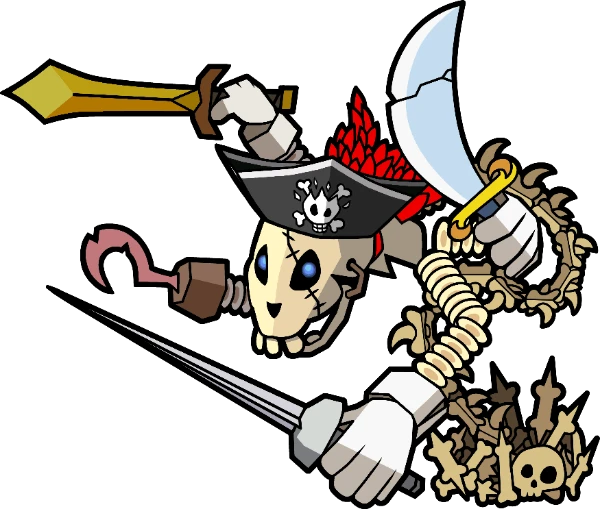
The ship is wrecked by burning Embers; Bobbery joins Mario’s party properly after a fake death sequence. The cave system of Pirate’s Grotto hides the ghostly pirate captain Cortez, a four-form skeletal swordsman whose battle requires Mario to whittle down each weapon in his arsenal in sequence. After defeat, Cortez willingly hands over the Sapphire Star. Crump drops his disguise and unleashes a horde of X-Nauts; the chapter ends with a dramatic ship-vs-ship sea battle.

3 Days of Excess
The sixth Star sits in Poshley Sanctum, a marble shrine in the wealthy resort town of Poshley Heights. The only route there is by the Excess Express, a luxury overnight train. After another Don Pianta favour, Mario boards.
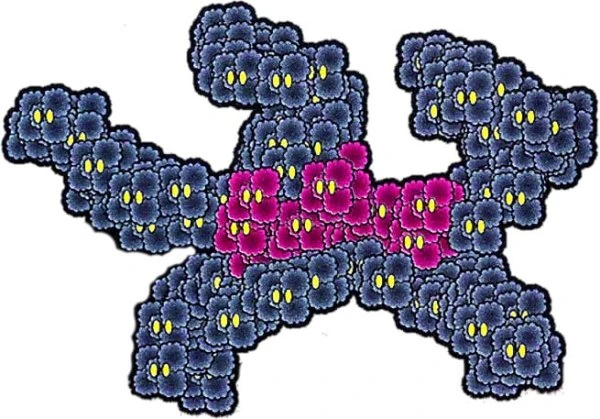
The three days of the journey become a chamber mystery: items go missing, threats are scrawled on bathroom walls, the train conductor is found bound and gagged, the drawbridge ahead of the train is sabotaged. The eccentric penguin detective Pennington takes the case, the fake passenger “Zip Toad” is exposed as Doopliss returning in disguise, and the train is eventually overrun by the Smorgs — a hive of green creatures who congregate into a single chapter boss. Once they’re destroyed, the train reaches Poshley Heights, and the player learns the Sanctum’s on-display Star is a decoy: the real Garnet Star is hidden in a back chamber.

Mario Shoots the Moon
The seventh Star isn’t even on Earth. Frankly’s research traces it to the X-Naut base on the Moon, accessible only via a giant cannon hidden in the snowbound mountain village of Fahr Outpost (a Bob-omb settlement). After convincing the eccentric Goldbob and the long-retired General White (who turns out to be napping under a quilt at home) to authorise the cannon’s firing, Mario is launched moonward.
The X-Naut Fortress is the densest, most puzzle-heavy dungeon in the game — a vertically-stacked alien research facility full of Yux defensive systems, transporter rooms, and minigame-driven password locks. Lord Crump fires up Magnus von Grapple 2.0 for a rematch, this time 70 HP and far meaner. Once Crump is defeated, the seventh and final Crystal Star is claimed. But the chapter ends on a hook: Bowser, who has been goofily chasing the same treasure for the whole game, finally figures out where the action is and heads straight for the Thousand-Year Door himself.

The Thousand-Year Door
The Magical Map is now complete. Beneath Rogueport, the seven Stars reveal the door’s seal, and Mario steps into the Palace of Shadow — the ruined throne hall of a long-dead civilisation that the X-Nauts have been trying to reach since the beginning.
Inside is a final dungeon stacked with everything the game has to throw: Gloomtail, Hooktail’s older and far meaner brother; a rematch with the entire Shadow Sirens trio (Beldam, Marilyn and a newly-arrived Doopliss filling in for the sister who defected to Mario); the X-Naut leader Sir Grodus himself, in a multi-form throne-room battle; and finally, the truth.
The treasure behind the Thousand-Year Door isn’t gold or fame — it’s the imprisoned Shadow Queen, a thousand-year-old demonic spirit who once ruled the world from this palace and was sealed beneath it by the same seven Crystal Stars that Mario has now stupidly assembled. Beldam has been working towards this moment since the prologue. Grodus tries to claim her power for himself; she destroys him in seconds. She possesses Peach’s body as a vessel and returns to the world. The final battle is fought against Peach’s shadow-corrupted form; mid-fight, the audience — every NPC the player has helped over the entire game, every random Glitz Pit fan, every Puni and Bob-omb sailor — sends Mario their power directly in one of the most genuinely moving moments in Mario history. The Shadow Queen falls. Peach is restored. Mario walks out of Rogueport into the credits.
Intermissions: Peach & Bowser
Between every chapter, gameplay shifts away from Mario for two short interactive sequences:
Princess Peach Intermissions
Peach is held captive in the X-Naut Fortress on the moon throughout the entire game. Her intermissions show her wandering the base after lights-out: hacking into the master computer TEC, who develops a strange Pinocchio-style attachment to her and starts feeding her intel; spying on Grodus’s plans; sneaking into restricted wings; and email-broadcasting her findings to Mario whenever she can. These scenes give the player real-time updates on the antagonist’s plot from inside the villain’s lair. They’re also where most of the game’s deepest worldbuilding lives.
Bowser Intermissions
Played for laughs as the perfect inverse. Bowser and Kammy Koopa lumber clumsily around the world, always one step behind Mario, raiding the same dungeons after they’ve been cleared, beating up minor enemies the player has long forgotten about, and getting it wrong every time. Each Bowser segment plays as a brief 2D side-scrolling minigame in the classic Super Mario style, with Bowser as the player character. They’re entirely optional to the plot but among the most beloved segments in the game.
Gameplay

From overworld perspective, Paper Mario plays as a 3D world rendered with 2D paper-cutout characters that fold, flip, slide and crumple on cue. Mario explores cities, dungeons and overworld areas freely, jumping on platforms, smashing crates with his hammer, talking to NPCs and engaging with enemies he encounters in the field. There’s no random combat — foes are visible on the map, and touching one triggers a transition into the turn-based battle screen.
Core Loop
- Explore each chapter’s overworld area, solving puzzles, talking to townspeople, accepting Trouble Center quests, and collecting Star Pieces, badges, recipes and items
- Fight enemies on the way using the theatrical turn-based combat system. Win to earn coins, Star Points (XP), badges, and audience members
- Level up by accumulating 100 Star Points. At each level the player chooses to increase HP, FP (Flower Points, used for special moves), or BP (Badge Points, used to equip badges)
- Spend rewards at shops, the Pianta Parlor casino, Lovely Howz of Badges, the Trouble Center, and Zess T.’s kitchen for cooked-item upgrades
- Progress the main story by claiming each chapter’s Crystal Star, returning to Rogueport between chapters to consult Professor Frankly about the next destination
Controls
The GameCube controller maps cleanly onto Mario’s actions: A for jump and primary action, B for hammer, X to flip back to standby form, Y to switch the active party member, Z to bring up the menu, R for partner action, L for the help system. In battle, Action Commands typically use A (or a quick stick-twirl) timed to a specific cue.
Battle System
The battle system is the single most distinctive part of TTYD. It runs on the foundation of the N64 Paper Mario’s combat but adds three transformative additions: the theatrical stage staging, the Audience system, and the Stylish move bonus chain. Combat is turn-based, with Mario and one partner facing off against one to five enemies arranged on a wooden stage.
Turn Structure
On Mario’s turn, the player chooses an attack (Jump, Hammer, special move, item, badge-granted move) and executes the corresponding Action Command. The party then takes the partner’s turn the same way. Enemies act in sequence, with the player choosing whether to Guard or Superguard for each incoming hit. Combat continues until one side is wiped.
The Stage Itself
Battles take place on a literal proscenium stage with painted backdrops, fly-rigged scenery, and an in-game audience watching from below. The stage isn’t cosmetic — it’s mechanically reactive. Stage props can fall on combatants mid-battle, fog can roll in to obscure vision, lightning can strike, and falling water can extinguish burning enemies. These stage hazards trigger randomly and can affect either side.
Star Power and Special Moves
Each Crystal Star Mario collects grants him a new Special Move with a unique cost in Star Power (SP). Star Power is shown as a small star icon meter that fills as Mario fights well, earns audience cheers, and uses the Appeal command. SP refills slowly during battle but can also be banked between fights up to a chapter-specific cap. See the Crystal Stars section for the full move list.
Star Points and Levelling
Each enemy defeated awards Star Points (the game’s XP). Accumulating 100 Star Points levels Mario up by one and forces a stat choice: increase Max HP by 5, increase Max FP by 5, or increase BP by 3. Strategic choice matters: a high-HP build trivialises tank fights but starves the player of badge slots; a high-BP build enables wild stacked-badge gimmicks; high-FP builds let the player spam special moves. The game caps at level 99 with theoretical maxes of 200/200/99 HP/FP/BP.
Action Commands
The defining mechanical innovation that makes TTYD’s combat feel active rather than passive. Every attack and defence is gated behind a real-time button input that, when timed correctly, dramatically increases the move’s effectiveness.
Offensive Action Commands
- Jump — press A precisely as Mario lands on the enemy’s head. Successful timing means full damage and a second jump for a double-hit
- Hammer — hold A until the star indicator on the hammer head glows red, then release. Late releases miss; perfect releases deal max damage
- Partner attacks — each partner has unique Action Command requirements (stick spins, multi-tap, single button press)
- Special Moves — vary by Crystal Star. Some require button mashing, some directional stick inputs, some rhythmic A-presses synced to audio cues
Defensive Commands — Guard vs Superguard
When an enemy attacks, the player has a small timing window to press a defensive button. There are two tiers:
- Guard — press A right before the hit lands. Reduces incoming damage by 1 HP. Easy to execute reliably
- Superguard — press B in a much tighter window. Reduces incoming damage to ZERO and also damages the attacker for 1 HP from their own attack. The tightest, most rewarding mechanic in the game; mastery of the Superguard is the single biggest difficulty gap between casual and expert players
Stylish Moves
Mid-attack animation, certain hits trigger a brief on-screen prompt for an additional “Stylish” input. Executing it doesn’t add damage, but it earns extra Star Power and audience members — the player’s incentive to keep playing artfully rather than mashing.
The Audience System
The Audience is the secret sauce of TTYD’s battle design. It’s not just decoration — it’s a literal mechanical system that powers Mario’s special moves.
How the Audience Works
- Each battle begins with a starting audience of mixed Toads, Koopas, Bob-ombs, Yoshis, Boos and other Mario-universe spectators. The size depends on Mario’s current Star Rank (Rising Star, B-list, A-list, or Superstar)
- Successful Action Commands and Stylish moves cheer the audience: bigger crowd = more Star Power generated
- Use the Appeal command on Mario’s turn to milk applause directly, gaining bonus SP at the cost of a turn
- Some audience members are hostile: certain enemy types in the audience will pelt Mario with garbage, throw rocks, or temporarily incapacitate him. The player can hammer the audience to neutralise threats
- Audience members can leave mid-fight if Mario performs badly. Bad failures lower attendance, and overstaying a fight thins the crowd
- Some bosses interact with the audience directly: Hooktail and the Shadow Queen eat audience members to heal; Magnus von Grapple 2.0 uses the audience as projectiles, firing spectators at Mario
Star Rank
Mario’s Star Rank determines maximum audience size and unlocks at level thresholds: Rising Star (levels 1-9), B-list Star (10-19), A-list Star (20-29), and Superstar (30-99). Higher rank = bigger crowd = more Star Power.
Bingo!
Occasionally during high-energy fights, three Bingo slot-machine reels appear above the audience. Successful Action Commands spin the reels; matching three same icons triggers a bonus effect — full HP/FP heal, doubled damage for one turn, status cures, or in the rare jackpot, an instant battle win.
Mario’s Stats & Equipment
The Five Tracked Numbers
- HP (Heart Points) — Mario’s health. Starts at 10, capped at 200 with maxed level-ups and HP Plus badges
- FP (Flower Points) — reserve used to cast special moves and badge moves. Starts at 5, capped at 200
- BP (Badge Points) — equipment capacity for badges. Starts at 3, capped at 99
- Star Power — the Crystal Star meter. Starts at 0, capped at 8 (one per Star collected)
- Level — abstract progress tracker, 1 to 99. Each level grants a choice of +5 HP, +5 FP, or +3 BP
Boots and Hammer Tiers
Mario’s two physical attack tools both have three upgrade tiers, found during specific chapters:
| Tier | Boots Damage | Hammer Damage | Notes |
|---|---|---|---|
| Standard | 1 per hit | 1 per hit | Mario’s starting equipment |
| Super | 2 per hit | 2 per hit | Found in Chapter 1 (boots) and Chapter 2 (hammer). Unlocks Spin Jump / Hammer Throw |
| Ultra | 3 per hit | 3 per hit | Found in Chapter 4 (boots) and Chapter 6 (hammer). Unlocks Tube Jump / Super Hammer Throw |
Status Effects
Combat throws a wide variety of status effects at both sides. Most resolve at battle’s end automatically.
| Status | Effect | Duration |
|---|---|---|
| Allergic | Immune to all status effects, positive and negative | Variable |
| Burn | Loses 1 HP per turn. Cleared by Frozen or falling water stage effect | 2-3 turns |
| Frozen | Cannot act. Cleared by Burn | 1-3 turns |
| Poison | Loses 1 HP per turn during action | 2-5 turns |
| Sleep | Cannot act. Wakes on damage | Variable |
| Dizzy | 50% chance to miss next action | 2-3 turns |
| Confuse | Random target including own party | 2-3 turns |
| Soft | Defence reduced to 0 | 3-5 turns |
| Tiny | Attack reduced | 3-5 turns |
| Slow | Acts every other turn only | 3 turns |
| Stop | Cannot act at all | 1-3 turns |
| Charge | Next attack does massively boosted damage | Until used |
| Power Up | Attack increased | 3-5 turns |
| Defense Up | Defence increased | 3-5 turns |
| Electrified | Direct-contact attackers take 1 HP damage | 3-5 turns |
| Dodgy | 50% chance to dodge incoming attacks | 3 turns |
| Invisible | Untargetable for non-AoE attacks | 2-3 turns |
| HP Regen | Recover HP each turn | 3-5 turns |
| FP Regen | Recover FP each turn | 3-5 turns |
| Immobilized | Cannot move (worse than Stop). Persists between fights | Permanent until cured |
Paper Abilities
The game’s paper-craft conceit isn’t purely cosmetic. Mario gradually learns a series of Paper Abilities that let him exploit the medium itself — folding, flattening, and shape-shifting into paper forms to navigate the world.
| Ability | Where Acquired | What It Does |
|---|---|---|
| Paper Mode (Plane) | Chapter 1 (Petalburg-area Black Chest) | Mario folds into a paper airplane and glides across gaps |
| Paper Tube | Chapter 2 (Boggly Woods Black Chest) | Mario rolls up into a tube and rolls through narrow passages |
| Paper Boat | Chapter 3 (Glitzville Black Chest) | Mario folds into a paper boat to cross water |
| Paper Plane (variant) | Chapter 5 (Pirate’s Grotto Black Chest) | Glide across larger gaps with directional control |
| Spin Jump | Chapter 4 (after upgrading boots) | Stomp into the ground hard enough to reveal hidden chambers and Star Pieces |
| Slip Through | Black Chest (Twilight Trail) | Mario turns sideways and walks through narrow vertical slits |
The seven Black Chests — each cursed to swap Mario into a paper form — are scattered across the chapters. Opening one binds Mario with a curse spirit who refuses to remove it; the curse is the ability.
The Seven Partners
Mario travels with seven recruitable companions, joined in fixed order across the chapters. Each is a fully voiced character with backstory, family ties, and a chapter-spanning emotional arc. Partners level up via Shine Sprites (3 per upgrade), advancing from Normal to Super to Ultra rank and learning two additional moves along the way.
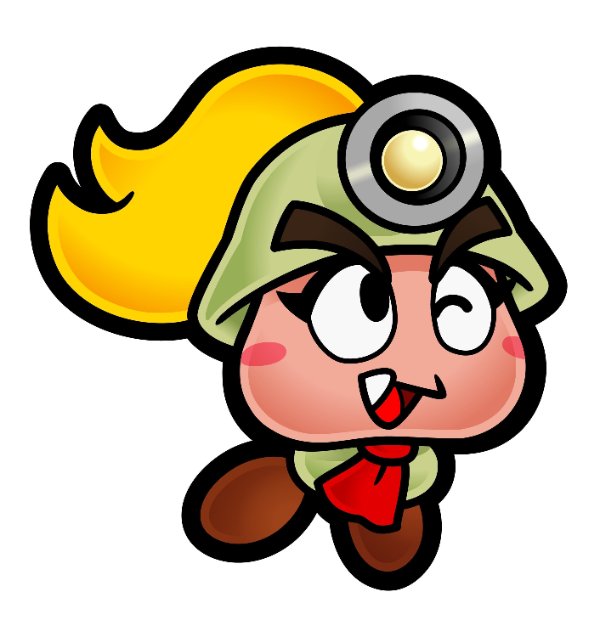
Goombella
Joins in the Prologue — Rogueport
A spirited Goomba archaeology student from the University of Goom, on field work for Professor Frankly when Lord Crump tries to abduct her in the Prologue. Mario’s first and most narratively foundational partner. Her Tattle move is the single most useful ability in the game — it reveals every enemy’s HP, weaknesses, and combat behaviour, and is also the gameplay framework for the entire Tattle Log bestiary.

Koops
Joins in Chapter 1 — Petalburg
A shy young Koopa Troopa from Petalburg, devastated by his father Koopley’s presumed death years ago at the claws of Hooktail. Has spent his life wanting to grow strong enough to avenge him. Joins the party precisely because the quest is heading for the dragon. His arc culminates in the chapter’s emotional reveal when Koopley turns out to have been alive in Hooktail’s stomach all along.
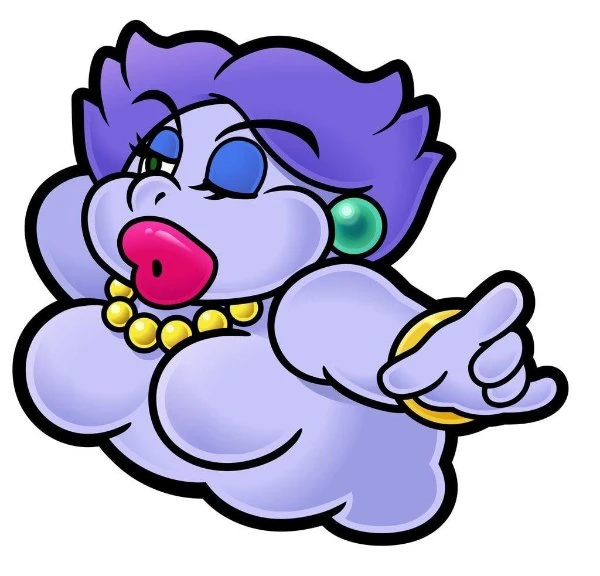
Madame Flurrie
Joins in Chapter 2 — Boggly Woods
A retired stage actress and Wisp creature living in seclusion in Boggly Woods. Grand, theatrical, vain in the most lovable possible way. Joins after Mario retrieves her stolen necklace from the Shadow Sirens. Her wind-based abilities solve overworld puzzles by revealing hidden panels and blowing enemies into vulnerable positions. Provides much of the game’s humour through her dramatic personality.
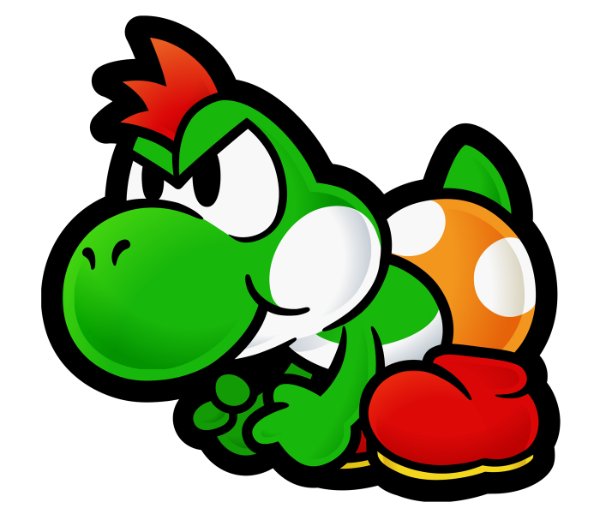
Yoshi Kid
Joins in Chapter 3 — Glitzville
A newborn Yoshi who hatches from an egg Mario receives mid-Chapter 3. Player chooses his colour and name. Talks like a tough-talking street kid — the absolute opposite of his cute appearance. Provides the fastest ground attacks in the party and the iconic Stampede move. Notable for the entirely player-chosen aesthetic flavour.

Vivian
Joins in Chapter 4 — Twilight Town
The youngest of the three Shadow Sirens and the game’s defining redemption arc. Treated like dirt by her older sister Beldam, who blames her for every failure and forces her into menial searches. Switches sides after Mario shows her kindness during the Doopliss body-swap sequence. Wields fire magic. Her loyalty to Mario by the end is genuinely affecting; she’s the most beloved partner among long-time fans.

Admiral Bobbery
Joins in Chapter 5 — Rogueport docks
A retired Bob-omb sea captain, hardened by the loss of his wife Scarlette at sea years ago. Refuses to sail again until the player completes a long subquest culminating in Scarlette’s final letter to him. Gruff exterior, deeply sentimental core. Has the highest single-hit damage potential in the party via his self-detonating Bomb attack.

Ms. Mowz
Optional, after Trouble Center quest
A Squeek (mouse-like creature) thief who runs the Lovely Howz of Badges in Rogueport. Joins the party as an optional party member after Mario completes her anonymous Trouble Center request. Her unique ability is stealing badges directly off enemies mid-battle — a hugely useful tool for badge-completionists, and the only way to obtain certain rare badges. Flirtatious, mischievous, completely steals every scene she’s in.
The Seven Crystal Stars
The seven Crystal Stars are the game’s central collectibles. Each ends a chapter, fills another tick of the Star Power meter, and grants Mario a new Special Move. The Magical Map itself counts as an eighth Star — the one Peach was tricked into sending Mario at the start — and it grants the Sweet Treat healing move from the prologue.
| Star | Chapter | Guarded By | Move Granted | SP Cost |
|---|---|---|---|---|
| Magical Map | Prologue | Mysterious merchant | Sweet Treat — heals up to 7 HP for both party members + 8 FP, cures most status ailments | 1 SP |
| Diamond Star | Ch.1 | Hooktail | Earth Tremor — party-wide quake damage ignoring Defence; scales by Action Command perfection (up to 6 HP to all foes at perfect) | 2 SP |
| Emerald Star | Ch.2 | Magnus von Grapple | Clock Out — inflicts Stop on all enemies, freezing their actions | 2 SP |
| Gold Star | Ch.3 | Macho Grubba | Power Lift — boosts Mario’s and partner’s Attack and Defence based on Action Command success | 2 SP |
| Ruby Star | Ch.4 | Doopliss | Art Attack — draw circles around enemies on screen with the stick; damage scales with how cleanly drawn the loops are. A skill-test Special | 3 SP |
| Sapphire Star | Ch.5 | Cortez | Sweet Feast — upgraded Sweet Treat. Heals up to 12 HP for the party + 12 FP, cures most ailments | 3 SP |
| Garnet Star | Ch.6 | The Smorgs | Showstopper — chance to instantly defeat all on-screen enemies. Rhythmic A-press input | 3 SP |
| Crystal Star | Ch.7 | Lord Crump / Magnus 2.0 | Supernova — high-damage party-wide explosion. Costs all 8 SP. The most damaging Special in the game | 8 SP |
Items & Recipes
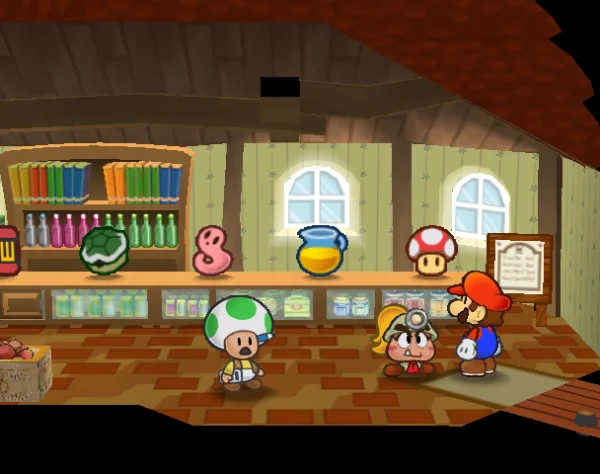
Item management is core to longer fights. Mario can hold up to 10 items by default (expandable to 20 with badges) and party members each have their own item slots in the menu.
Item Categories
- Healing items — Mushrooms, Super Mushrooms, Ultra Mushrooms (HP); Honey Syrup, Maple Syrup, Jammin’ Jelly (FP); Life Mushrooms (auto-revive when KO’d)
- Status cures — Tasty Tonic, Mystery (random effect); various potion variants for specific ailments
- Offensive items — Fire Flower, POW Block, Mr. Softener, Earth Quake, Volt Shroom, Shooting Star, Thunder Bolt — one-use battle items dealing damage or inflicting status
- Rare items — collectables sold or found uniquely: Cake Mix, Inn Coupon, Whacka Bump (legendary HP item that an NPC named Whacka grows on his head; harvesting all 8 makes him sad)
- Important Things — key items for puzzles and quests. Cannot be discarded. Stored separately from regular item inventory
Zess T.’s Kitchen
The Rogueport chef Zess T. cooks combination meals from raw ingredients. Bring her any item, and she’ll prepare it; bring her two items at once, and she may produce a special combination recipe. The game has 59 official recipes, ranging from straightforward (Mushroom + Honey Syrup = Honey Shroom) to deeply obscure (Slow Shroom + Dried Bouquet = Mistake). A complete recipe book is one of the longer side-collectible chases.
Important Things (Key Items)
Story-locked plot items: Magical Map (always carried), Pieces of Heart (overworld puzzles), Storage Key (Glitz Pit locker), Sun and Moon Stones (Twilight Steeple), Skull Gem (Pirate Captain Cortez’s eye), Champ’s Belt (Glitz Pit rank trophy), Ultra Stone (Merlon’s upgrade catalyst), Cake (Toadette’s present to Toadsworth), and a few dozen more.
Item Shops
Each chapter’s hub area has a dedicated shop. Rogueport’s general store sells the basics; Petalburg, Boggly Woods, Glitzville, Twilight Town, Keelhaul Key, and the Excess Express dining car all have specialised shops with chapter-specific stock. Charlieton roams Rogueport Plaza with a rotating supply of rare badges and items. Some of his items are absurdly priced (10,000+ coins) but exclusive.
Badges
Badges are the single deepest character-building system in the Mario RPG canon. Over 80 unique badges are scattered through the game in red ? Blocks, sold at shops, traded for Star Pieces with the wizard Dazzle, won at the Pianta Parlor, found on enemies (stealable by Ms. Mowz), or hidden behind sidequests.


Each badge costs Badge Points (BP) to equip. Mario starts with 3 BP and can boost it to 99 by spending level-ups on BP. The strategic puzzle is fitting the most synergistic loadout into a limited BP pool.
Major Badge Categories
- Stat boosters — HP Plus (+5 HP each, stackable), FP Plus (+5 FP), Power Plus (+1 Attack), Defend Plus (+1 Defence), Speedy Spin (longer Spin Jump charge)
- Move-granters — Power Smash, Mega Smash, Power Bounce, Multibounce, Hammer Throw, Super Smash, Spike Shield, Ice Smash, Fire Drive. Each adds a new move to the Jump or Hammer category in battle
- Conditional buffs — Last Stand (halves damage at low HP), Pity Flower (10% chance to gain 1 FP after a hit), Damage Dodge (perfectly timed Guard saves an extra HP)
- Coin/drop boosters — Money Money (more coins from foes), Item Hog (more items dropped), Flower Saver (special moves cost 1 less FP)
- Joke/extreme badges — Mega Rush (massive Attack boost in red-HP; perfect with Last Stand), Power Rush (smaller Attack boost in danger HP), All or Nothing (perfect Action Command = doubled damage; failed = miss), Pretty Lucky (% chance to dodge), Peekaboo (see enemy HP in battle without Tattle), and the iconic Spike Shield (eliminates stomp counter-damage from spiky foes)
- L Emblem & W Emblem — cosmetic badges that change Mario’s sprite to Luigi’s palette and Wario’s palette respectively. No gameplay effect. Fan-favourite collectibles
Build-defining badges (Power Bounce, Power Smash + Charge, P-Up D-Down combinations, etc.) can transform Mario from a balanced fighter into a hyper-specialised glass cannon, an unkillable defensive tank, or a stat-stacker boss-melter. Endgame Pit of 100 Trials builds typically involve very specific badge combos.
Bestiary (Tattle Log)
The Tattle Log (filled in via Goombella’s Tattle move) catalogues every enemy in the game. Below is a representative selection of the bestiary; the full list runs to 112 distinct entries across chapters.
| Enemy | HP | Atk | Def | Found In | Notes |
|---|---|---|---|---|---|
| Goomba | 2 | 1 | 0 | Rogueport Sewers, Petal Meadows, Glitz Pit, Riverside | The classic. Stomp-vulnerable |
| Paragoomba | 2 | 1 | 0 | Petal Meadows, Hooktail Castle | Flying. Knock to ground first |
| Spiky Goomba | 2 | 2 | 0 | Petal Meadows, Glitz Pit | Cannot be stomped without Spike Shield |
| Spinia | 3 | 1 | 0 | Rogueport Sewers, Glitz Pit, Pit of 100 Trials | Spinning top-shaped foe |
| Koopa Troopa | 4 | 2 | 1 | Petal Meadows, Hooktail Castle | Standard. Flip to expose |
| Bald Cleft | 2 | 1 | 2 | Petal Meadows | Stone-headed. Hammer only |
| Bristle | 2 | 1 | 4 | Petal Meadows, Glitz Pit | Heavily-armoured cleft variant |
| Cleft | 2 | 2 | 2 | Petal Meadows, Boggly Woods, Pit | Mid-tier cleft |
| Fuzzy | 3 | 1 | 0 | Shhwonk Fortress, Glitz Pit, Pit | HP-drain on contact |
| Paratroopa | 4 | 2 | 1 | Hooktail Castle, Rogueport Sewers | Flying Koopa |
| Dull Bones | 1 | 2 | 1 | Hooktail Castle, Glitz Pit, Palace | Dry Bones variant. Reanimates if not finished off |
| Spania | 3 | 1 | 0 | Rogueport Sewers, Glitz Pit, Pit | Spiny spinia variant |
| Pale Piranha | 4 | 2 | 0 | Boggly Woods, Great Tree, Glitz Pit | Sickly-coloured Piranha Plant |
| Dark Puff | 3 | 2 | 0 | Boggly Woods, Glitz Pit, Pit | Lightning attack |
| X-Naut | 4 | 3 | 0 | Great Tree, X-Naut Fortress | Foot soldier of the antagonists |
| Yux | 3 | 2 | 0 | Great Tree, X-Naut Fortress | Generates Mini-Yux defensive drones |
| Mini-Yux | 1 | 0 | 0 | Generated by Yux | Shield drone |
| Pider | 5 | 2 | 0 | Great Tree, Glitz Pit, Pit | Web-spitting arachnid |
| Boo | 7 | 3 | 0 | Creepy Steeple | Ghosts. Invisibility attacks |
| Atomic Boo (optional boss) | 40 | 4 | 0 | Creepy Steeple | Massive Boo cluster |
| Embers | 8 | 3 | 0 | Keelhaul Key | Flame elementals |
| Phantom Embers | 10 | 4 | 0 | Pirate’s Grotto | Tougher Ember |
| Bulky Bob-omb | 5 | 4 | 0 | Pirate’s Grotto, Glitz Pit | Self-detonating explosive |
| Wizzerd | 9 | 4 | 2 | Palace of Shadow, Pit | Endgame caster |
| Chain-Chomp | 7 | 4 | 5 | Twilight Trail | High Defence, charge attack |
| Dry Bones | 8 | 5 | 2 | Palace of Shadow, Pit | Endgame skeleton. Auto-reanimates |
| Bombshell Bill | 3 | 4 | 1 | X-Naut Fortress | High-damage Bullet Bill variant |
For Pit of 100 Trials regulars, expect Amazy Dayzee (single-hit 20 damage flat, 0 Defence), Dark Wizzerd, Poison Pokey, Bob-ulk, Frost Piranha, Putrid Piranha, Phantom Bowyer, and the climactic Bonetail at the bottom.
Chapter Bosses
The eight chapter bosses plus the Pit of 100 Trials finale form some of the most memorable boss design in Mario RPG history. Below is each chapter’s major boss with their backstory and stats.

Hooktail
Chapter 1 — Hooktail Castle
A red dragon who has been eating villagers from Petalburg for years, including Koops’s father Koopley. Lives in a ruined castle perched in Petal Meadows. Has a particular weakness to a specific Badge the player will have collected through ordinary exploration — learning to deploy it mid-fight is the chapter’s skill test. After defeat she begs for her life and reveals Koopley is alive in her stomach, leading to one of the game’s genuine emotional payoffs.
Magnus von Grapple
Chapter 2 — The Great Tree
An X-Naut combat mech piloted by Lord Crump. The first of two giant robots in the game (Magnus 2.0 returns in Chapter 7). All-metal armoured rolling assault frame with rocket-fist attacks. The chapter’s major obstacle to recovering the captured Punies and the Emerald Star.
Rawk Hawk
Chapter 3 — Glitz Pit
The reigning champion of the Glitz Pit, holder of the Champ’s Belt (which carries the chapter’s Crystal Star). A muscle-bound bird-wrestler in red wrestling tights. Bombastic, narcissistic, and surprisingly tough — he’s the immediate boss before the true villain reveal. Defeating him gets Mario the belt; but the Star turns out to be fake.

Doopliss
Chapter 4 — Creepy Steeple (fought again Ch.6 & Ch.8)
A shape-shifting sheet-ghost who steals victims’ names and bodies, taking their place. Behind the Twilight Town pig-transformation curse. Mid-boss-fight, he steals MARIO’S name and body, ejecting the player into a nameless shadow form — the most narratively daring boss mechanic in any Mario game. Reappears as a disguised passenger on the Excess Express in Chapter 6 and again in the Palace of Shadow with the Shadow Sirens in Chapter 8.
Cortez
Chapter 5 — Pirate’s Grotto
A skeletal pirate captain who has been dead for centuries but refuses to leave his treasure. Fights in four sequential phases, each tied to a different weapon (cutlass, hook, lance, twin scimitars). Defeating each form depletes one weapon; only at zero weapons does the fight end. After defeat, willingly gives Mario the Sapphire Star — he has been the guardian of it, not its thief.
The Smorgs
Chapter 6 — Excess Express
A hive-mind of small green creatures who have infiltrated the Excess Express and intend to consume everyone aboard. Encountered as the train approaches Poshley Heights. The boss fight stages aboard the moving train, with the Smorgs splitting into multiple targets that must be cleared simultaneously.
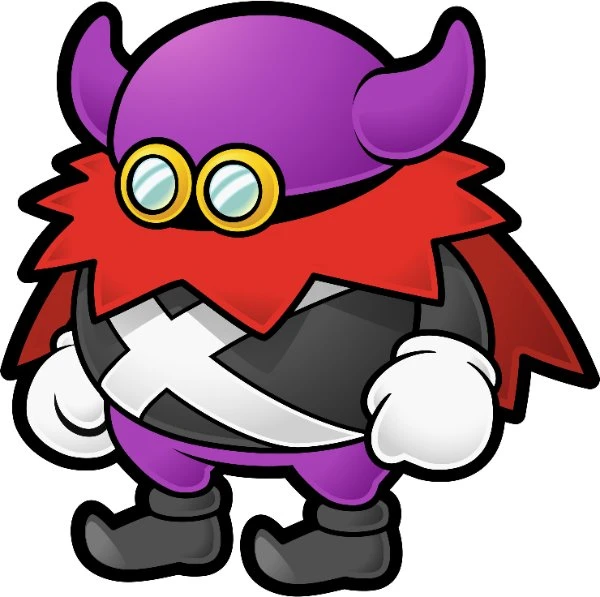
Lord Crump / Magnus 2.0
Chapter 7 — X-Naut Fortress
The X-Naut commander Lord Crump returns piloting an upgraded version of his Chapter 2 mech: Magnus von Grapple 2.0. Far meaner than the original. New attacks: launches audience members at Mario as projectiles, deployable shield, multi-target rocket fists. The hardest mid-game boss in the game and one of TTYD’s most memorable fights.
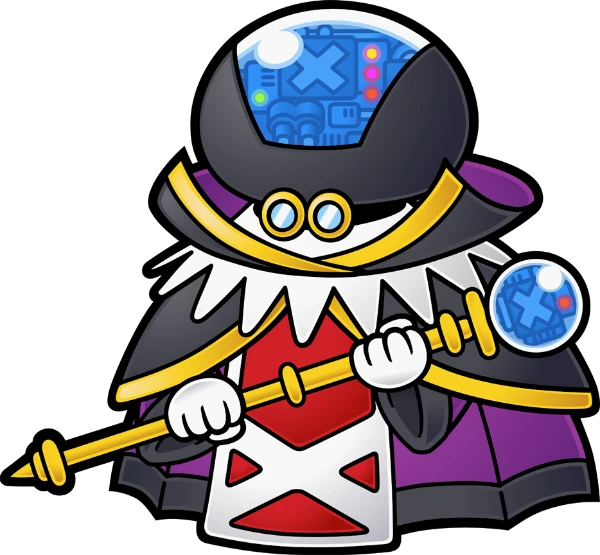
Sir Grodus
Chapter 8 — Palace of Shadow
The supreme leader of the X-Nauts. A cybernetic alien scientist with a metallic head, glowing red eye-visor, and a magic staff. Has been the puppet-master since the prologue. Multi-form throne-room battle: spawns Grodus X drones, casts magic projectiles, teleports around the arena. After defeat he reveals he’s been holding Peach hostage but is then destroyed by the Shadow Queen who he naively thought he could control.
The Shadow Queen
Chapter 8 final boss — Palace of Shadow
The true antagonist. A thousand-year-old demonic spirit who once ruled the world from the Palace of Shadow and was sealed beneath Rogueport by the seven Crystal Stars. Beldam has been working to free her since the prologue. She possesses Princess Peach’s body as her vessel and emerges as the final boss. Multi-phase fight with massive HP — nearly impossible without the audience’s direct support in the final phase, where every NPC Mario has helped sends their power to him. The most genuinely epic confrontation in Mario history.
Major Villains
The antagonists of TTYD form one of the deepest villain rosters of any Mario RPG. Below: the major faces of evil arrayed against Mario across the eight chapters.



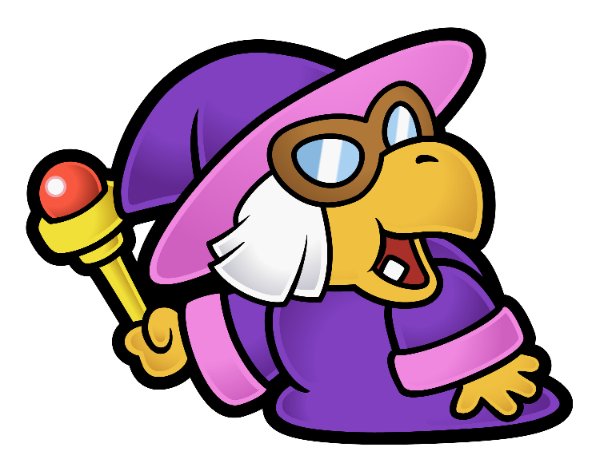
Sir Grodus
The supreme leader of the X-Nauts. Cybernetic alien overlord with a chrome dome, glowing red eye-slit, and floating magic staff. Has spent the entire game manipulating events from the moon base, sending Crump to harass Mario, and intending to use the Crystal Stars to unleash the Shadow Queen and assume her power for himself. Discovers, too late, that the Queen is not a tool to be controlled.
Lord Crump
Grodus’s buffoonish but persistent field commander. Wears X-Naut goggles and a metallic chestplate that doubles as armour. Encountered in every chapter except the Excess Express. Pilots both Magnus von Grapple mechs. His three encounters — the Prologue brawl in Rogueport, the Chapter 2 mech fight, and the Chapter 7 mech rematch — track his escalating frustration with being unable to beat Mario at anything.
The Shadow Sirens
Three sister witches who have been working towards the Shadow Queen’s release for centuries. Genuinely the most layered antagonist trio in the game:
- Beldam — the eldest. Cold, scheming, mastermind of the long-game plot. Treats her sisters as tools, especially Vivian, on whom she pins every failure
- Marilyn — the middle sister. Can only say variations of “Guh!” Despite her limited vocabulary, she’s the heavy hitter in combat and unquestionably loyal to Beldam
- Vivian — the youngest. Initially the antagonist; defects to Mario’s party in Chapter 4 after his kindness during the Doopliss segment exposes how badly her sisters have been mistreating her. The party’s most beloved member
Beldam and Marilyn are fought multiple times: as bosses in Chapter 2, as a recurring threat throughout, and as the Shadow Sirens (with Doopliss as the replacement third) in the Palace of Shadow finale.
Bowser & Kammy Koopa
The parallel-quest comic relief. Bowser has heard a rumour about a great treasure hidden somewhere and decides he wants it, completely failing to grasp the actual stakes. Kammy Koopa, his ancient witch advisor, tries to keep him on track. The pair show up only in the playable Bowser intermissions and as a brief boss fight in Chapter 3. Their goofy parallel adventure is one of the game’s great comic engines.
The Shadow Queen
The true final antagonist, but unseen for most of the game. A thousand-year-old demonic spirit who ruled the world from the Palace of Shadow until being sealed beneath Rogueport by seven Crystal Stars. Her resurrection is the entire purpose of the X-Naut plot. Once freed, she possesses Princess Peach’s body and emerges in physical form. Defeating her requires the audience — every NPC Mario has ever helped — to lend their collective power directly. The game’s emotional climax.
World & Notable NPCs

The TTYD world is unusually densely populated for a Mario game. Every chapter introduces a full cast of named, characterised NPCs — locals with backstories, professions and gossip about each other. The total cast runs to several hundred named characters.
Major NPCs
- Professor Frankly — Goombella’s archaeology professor at the University of Goom. Operates the Rogueport home base where the player consults him between chapters to decipher each new map location. Wears thick spectacles and a tweed jacket. The closest thing the game has to a mission control character
- Toadsworth — Peach’s loyal retainer, also stranded in Rogueport when Peach disappears. Provides early-game guidance and emotional context for the search
- Merlon — the local fortune-teller who upgrades party members in exchange for Shine Sprites. Lives in Rogueport. Voice of mystical wisdom
- Merlee — Merlon’s mysterious counterpart in the Rogueport Sewers. Casts random luck-spells on Mario for coin
- Merluvlee — fortune-teller in the east sewers; reveals locations of Star Pieces, badges, and Shine Sprites for tip money
- Don Pianta — the mob boss who controls Rogueport’s east side. Provides essential travel tickets to Glitzville and the Excess Express in exchange for favours. Pianta crime-family politics drive several side quests
- Zess T. — Rogueport’s only chef. Cooks any item Mario brings her; combination recipes are her specialty. Frequently insults Mario but reliably delivers
- Charlieton — travelling merchant who appears in Rogueport Plaza with rotating rare items and badges. The most reliable source of late-game power purchases
- Dazzle — the badge-trader in the sewers. Exchanges Star Pieces for unique badges
- Ms. Mowz — runs the Lovely Howz of Badges. Also recruitable as a party member through the Trouble Center
Chapter-Specific NPCs
- Koopley — Koops’s father, presumed eaten by Hooktail. Survives in her stomach. Returns to Petalburg at the end of Chapter 1
- Koopie Koo — Koops’s girlfriend, anxiously waiting in Petalburg
- Punio & the Puni Elder — Chapter 2 quest-givers. The Punies are a tribe of 101 tiny beings inside the Great Tree
- Jolene — Glitz Pit administrator, secretly the mysterious “X”. Her sister Prince Mush was Grubba’s first victim
- Grubba — the Glitz Pit promoter and chapter villain. Sliver-tongued muscle bro with a dark secret
- Eve, Mayor Dour, and the Twilight Town villagers — victims of the pig-transformation curse
- Doopliss’s parrot — a single witness who can be bullied into helping Mario discover Doopliss’s name
- Flavio — the eccentric wealthy merchant who owns the boat to Keelhaul Key. Has a coat made of the same fabric his great-great-grandfather wore
- Pa-Patch — pirate Bob-omb, descendant of Cortez’s old crew
- Pennington — eccentric penguin detective on the Excess Express
- Toadette — Toad guide who appears periodically to remind the player of controls and goals
- Goldbob & General White — the eccentric officials whose authorisation is needed to fire the moon cannon at Fahr Outpost
- TEC — the X-Naut master computer in the moon fortress, who develops a touching crush on the captive Princess Peach
Side Activities
Roughly half the content in TTYD lives outside the main story path. The completionist track is one of the deepest in any Mario game.
Star Pieces
100 Star Pieces are scattered across the overworld, hidden in flooring tiles (revealed by Spin Jump), in NPC-gifted bundles, in inaccessible chests, and behind side puzzles. Trade them with Dazzle for unique badges. Merluvlee will reveal their general locations for a fee. Collecting all 100 is one of the most demanding chase quests in the game.
Trouble Center
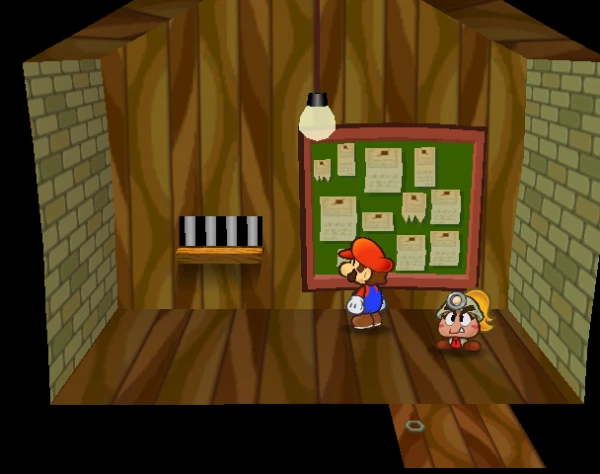
An east-Rogueport notice board where citizens post requests for Mario’s help. Over 30 quests across the game; each rewards coins, items, badges, or Star Pieces. Quests range from delivery missions and item retrievals to elaborate multi-NPC mysteries. Ms. Mowz’s anonymous quest unlocks her as a party member.
Pianta Parlor
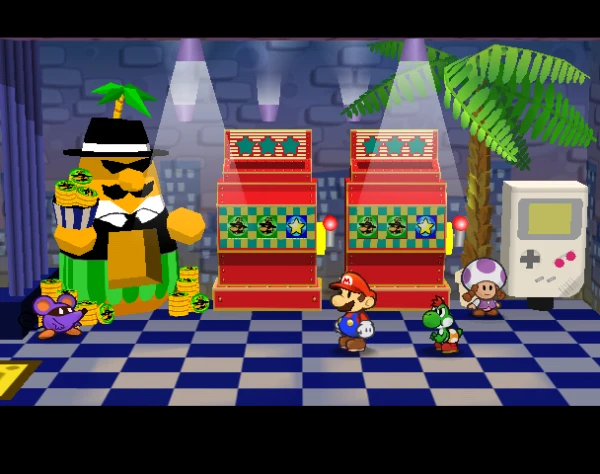
The Rogueport casino. Exchange coins for Piantas (the in-house currency), then play Tube Slide, Plane Game, and Slots for badge prizes. The minigames range from skill-based to pure luck. The cumulative reward pool includes some of the rarest badges in the game.
Recipe Hunting (Zess T.)
59 official recipes. Discovering all of them by trial and error is a massive sub-game in itself. The Cooking Disasters tab where failed combinations are recorded is one of the funniest extras in the game.
Lottery (Lucky’s Stand)
Rogueport’s daily lottery, opened after Chapter 1. Play once per real-time day for a chance at huge coin payouts.
Lumpy’s Investment
The mysterious dock-side character Lumpy asks Mario to invest coins in his oil-search business. If Mario accepts, Lumpy returns much later in the game with a share-out. It pays out roughly double the investment if you remember to come back.
Pit of 100 Trials

The endgame challenge dungeon. Hidden in Rogueport’s east sewers, the Pit of 100 Trials is a 100-floor dungeon of escalating enemy formations, each floor a single battle followed by a pipe to the next. Every tenth floor has a chest with a rare badge reward.
Structure
- 100 floors, each a battle followed by a pipe down
- Every 10th floor: special reward chest with a rare badge or Star Piece
- Floors get progressively harder; the deepest tier includes the toughest enemies in the game
- No save points until you exit. Death sends you back to floor 1
- Bonetail, the third and skinniest dragon sibling, waits at the bottom on floor 100 as the toughest fight in the game (HP 200, Attack 8, Defence 2). Hooktail and Gloomtail’s big sister, withered after centuries in the abyss
Notable Pit Rewards
- Floor 10: Sleepy Stomp badge
- Floor 30: Strange Sack (expands item inventory)
- Floor 50: Lucky Star (key item)
- Floor 70: Bump Attack badge
- Floor 80: Double Dip P badge
- Floor 100 — defeat Bonetail: Return Postage badge (counter-attack damage to attacker) plus the moral satisfaction of having beaten one of Nintendo’s hardest optional bosses
Strategy Notes
Pit runs typically require 40+ HP, near-max FP, the Power Bounce + Mega Rush combo build, full Action Command mastery, and a deep item bench. Many speedrun and badge-cheese strategies revolve around this dungeon. A successful first run is widely treated as the unofficial completion benchmark for the game.
Regional Differences
TTYD shipped in three regional versions with significant differences. The Japanese release came first (July 2004); the North American version arrived three months later with extensive tweaks; the PAL version added further localisation work.
Title and Branding
- Japan: the game is titled Paper Mario RPG (ペーパーマリオRPG). The “Thousand-Year Door” subtitle was a Western addition
- Logo: the JP logo features a different colour treatment with red emphasis; the Western logo emphasises blue and gold
- Title screen music: entirely different between regions. The Japanese version uses a different opening cue
Technical and Gameplay Changes (NA vs JP)
- Re-balanced enemy stats throughout; many enemies are slightly tougher in the Western releases
- Adjusted Action Command timing windows in places
- Hit-reaction frame data tweaked to feel more responsive
- New Tattle dialogue for several enemies, particularly bosses
- Several area-specific dialogue rewrites and new gags — the famously dense English-language puns are largely Treehouse additions for the NA release
- PAL adds 50 Hz region detection and language menus for English, French, German, Italian and Spanish
Area Changes
Multiple smaller revisions across chapters: minor map adjustments, additional collectibles, NPC dialogue changes. Notable: a Chapter 4 NPC questline involving Vivian had its text revised in the English version due to localisation handling of a character note in the original Japanese script.
Promotion & Commercials
Paper Mario: The Thousand-Year Door launched in late 2004 with a comparatively muted Nintendo marketing push for a major Mario release, focused around two GameCube TV commercials in North America. Both spots emphasised the game’s humour, partner cast, and the paper-craft visual hook over its RPG depth — selling it broadly to GameCube owners rather than to the RPG-fan niche.
Development Staff
TTYD was developed by Nintendo’s long-running first-party RPG studio Intelligent Systems, the same team behind the original Paper Mario, Super Mario RPG (jointly with Square), Fire Emblem, and Advance Wars.
- Developer: Intelligent Systems
- Publisher: Nintendo
- Director: Ryota Kawade. His directorial debut; he had previously worked as a designer on Paper Mario N64. Would go on to direct Super Paper Mario (Wii) and Paper Mario: Sticker Star (3DS)
- Producer: Kensuke Tanabe (Retro Studios producer for the Metroid Prime series; long-time Nintendo R&D producer)
- Executive Producer: Shigeru Miyamoto
- Composers: Yoshito Hirano (lead) and Yuka Tsujiyoko (returning from Paper Mario N64). Hirano would later score WarioWare and Mario Strikers Charged; Tsujiyoko is a long-time Fire Emblem composer
- Localisation: Nintendo Treehouse (NA). The English script’s legendary pun-density and named-character distinctness is largely the Treehouse team’s contribution
- Voice acting: minimal voice work; Mario uses his standard Charles Martinet vocal effects, Peach has limited spoken dialogue, and most NPCs use textual dialogue with character-specific blip-sounds
Reception & Legacy
Paper Mario: The Thousand-Year Door received universal critical acclaim on launch and has only grown in stature since. Widely cited as one of the greatest video games of all time and the definitive Mario RPG.
Critic Scores at Launch
- IGN (Peer Schneider): 9.1/10 — called it “an absolute blast to play”, praising the story, varied gameplay, charming world and memorable score
- GameSpot: 8.9/10 — highlighted the partner system depth and the battle staging conceit
- Nintendo Power: 9.0/10 with a Game of the Month rating
- Famitsu (Japan): 35/40 (8/9/9/9) — a notably high score for a Mario RPG
- EDGE Magazine: 8/10 — praised the writing and innovative battle design
Sales
The game sold approximately 1.9 million copies worldwide as the original GameCube release — a strong number but, like many GameCube hits, not the runaway commercial success the platform might have wanted given the critical reception. Lifetime sales across all releases (including the 2024 Switch remake) push the total well past 3 million copies.
Retrospective Position
In every major “greatest Mario games” ranking from 2010 onwards, TTYD typically sits in the top three or four. Many polls place it as the greatest Mario RPG ever made. The 2024 Switch remake’s success confirmed Nintendo’s recognition of the game’s enduring fanbase.
Switch Remake (2024)
Nintendo released a full HD remake on 23 May 2024 for Nintendo Switch. The remake preserves every story beat, every party member, every chapter structure, while modernising the visuals to a high-resolution paper-craft 3D engine. The remake was met with strong critical reception and significant commercial success, bringing the game to a new generation of players. For purists, however, the original GameCube version remains the definitive experience.
Trivia
- Direct sequel to Paper Mario (N64, 2000). The third entry would be Super Paper Mario (Wii, 2007), which radically changed format from turn-based RPG to action-platformer hybrid. After Sticker Star (3DS), the series moved away from RPG mechanics entirely
- Title in Japan is Paper Mario RPG. The “Thousand-Year Door” subtitle was added by Western localisation
- Development director Ryota Kawade was previously a designer on the N64 original. TTYD was his directorial debut. He would continue with Super Paper Mario and Sticker Star
- Producer Kensuke Tanabe would go on to producer roles on the Metroid Prime series at Retro Studios, including Prime Trilogy. His RPG experience here is foundational
- The Doopliss body-steal mechanic in Chapter 4 is one of the most narratively daring story beats in any Mario game — the player’s character is literally erased from existence for a mid-chapter stretch and they must play as a faceless shadow Mario
- Vivian’s redemption arc is a fan-favourite Mario RPG moment. She remains a deeply-loved character; her cameo in Super Paper Mario delighted fans
- The Audience system is unique to TTYD — no other Mario RPG before or since has used in-game spectators as a battle mechanic. The system was reportedly inspired by professional wrestling staging
- The Pit of 100 Trials bottom-floor boss Bonetail completes the dragon-sibling trilogy with Hooktail (red, Chapter 1 boss) and Gloomtail (gold, Chapter 8 mid-boss). All three are siblings
- The Excess Express train mystery chapter (Chapter 6) is widely considered the strongest single chapter in any Mario game — an Agatha Christie-style locked-room mystery played out across three in-game nights
- TEC, the X-Naut master computer who falls in love with Peach, was designed as a deliberate Pinocchio reference: an artificial being who learns about feeling through human connection
- The seven Crystal Stars are themed after specific gemstones (Diamond, Emerald, Gold, Ruby, Sapphire, Garnet, Crystal). Their special moves are named in-theme: Earth Tremor, Clock Out, Power Lift, Art Attack, Sweet Feast, Showstopper, Supernova
- Charles Martinet provides Mario’s vocal effects (no proper dialogue). All party member dialogue uses character-specific blip sounds matched to text speed
- The L Emblem and W Emblem badges turn Mario’s sprite into Luigi and Wario palettes respectively. Equipping both simultaneously gives Mario a fused L+W look. No gameplay effect but beloved by fans
- Whacka, the bonk-able mole NPC in Keelhaul Key, grows Whacka Bumps on his head that the player can harvest as legendary healing items (+25 HP and FP). After 8 harvests he sadly disappears forever — one of the saddest gags in Mario
- Yoshi’s colour in Chapter 3 is randomly selected by the game on first hatch but can be chosen by editing the egg-collection timing — speedrun strats lock in specific colours via frame-perfect inputs
- The Glitz Pit champion belt in Chapter 3 contains a fake Star planted by Grubba; the real Star was used by him to drain fighters. This twist established TTYD’s reputation for darker storytelling than typical Mario fare
- The game contains a 59-recipe cookbook for Zess T.’s kitchen; the joke item Mistake (made from any failed combination, fully restored HP) is one of the most useful late-game items
- A famous late-game NPC conversation reveals the X-Nauts’ obsession with cookies; their internal communications and email-style letters in Peach’s segments reveal a snack-driven workplace culture
- The Shadow Queen’s final form boss music is widely considered one of the greatest Mario RPG combat tracks ever composed, and the final-phase audience-power-restore sequence is one of the most replayed moments in Mario RPG history
- Nintendo Switch remake released 23 May 2024 with full HD visuals, modernised UI, and the option to swap between the original and remake soundtracks. Critical reception was strong; the remake confirmed Nintendo’s commitment to the TTYD legacy
Reference / Information
Sub-pages, guides, and walkthroughs for Paper Mario: The Thousand-Year Door.
Media / Downloads
Box art gallery and screenshots for Paper Mario: The Thousand-Year Door.