
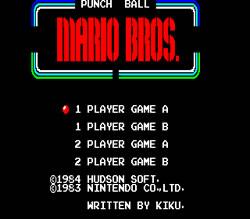
Punch Ball Mario Bros.
Mario Bros. — but with punch balls. Hudson Soft’s 1984 Japan-only computer game takes the original arcade formula and adds a projectile mechanic that changes everything. Released across eight different Japanese home computer systems, it’s one of the most widely-ported Mario games you’ve probably never heard of.
Overview

Punch Ball Mario Bros. was developed and released by Hudson Soft on October 5, 1984 — making it one of the earliest Mario games outside of Nintendo’s own platforms. It was part of Hudson’s trio of Mario computer titles alongside Mario Bros. Special and Super Mario Bros. Special, all licensed by Nintendo for Japanese home computers.
The game is built on the same arena-platformer foundation as the original Mario Bros., with Mario and Luigi working through single-screen stages, flipping enemies and kicking them off. The core twist is the Punch Ball — a throwable projectile that replaces the classic floor-bump as the primary way to stun enemies. Instead of hitting the floor beneath a foe, you throw a ball directly at them.
What makes this version particularly notable is how widely it was ported. Eight different Japanese home computer systems received versions of the game, each with their own box art, palette differences, and minor gameplay variations. The Hitachi S1 and IBM JX versions are now largely lost.
The title screen music is the opening melody from “Dixie” — the 19th-century American folk song. It’s an unusual choice that gives the game a distinctive flavour from the moment you boot it up.
Story
From the instruction booklet (translated from Japanese):
“At some point, humans gained the ability to use tools… At first, they were simple things using the bones of animals and fragments of rock. Using their wisdom, humans improved their tools. Harnessing fire, wind, and nowadays even atomic energy, they began to build up a sophisticated culture.
On the other hand, however, there are people who still only use stone. How do they catch game and defend themselves from outsiders? Using only their strong jumping power and stone spheres. They use those skillfully to defend themselves.
Here, we introduce two such people. It seems their names are Mario and Luigi. Will they ever learn about sophisticated culture?”
The story casts Mario and Luigi as primitive men who haven’t caught up with modern society — their “punch balls” are stone spheres, and their jumping ability is their only defence. It’s a charmingly absurd reframing that has nothing to do with pipes, turtles, or princesses. Hudson clearly had a lot of creative freedom with the lore.
Gameplay
 A typical stage — floors in the middle, pipes as pits at the bottom
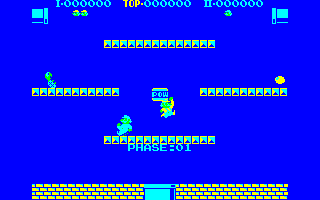 Hitting the POW inverts screen colours momentarily
 Bonus stage — grab 10 coins before time runs out
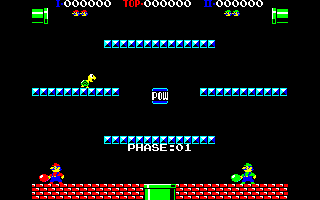 Two-player mode — Mario and Luigi compete for coins
Like the original Mario Bros., the goal on each phase is to defeat all enemies on screen. Enemies must first be stunned, then kicked off the stage. The big change is how stunning works: there is no floor-bump mechanic here. Footholds are sturdier and don’t trip enemies when hit from underneath. The Punch Ball and POW block are the only ways to flip an enemy over.
The POW block can be used three times per phase. When the POW is hit, the screen inverts its colours momentarily — a striking visual effect. After three uses the POW is gone, so the Punch Ball becomes the primary tool for the rest of that phase.
Once an enemy is stunned, it behaves as in the original game — it rights itself after a short window, and becomes faster if it does. There are only two forms per enemy in this version, no third “angry” form. Defeating an enemy produces a coin that appears on the top floor, but only one coin can exist on screen at a time.
There are two difficulty modes, A and B — though B is only slightly harder than A. The game also features bonus stages where Mario must collect 10 coins before the timer runs out. In two-player mode, these stages become competitive, with both players racing for the same coins.
If a player loses a life, they respawn on a temporary floor just above the POW block — Mario slightly to the left, Luigi slightly to the right. The Punch Ball also reappears at this location if it falls into the pit at the bottom of the stage.
The Punch Ball


The Punch Ball is the defining mechanic of this game. When thrown at an enemy, it stuns them — leaving them flipped over and vulnerable to a kick, exactly as if they’d been hit by the floor-bump in the original Mario Bros.
There’s an important control quirk: the button for throwing the Punch Ball is the same button used for jumping. This means Mario must be standing completely still to throw the ball — if he’s moving, pressing the button makes him jump instead. Players have to consciously stop, aim, and throw, which adds a rhythm to the gameplay that feels quite different from the original.
After being thrown, the Punch Ball doesn’t vanish — it stays on the ground where it lands until a player walks over it to pick it up again. This means the ball’s position on the screen is always a factor in how you plan your next move. If it’s fallen into the pipe pit at the bottom, it reappears at the respawn point above the POW when someone loses a life.
Stage Layout — Almost the Exact Opposite
One of Punch Ball Mario Bros.’s most distinctive features is how different its stage layouts are from the original Mario Bros. MarioWiki describes it as “almost the exact opposite.” In the original, floors extend from the edges of the screen with a gap in the middle. In Punch Ball Mario Bros., the floor is placed in the middle with gaps around the edges. What was solid in the original is open here, and vice versa.
The pipe at the bottom of the screen — the enemy spawner in the original — effectively functions as a pit here. Falling in loses a life and is how the Punch Ball gets “lost.”
As the game progresses, stage layouts become more complex with moving floors, frozen floors, and frozen moving floors — adding slippery surfaces and shifting platforms to the challenge. Later phases require reading the stage geometry carefully before committing to any move.
Enemies


There are four enemies in Punch Ball Mario Bros., all carried over from the original arcade game:
| Enemy | Debut Phase | Behaviour | Fast Form |
|---|---|---|---|
| Shellcreeper | Phase 1 | Walks forward steadily. The most basic enemy — equivalent to Koopa Troopas in later games. | Red |
| Sidestepper | Phase 4 | Walks forward like Shellcreepers but behaves identically to them once stunned. | Green with angry face |
| Fighterfly | Phase 6 | Hops along the ground, pausing between jumps and able to change direction while grounded. Difficult to time a stun against. | Green |
| Fireball | Phase 4 | Red, but acts more like the green fireballs from the original — bouncing along unpredictably. Completely invincible; cannot be stunned or defeated. | N/A (invincible) |
Unlike the original Mario Bros., enemies in Punch Ball Mario Bros. only have two forms — their normal state and their fast (angry) state. There’s no intermediate “fast but not yet flipped” form. An enemy enters its fast form either by righting itself after being stunned, or by becoming the last remaining enemy on screen.
Platform Versions
Punch Ball Mario Bros. was released across eight different Japanese home computer platforms — an impressive spread for any game of this era, let alone a Mario title. Each version has minor differences in palette, sound, and gameplay flow, with the most capable hardware showing the game at its best.

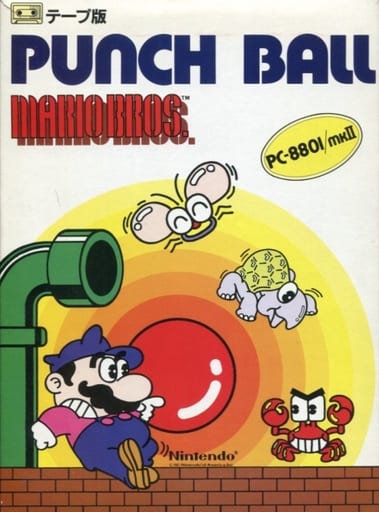


The Hitachi S1 version survives only as photos of the box, inserts, and tape. The IBM JX version is entirely unaccounted for. Both are considered lost media.
Trivia & Facts
- The title screen music is the opening melody of “Dixie” — a 19th-century American folk song. An unusual choice that gives the game an immediately distinctive identity.
- The instruction manual’s story has nothing to do with the Mushroom Kingdom. Mario and Luigi are framed as primitive men who defend themselves with stone balls and jumping ability, yet to discover sophisticated culture.
- The game was released across 8 different Japanese computer platforms — one of the most widely ported Mario titles of the era.
- The throw button and jump button are the same. Mario must stand completely still to throw the Punch Ball; moving while pressing it makes him jump instead.
- The stage layout is almost the exact opposite of the original Mario Bros. — floors in the middle, gaps at the edges.
- The Hitachi S1 version exists only as photos of the physical box and tape. The IBM JX version is entirely missing — no ROM, no photos, nothing.
- The POW block visually inverts the screen colours when struck — a striking effect used across many of Hudson’s Mario ports.
- Punch Ball Mario Bros. was developed alongside Mario Bros. Special and Super Mario Bros. Special as part of Hudson’s trio of Nintendo-licensed computer titles.
- The main programmer, Kikuta Masaaki (credited as “Kiku”), is the only staff member credited in the game.
- This is one of the only Mario games to feature fully competitive two-player gameplay — in bonus stages, both players compete for the same coins simultaneously rather than taking turns.
Videos
Promotional Flyer & Box Arts
 Original promotional flyer — Mario is shown holding the Punch Ball on all box art versions