
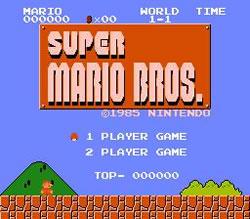
Super Mario Bros.
Overview
Super Mario Bros. is a side-scrolling platform game. It was released in 1985 (for the Japanese Famicom) and 1987 (for the NES). It is the first game in the ‘Super Mario’ adventure game franchise and the game that really placed Nintendo on the map of the gaming world (and in the highest possible position, back at the time). While it is not the first game where everyone’s favorite plumber appeared (he debuted back in 1981 in the arcade classic Donkey Kong as Jumpman), it certainly is a game where Mario got his personality, a story and the gameplay that became a trademark of the series up to this day. That same gameplay has also established the standards, that were later used, not only by the later games in the Mario franchise, but all the other platform games as well. Super Mario Bros. is a revolutionary game, by all means, and it is the game that, almost single-handedly, managed to save the video game industry. The reason why we have other popular franchises like Halo, Call of Duty, Sonic the Hedgehog, Crash Bandicoot…..is, mostly, because of this game.
The plot of the game is very simple. It is placed in the lovely setting of Mushroom Kingdom. The Mushroom Kingdom is attacked by a horde of the evil Koopas (turtle-like creatures) who were led by a Godzilla-like beast named Bowser (also referred to as “King of the Koopa”). He also kidnapped Princess Peach (also known as Princess Toadstool), the ruler of this wonderland. It is Mario’s task to save the princess from Bowser and to bring back the peace that the evil Koopas and their leader took away from the inhabitants of the Mushroom Kingdom.
Story
The official story from the Super Mario Bros. game manual is below:-
One day the kingdom of the peaceful mushroom people was invaded by the Koopa, a tribe of turtles famous for their black magic. The quiet, peace-loving Mushroom People were turned into mere stones, bricks and even field horse-hair plants, and the Mushroom Kingdom fell into ruin.
The only one who can undo the magic spell on the Mushroom People and return them to their normal selves is the Princess Toadstool, the daughter of the Mushroom King. Unfortunately, she is presently in the hands of the great Koopa turtle king.
Mario, the hero of this story (maybe) hears about the Mushroom People’s plight and sets out on a quest to free the Mushroom Princess from the evil Koopa and restore the fallen kingdom of the Mushroom People. You are Mario! It’s up to you to save the Mushroom People from the black power of the Koopa.

The artwork used on the Japanese cover of Super Mario Bros, originally drawn by Shigeru Miyamoto.
Gameplay & Controls
The gameplay is very simple, but also really addictive, and this is where all the accent was put during the making of the game. You control Mario in the series of levels that were divided by 8 different “worlds”. Each world has 4 levels and your objective is to reach the end of the level (basically: “make it from point A to point B”). Majority of levels are a mix of platforming sections, although there are 2 underwater levels in the game as well (the objective is still the same, though). The first 3 levels of each world are completed when Mario jumps on the flagpole, and when he takes down Bowser’s flag that is placed above the castle. The 4th level of each world is different. Not only are Bowser’s castles bigger this time, but the objective is not only to make it until the end of the level, but you have to fight with Bowser as well. Bowser is defeated either by shooting the fireballs at him, or by removing the hammer that holds the bridge where he is located, and that is placed behind his back. The Bowsers, that the player battles at the end of the first 7 worlds, are not the real Bowsers. The only real Bowser is located at the end of the 8th world (level 8-4), and that is also the castle where Princess Peach is held as a prisoner. At the end of the first 7 worlds, and after each of the “fake” Bowsers is defeated, Mario releases Toad (a mushroom-walking creature and inhabitant of the Mushroom Kingdom) who thanks him, but also says that the princess is in another castle. This reference is one of the things why this game is so iconic even today.
Mario can jump (used for moving across gaps and as an attack for killing the enemies), shoot fireballs (that are acquired once he picks up the Fire Flower power up) and run (which is used for faster movement and also for jumping across bigger gaps). He can also navigate through pipes, which are used to enter secret and hidden areas and also it is sometimes necessary to do this in order to reach the end of the level.

Fire Mario jumping, the iconic artwork used in the front cover of the European version of Super Mario Bros.
The main items, that Mario collects in the game, are coins. Coins increase the number of points in the game and they can also give Mario extra lives (100 coins give 1 extra life), and they can be found floating above the platforms of each level or under the coin boxes or certain blocks (in that case, Mario has to jump beneath the block to get the coins). However, Mario can pick up several power-ups as well. One of them is a Mushroom power-up, which makes Mario grow in size. In the normal form, Mario takes only 1 hit by the enemy to be killed off, and in his bigger form, he is killed with 2 hits (the first one reverts him to his normal form and the second one kills him). The second power-up is the Fire Flower power up. It changes the color of Mario’s attire from red to white and it gives him the ability to kill the enemies from distance with a single shot. It should be noted, though, that there are enemies that can’t be killed with fireballs (Buzzy Beetles), and Bowser takes multiple hits to be killed. There is also a Starman power-up. It is a power-up that looks like a star and it gives Mario temporary invincibility. Also, with this power-up, Mario kills all of his enemies as soon as he touches them. There are also mushrooms that give Mario extra lives and they are different in color from the classic Mushroom power-ups (the classic Mushroom power-up has an orange cap with red dots on it and the mushroom that gives extra lives has an orange cap, but with green dots instead). Mario dies when he gets touched/hit by any enemy on screen or by their attacks. It takes 1 hit to kill Mario in his normal form (or 2 hits when he is in his bigger form after granting either the Mushroom or the Fire Flower power-up). The second way of dying is falling down into the pits, and the third one happens when the time to beat the level runs out.

Items sitting on top of blocks including a Fire Flower, Gold Coin, Mushroom and Star man.
There is also a multi-player mode, in which the first player controls Mario and the second one controls Luigi. There is no difference between their abilities in this game, except that the color of Luigi’s attire is green and Mario’s is red. The two players don’t appear at the same time on the screen and it is not a classical co-op mode. Rather than that, the game starts off with the first player controlling Mario. As soon as he loses a life, the game switches to the second player who takes control of Luigi and vice-versa. Luigi’s gameplay is identical to Mario’s and there are no changes at all.
The controls in the game are:
Right – Move right
Left – Move left
Down –Duck (it can only be used when Mario is in his bigger form)
Up – Used for climbing the vines
A – Jump (it is also used for swimming in the underwater levels)
B – Shoot fireballs (it can only be used when Mario has acquired a Fire Flower power-up)
Press and hold B + Left/Right – Running
Start – Pause the game.
Hard Mode
Once he beats Bowser in the final stage of the game, Mario (or Luigi) rescues Princess Peach (Princess Toadstool). She thanks him for saving her and the player gets the ability to play through the entire game again, but in a higher difficulty called “Hard mode”.
Hard mode is similar to the normal mode of the game, but it plays different and it is, as the name implies, tougher than the normal mode.
Here are the major changes in the Hard mode of the game:
-
All Goombas in the game are replaced by Buzzy Beetles
-
The music is much faster
-
All enemies in the game walk much faster
-
Firebars appear on every possible location in the game
-
Pipe-elevators are much smaller
-
Mario and Luigi cannot acquire any special powers in this mode and they don’t get any extra points when they kill an enemy.
-
The time to finish each level is the same as in the normal mode of the game and it is unaffected. The plot is also the same. When the game is beaten in the Hard mode, nothing new is unlocked, so the only option that the player has is to play the entire game all over again.
Characters
Unlike its successors in the franchise, the original Super Mario Bros. doesn’t have a huge number of characters. But, anyway, here is the list of the main and supporting characters, as well as the enemies that the player encounters during the game:
Main and supporting characters
Mario – This Italian plumber is the main protagonist of the game (and the whole franchise) and the hero of Mushroom Kingdom. Outside his domain, Mario (originally known as Jumpman) is a mascot of Nintendo and the most popular video game character of all times. Mario’s mission is straight-forward and simple – to save Princess Peach and the Mushroom Kingdom from the evil Bowser and his army of Koopas.
Luigi – He is Mario’s younger (and taller) brother and he is his sidekick in the quest of saving the princess and the Mushroom Kingdom from the Koopas. While having some heroic qualities just like our previous mentioned hero, Luigi is not as brave as him when it comes to fights with Bowser and dealing with the ghosts. Still, he became popular enough to get his own game as well (actually, not just one), which is an achievement. Even though the only difference between the two brothers in this game is in the color of the attire, later games introduce differences between them, and it is not the same whether the player controls Mario or Luigi.
Princess Peach – Also known as Princess Toadstool, she is that female character that must be saved by her “Romeo”, or, in this case, Mario. She is the ruler of Mushroom Kingdom and she is Mario’s love interest, while she is a good friend with Luigi. She isn’t a playable character in the first game, but in some of the later games, the players can take control of her. For example, in Super Mario Bros. 2 she is one of the 4 playable characters. She is always one of the playable characters in the Mario Kart and Smash Bros. sub-series. Even though she appears as a shy and charming young lady, she knows how to kick one’s butt, so better not mess with her!


Mario, Princess Toadstool and Toad.
Toad – Originally known as Mushroom Retainer, Toad is a member of the most dominant specie in the Mushroom Kingdom. These cute “humanoid mushrooms” are loyal servants of the kingdom and they are a typical example of why Mushroom Kingdom has such name. While in the first game they are passive characters that are also the ones that Mario and Luigi are saving, in the future games they gain more personality, and there is a difference in the color on the mushroom caps placed on their heads. One Toad also gets to be Mario’s sidekick along with Luigi (and Yoshi).
Bowser – He is the “King of the Koopa”, the main antagonist of the whole franchise. He is the one who keeps kidnapping Princess Peach over and over, and he is the one who makes Mario go after him to stop his evil ambitions. He looks like a dragon, but with a shell of a turtle on his back and with spikes on it (he is a Koopa after all). The main ambitions of the villains are usually to rule the world, to be the most powerful people in the universe, etc etc……..and Bowser wants to take over and control the entire Mushroom Kingdom. He has also attempted to take control of the entire Mushroom World and even the whole universe, in the later games. In this game, there are 7 of his fake clones and Mario must first battle and defeat them in order to reach the real Bowser and save the princess. In some occasions, Bowser was an ally of Mario and his friends, but that doesn’t change the fact that his nature is utterly evil.
Enemies
Bloopers – They are the enemies that look like squids. They are located in the underwater levels and sections of the game and they swim towards Mario and Luigi in order to kill them. They can be defeated with fireballs acquired from the Fire Flower power-up and also with the Starman power-up.
Bill Blasters – They are cannons that cannot be defeated. They are stationary and they fire bullets left and right in order to kill Mario/Luigi. However when they are just next to them, the cannons don’t fire any bullets.
Bullet Bills – The bullets fired by Bill Blasters. They have both the eyes and the arms. They are defeated when Mario and Luigi jump on them or with a Starman power up. They cannot be defeated with fireballs.
Buzzy Beetles – They are small black turtle-like creatures with huge shells that walk back and forth. Fireballs can’t harm them, but when Mario and Luigi stomp on them, they retreat into their shells just like the Koopa Troopas and they can then be tossed around.


A Cheep Cheep, Lakitu and Goomba.
Cheep Cheeps – They are fishes found in the underwater levels and also in the bridge levels, where they jump out of the water in order to attack Mario and Luigi. They come in 3 color combinations: red, green and gray.
Firebars – A bunch of fireballs placed one next to another, rotating around in either the clockwise or counter clockwise direction. There are firebars that are short in length, but there are also those that are very long and that are difficult to dodge.
Goombas – These are the first enemies that Mario and Luigi encounter in the game. They are shaped like mushrooms and the only thing they do in the game is to walk back and forth, but in a very slow manner. They are the easiest enemies to beat in the game and all the attacks are effective against them.
Hammer Bros. – Some people (those that are not fans of Mario, of course) call these enemies “Ninja Turtles”. And not without a reason. They are green turtle-like creatures and their only attack is to throw a countless number of hammers at Mario and Luigi in order to kill them. They also jump from time to time and this makes the whole process of dodging their hammers much harder. Still, they are also vulnerable to all attacks and can be killed either by stomping on their heads, with the fireballs or with invincibility from the Starman power-up.
Koopa Troopas – They are turtles that move back and forth. They come in two color variations: green and red. Green Koopa Troopas move back and forth without any boundaries and even if that means that they will commit suicide by falling down into the pit. Red Koopa Troopas move back and forth and their movement is limited to a platform on which they are standing on only. They can be killed with any attack. Once Mario and Luigi stomp on them, they hide under their shells and they can then be tossed around.
Koopa Paratroopas – They are Koopa Troopas, but with wings. There are also two species of Koopa Paratroopas: green and red. Green Koopa Paratroopas jump up in the air and down to the platform, in both directions and the red ones fly back and forth/up and down in a straight horizontal/vertical path. Every attack is effective against them as well.


A Koopa Paratroopa, Piranha Plant and Bullet Bill.
Piranha Plants – They are carnivorous plants that are located exclusively in the elevator-pipes. They rise up from the pipes in order to catch and eat Mario and Luigi. The interesting fact is that, when Mario and Luigi jump and stand at the top of the elevator-pipe blocking the entrance, Piranha Plants don’t rise up at all. They can’t be killed by stomping, but they can be killed with fireballs and invincibility.
Lakitu’s – These creatures are Koopas shifted with glasses and they have small clouds that they use for riding. They chase Mario and Luigi all through the levels that they appear in, and they throw “red bubbles” (Spinny Eggs) at them. They can be killed with with any of the attacks, but, of course, the player must be on a very high platform in order to reach Lakitu.
Podoboos – They are big fireballs from Bowser’s castle. They jump up and down in order to kill Mario and Luigi.
Spiny – This is a small red Koopa with a shield on its shell. It “hatches” from the Spiny Eggs that Lakitu is throwing. It can’t be killed by stomping but fireballs and invincibility are more than effective.
Spiny Eggs – They look like red bubbles, but they are, in fact, eggs that are hatched into a Spiny as soon as they fall to the ground.
Glitches
Creating any video game is a tough process and the programmers are not robots, so mistakes happen. There is no video game today that is free of glitches and that is the case with Super Mario Bros. as well. In some cases, though, glitches are added with a reason and intentionally. Whether that is the case here or not, some of the most “popular” and most interesting glitches will be listed now….
World -1/ Minus World
Yes, there is actually a level/world like this. This is, practically, an endless underwater level. You can swim until you fall asleep in front of the screen, exhausted, but the level will never end. Actually, when you think you have reached the end and when you enter the pipe, it takes you back to the very beginning of the stage. This is a pointless glitch but it is still fun to perform.
In order to activate it, you need to enter World 1-2 and stand on the pipe that takes you out of the water and into the end of the level. But only jump on the pipe, don’t enter it. The next step is to smash the second and third block from the pipe. Only those two, and leave the one on the far right unaffected. Then move closer to the left edge of the pipe, turn left and duck. You need to jump while in the ducking position (press and hold the “down” button and press “A” at the same time) and quickly turn to the right while in mid-air. If you do this correctly, Mario (or Luigi) will go through the block that is located to the far right of the screen and he will pass through the wall that will lead him to the Warp Zone. Now, instead of starting World 2-1 or World 4-1 from their corresponding pipes, you will enter the Minus World.
A video showing how to get to Minus World in Super Mario Bros.
Get over the flagpole
Majority of players, even in their earliest stage, were dying from curiosity to find out what would happen if they jump over the flagpole at the end of the level. Even though it would seem logical that such thing is not possible….guess what – it is! And do you know what happens when you manage to jump over the flagpole? Nothing……….just like in the Minus World level, you have entered the section that has no end. This time instead of the swimming, you will run and run and run and run……..and the only way to get out is either to let the time run out or to reset the game. Again, a pointless glitch, but at least it is now known what happens when you manage to jump over the flagpole.
To perform this glitch in the very first level of the game (World 1-1), you need to get to the second pit. Now wait for the Koopa Troopa to fall down into the pit, but while this is happening, you must be at the very top of the level high above the Koopa Troopa and jump at the same time when it falls into the pit. The Koopa Troopa is now stuck underneath the level, but you can still see it. It will start moving towards the end of the level and you must follow it. You must also get the Mushroom power-up while doing this. When the Koopa Troopa passes the stairs, and when it is about halfway between the stairs and the flagpole, you must quickly repeat the glitch and, as a result, Mario will jump over the flagpole.
To do this in World 3-3, you must stand on the last lift, near the end of the level, until its pair lift is completely lifted. Now, quickly run and jump from the far edge of the lift that was just risen up to its maximum. But watch out that the lift doesn’t fall while doing this. If you do everything properly, Mario (or Luigi) will jump over the flagpole.
Get killed and beat the level at the same time
This is a very funny and interesting glitch. It kinda makes losing a life at least a bit satisfactory. This glitch can be performed in the castle levels, during the fights with Bowser. The first thing you must do is to reach Bowser without any power-ups. Jump over Bowser and get yourself next to the hammer. Try to get Bowser next to you and try to touch the hammer, but also try to make the Bowser kill you at the same time. Mario (or Luigi) will then lose a life but he will also beat the level. In case this is your last life, just after the classic message that you get when beating Bowser (“Thank you Mario! But our princess in another castle”), you will get the “Game Over” screen. Isn’t it epic?
Flag remains up after beating the level
In order to activate this glitch you must jump next to the block, that holds the flagpole, and then quickly jump again. If you succeed, Mario (or Luigi) will grab the flagpole as he normally does, but the flag will stay unaffected.
Touch the hammer and it stays there
In order to make this glitch work, you must reach Bowser with fireballs and defeat him that way. After that, go to the far left, run and then jump to the far right of the hammer. You will touch it, but it will stay where it has been, and the bridge will not fall down. You will normally proceed further.
Immediate “Game over” screen
As soon as you get 128 lives and as soon as you die the first time, you will instantly get the “Game Over” screen. This happens, probably, because of the limited data systems back at the time. Even though it sounds insane, it is possible to get this number of lives, especially if you perform the old “Koopa Troopa tipping trick” (it is done when Koopa Troopa is on the staircase. You must stomp on it to make it hide to its shell. After that, stomp to the left side of the shell and it will keep hitting the block constantly, earning new points for you and, of course, new extra lives).
Re-releases
-
Just like it happens with every other successful title, Super Mario Bros. was re-released numerous times, for other gaming systems, as well as for the NES, but as a part of the compilation cartridges (for example with Duck Hunt, and also with World Class Track Meet as a treble pack). Here is the list of all the alternative versions and re-releases of the game, as well as the years when they were launched:
-
1985 – The game was ported to Nintendo PlayChoice 10 (It is an American arcade machine)
-
1986 – The game was re-released in Japan (on the Famicom Disk System)
-
1986 – The game was re-released in the form of the “Game & Watch” title

The box art for the Game & Watch release of Super Mario Bros.
-
1986 – It was re-released in the arcades as the game called “Vs. Super Mario Bros.”
-
1986 – It was re-released as “All Night Nippon Super Mario Bros.” (on the Famicom Disk System)
-
1988 – it was re-released on its original system (the NES) in the United States, as part of the “2-in-1 Super Mario Bros./Duck Hunt” combo cartridge, and with the NES Action Set added on
-
1988 – it was re-released on its original system (the NES) in Europe, as part of the “Super Mario Bros./Tetris/Nintendo World Cup” compilation cartridge. It was sold either alone or packaged with the Top Loader
-
1990 – It was re-released, again, on the NES in the United States as part of the “3-in-1 Super Mario Bros./Duck Hunt/ World Class Track Meet ” compilation cartridge. It also came in pack with the NES Power Set
-
1990 – Yet another re-release on the NES as part of “Nintendo World Championships 1990”

A poster advertising the 1990 Nintendo World Championships, in which Super Mario Bros (NES) featured.
-
1993 – A remake of the game became available on the SNES (Super Nintendo Entertainment System) as part of the “Super Mario All-Stars + Super Mario World” compilation cartridge (the visuals and the sound were updated, and many glitches were fixed)
-
1994 – The same game became available on the SNES in the United States as part of the “Super Mario All-Stars + Super Mario World” compilation cartridge. It was sold together with the SNES Mario Set
-
1999 – The game was released on the Game Boy Color, as a remake called “Super Mario Bros. Deluxe”. It had the same visuals as the original game, but a lot of the additional content was added
-
2002 – The original game was available as an unlockable game in the Nintendo Game Cube title: “Animal Crossing”. However, nowadays, it can only be unlocked by cheating
-
2004 – The original game gets re-released on the Game Boy Advance as part of the “NES Classics/Famicom Mini Collection”. This compilation was released in order to celebrate the 20 years of the Japanese Famicom. It was also released in Japan, the following year, in order to celebrate 20 years of the original NES classic
-
2006 – The game became available on the Nintendo Wii as part of the Virtual Console
-
2008 – The game became available as part of the ultra-popular “Super Smash Bros. Brawl”, but it was only a demo version
-
2010 – The game was remade, once again, as part of the “Super Mario All-Stars Limited Edition” compilation for the Nintendo Wii
-
2010 – The game was released as a remake on the Virtual Console. It replaced the question marks on the blocks with a number (25). It was also packaged together with a red Nintendo Wii console
-
2011 – The game was released on the 3DS as part of the Virtual Console. It can also be downloaded for free, but only the 3DS users who bought the console before 12th August have this privilege. The full version of the game was released on 5th
-
January, 2012 in Japan, on 16th February, 2012 in North America and on 1st March, 2012 in Australia and Europe
-
2013 – The game was re-released on the Nintendo Wii U as part of the Virtual Console service via the Wii U eShop in Japan on 5th June, and in Australia, United States and Europe on September. It also appeared in the “NES Remix” compilation
-
2014 – The game was re-released as part of the “NES Remix 2” compilation as “Super Luigi Bros.”.

The Making of Super Mario Bros.
Super Mario Bros. is developed and produced by Shigeru Miyamoto and Takashi Tezuka, two members of Nintendo’s Creative Department. The gaming mastermind, Shigeru Miyamoto, is considered as the father of Mario, as he is the one who developed the original idea and the concept of the moustache-wearing plumber. As Famicom was just released in Japan, and it was still a new system, it needed a game to “launch it into the orbit”. That is when Miyamoto and Tezuka came to an idea to develop the game that will be extraordinary in every aspect and that will become a trademark of the Famicom.
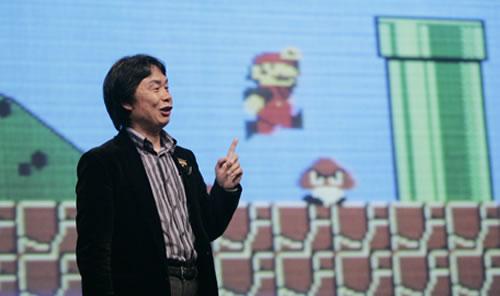
Shigeru Miyamoto speaking at a conference, with a Super Mario Bros backdrop behind him.
The base for making this game was the previously released Mario Bros. . It was a platform game but with a slightly different gameplay. The original concept of Super Mario Bros. was mostly revolving around shooting and much less around jumping and platforming, in general. However, this approach was dropped and new ideas were born. The developers were focused on all the bad aspects from the Mario Bros. game, and that gave them ideas for improvements in the new game, and those improvements have also set the standards for all the future games to come. For example, they realized that Mario getting hurt when he jumps on the turtle is a lame segment. So, in the new game, when Mario stomps on the turtle (Koopa Troopa), it retreats into its shell. Also, they figured out that Mario was, simply, too small in the previous game and that is how they got an idea to make him bigger. As the development of Super Mario Bros. was going on simultaneously with The Legend of Zelda (the other “child” of Shigeru Miyamoto), and as Miyamoto was getting inspirations from his childhood stories (for both games), he got an idea to include mushrooms in the game. When this idea was developed even more, power-ups were born and the Mushroom power-up was only one of them. The levels are made in a way that, first Miyamoto and Tezuka were drawing them on pieces of paper, and then people from the Systems Research and Development (SRD) would implement them into the game. All stages had less than 40 screens in total, with 32 being the highest amount.
The soundtrack of the game was composed by the (now) legendary Koji Kondo. He is the one that made every single tune of this game sound so iconic, that even people who are not involved in video games at all, could recognize them and know what game that comes from. His basic idea was that short pieces of music (6 of them) could be repeated without causing any frustration. And the legacy that all these iconic sounds later received just proved that he was spot-on. It is interesting to note that all the music in the game is played on the synthesizer.
Videos — Gameplay, Trailers & Commercials
A playthrough of Super Mario Bros from the start screen through to the ending.
Super Mario Bros 1, 2 and 3 commercial
A Japanese TV Commercial for the 25th Anniversary since Super Mario Bros’ original release on the FDS
The official Super Mario Bros 25th Anniversary TV Commercial
Reception
Super Mario Bros. got great reviews and it was greatly accepted by the entire gamming community. It is the game that revolutionized the side-scrolling platform sub-genre and the entire video game industry. It can be said that the gaming industry was back on track after this game was released. The game has set the standards for all the future games, not only games in the Mario franchise, but all games, in general.
The trademark of the game is the gameplay, and especially the controls – they are tight and “spot-on”. This was one of those aspects that was mostly praised by the majority of the gaming critics, and this became the trademark of the whole franchise later as well. The soundtrack of the game also got fantastic reviews, and a clear sign of how good the music in this game is, is the fact that every single sound of this game is iconic and recognized by everyone, worldwide.
The article called “100 best Nintendo games of all time ” from Nintendo Power ranked this game as 14th best game of all times. Electronic Gaming Monthly’s “Greatest 200 Games of Their Time” has put it on the very first spot, and the popular IGN ranked it as the 3rd best game on their list of 100 best NES games ever made. It must be noted that, with the number of sold games of 40.24 million copies, Super Mario Bros. is the second best selling game of all times, as well as the best selling Mario game ever.
Lastly, it is interesting to know that one street in Zaragoza (Spain) changed its name, inspired by this game. The name of the street is, of course – “Super Mario Bros.”.
References in Later Nintendo Titles
As a highly influential game, its elements have found their respective places in the future games. This list shows every single mention in the later Nintendo releases:
-
Super Mario Bros. Special – this is a sequel of the original game that was developed by Hudson Soft
-
Super Mario Bros: The Lost Levels – This was supposed to be a direct sequel to the original game, but because it was thought that it is too hard, it was only released in Japan. It is basically identical to the original game, but the levels are much tougher
-
Vs. Super Mario Bros. – a harder version of the original game developed for the arcades
-
All Night Nippon Super Mario Bros. – It is a remake of the original game but with one exception. Elements and motives from the radio program called “All Night Nippon” replaced some elements and motives from the original game
-
Super Mario Bros. 2 – This is the actual sequel of the original game. It is often considered as “the black sheep” of the franchise, mostly because it doesn’t play and/or feel as a real Mario game. The gameplay is much different than the gameplay of the classic Mario games. It is no wonder why this is the case, as it is actually a remake of the Japanese game called “Doki Doki Panic”
-
Super Mario Bros. 3 – Most elements of the original game return in this one. Many people consider this game as the true follow-up, instead of the actual Super Mario Bros. 2. When the player beats the game, Princess Peach says: “Thank you! But our Princess is in another castle!…Just kidding!”, which is actually the same reference that is so well known in the original game, but this time it is used in a comic kind of way
-
Super Mario Land – Even though this game was released for the original Gameboy (and the Gameboy Color) and even though it has a different gameplay, many of the elements from the original game appear in this title
-
Alleyway – Some sprites from the original game appear in the bonus levels of this release
-
Super Mario World – In case you don’t do anything for 2 minutes, while standing on the Special World Map, you will hear the remix of the overworld theme from the NES original.
-
Super Mario RPG: Legend of the Seven Stars – If you go behind a curtain in Booster Tower, Mario will transform into his 8-bit sprite from the original game, for a short period of time. Also, the overworld theme of the original game in Mario’s interpretation can be heard when he takes a shower at Marrymoore
-
Super Mario 64 – Outside the elevator-pipe that leads to the final boss fight, sprites of Mario and Bowser from the original game can be seen on the pillars
-
Paper Mario – In case that Mario jumps into a vase, that is located in a room on the first floor in the Boo’s Mansion, he will transform into his 8-bit form. His allies, though, stay unaffected
-
Super Smash Bros. – The main theme of the original game can be heard in the Peach’s castle stage and the Mushroom Kingdom level can be unlocked
-
Luigi’s Mansion – The 7 fake clone Bowsers that appear in the original game are an inspiration for Bowser’s decoy in this game
-
Super Smash Bros. Melee – Just like in the original Smash Bros. game, the main theme of the original game can be heard in the Peach’s castle stage. The underground theme can also be heard in that level. The underwater theme of the original NES classic can be heard in the Rainbow Cruise stage
-
Super Mario Sunshine – When you first meet F.L.U.D.D. you should be able to see a castle level. Also, in the secret levels of the game, you can hear the main theme from the original game, and you can see various 8-bit sprites from the original game as well
-
Super Mario Advance 4: Super Mario Bros. 3 – Some levels from the original game are remade in the World-e in this game
-
Mario & Luigi: Superstar Saga – A minigame called Border Jump has the level endings of most stages from the original game
-
Paper Mario: The Thousand-Year Door – If you drop down from the vent into the X-Naut Fortress, Mario and his friends will become 8-bit
-
Mario Superstar Baseball – On the loading screen you can see Mario hitting the block with a question mark on it, and you can notice the graphics from the original game
-
Mario Tennis Power Tour – At the end of the game, you can hear the remix of the original main theme song
-
Mario & Luigi Partners in Time – As soon as you hear Toadsworth the Younger saying: “You will save her, won’t you? I assure you she’s NOT in another castle” you will recognize this legendary reference from the original NES game
Interesting Facts
-
Nintendo power magazine in 1997 rated this game as being the 18th best Nintendo game of all time
-
At the end of May 2007 a Super Mario Bros. Stamp set was released in Japan, these stamps featured graphics of the sprites from Super Mario Bros.
-
Second best selling game of all time
-
Biggest selling Mario game of all time
-
The theme music for this game is famous in its own right even to people who have never played the game, this music was by Koji Kondo
-
Super Mario Bros. is the first actual game in the franchise and the first real side-scrolling platform game. It is a revolutionary game that set up the standards for both the future games in the franchise and all the future games in general
-
Super Mario Bros. is the second best selling game of all times and the best selling game in the Mario franchise
-
Due to technical limitations of the system, the second playable character (Luigi) was basically only a remake of Mario’s sprites, but in a different color
-
The manuals of the original game and Super Mario Bros. Deluxe, as well as the Virtual Console page of the game all say that Koopas used black magic in order to turn inhabitants of the Mushroom Kingdom into stones, plants and bricks, while the real fact is that only Koopalings did this in Super Mario Bros. 3 and Bowser did it in Paper Mario and in Mario Party 8
-
The Guinness Book of World Records 2011: Gamer’s Edition says that the remake of this game was also released on the Nintendo 64. This information is not correct
-
The sprites of Mario on the game’s cover and on the re-releases of Donkey Kong and Mario Bros. on the NES are the same

-
There are numerous ROM hacks of the game. It can be noticed that, in each of them, the titles and sprites all have at least 4 color templates, and one is used for each setting (for example – brown, black and beige or yellow, green and white are used for overworld levels)
-
The bushes and clouds are, in fact, the same sprites, but in different colors.
Worlds & Levels
Super Mario Bros. has eight worlds, each divided into four courses — for a total of 32 levels. Each world ends with a castle stage and a Bowser fight (well, technically a fake Bowser until World 8). Courses are themed: Ground, Underground, Underwater, Athletic (treetops or sky), Bridge or Castle.
| World | 1 | 2 | 3 | 4 (Castle) |
|---|---|---|---|---|
| World 1 | Ground (1-1) | Underground | Athletic | Castle |
| World 2 | Ground | Underwater | Athletic | Castle |
| World 3 | Ground | Ground (night) | Athletic | Castle |
| World 4 | Ground | Underground | Athletic | Castle |
| World 5 | Ground | Ground | Athletic | Castle |
| World 6 | Ground | Ground | Athletic | Castle |
| World 7 | Ground | Underwater | Athletic | Castle |
| World 8 | Ground | Ground | Ground | Bowser's Castle |
Three Warp Zones exist: in World 1-2 (warps to Worlds 2, 3 or 4), World 4-2 (warps to Worlds 6, 7 or 8 — you reach this by jumping the brick ceiling), and another in 4-2 (warps to World 5). The famous Minus World (the unreachable World “-1”) is accessed from a glitch in this same World 1-2 area — covered in detail in Luke's Glitches section.
Enemies & Bosses (Full Roster)
The original Super Mario Bros. introduced the entire core enemy roster that the franchise still draws from today. The instruction booklet famously labels them “bad guys”.
| Enemy | First Appears | Behaviour | Points |
|---|---|---|---|
| Little Goomba | 1-1 | The most common enemy — mushroom-creatures that walk in straight lines and fall off ledges. Defeated by any attack. | 100 |
| Koopa Troopa (green) | 1-1 | Foot soldiers of the Turtle Empire. Stomping recedes them into kickable shells. Green ones walk off ledges. | 100 |
| Koopa Troopa (red) | 1-2 | Smarter shell-soldiers that turn around at ledges instead of falling off. | 100 |
| Koopa Paratroopa (green) | 2-1 | Winged green Koopas that bounce across the ground or fly back and forth in set paths. | 400 |
| Koopa Paratroopa (red) | 1-3 | Red Paratroopas fly up and down in fixed vertical paths. | 400 |
| Buzzy Beetle | 4-1 | Black-shelled beetles that are immune to fireballs. | 100 |
| Piranha Plant | 1-2 | Carnivorous plants that emerge from green pipes. Won't emerge while Mario stands next to the pipe. | 200 |
| Hammer Bro. | 3-3 | Koopa elite who throw arcing hammers in barrages. Tough to approach. | 1000 |
| Bullet Bill | 5-1 | Sentient bullets fired from off-screen cannons. | 200 |
| Lakitu | 4-1 | Cloud-riding Koopa that throws Spiny Eggs which hatch into Spinies. | 200 |
| Spiny | 4-1 | Lakitu's spike-shelled offspring — cannot be stomped. | 200 |
| Cheep-Cheep | 2-2 | Underwater fish that swim straight or in waves. Some leap out of water. | 200 |
| Blooper | 2-2 | Squid-like creatures that chase Mario underwater in zig-zag patterns. | 200 |
| Podoboo | 1-4 | Fireballs that leap out of lava pools in castle stages. | — |
| Bowser (fake) | 1-4 — 7-4 | The castle bosses of Worlds 1-7 are actually disguised minions: Goomba, Koopa, Buzzy, Spiny, Lakitu, Blooper, Hammer Bro. | 5000 |
| Bowser (real) | 8-4 | The final battle. Fire-breathing king of the Koopas guarding Princess Toadstool. | 5000 |
Development Staff
The original Super Mario Bros. credits read like a who's who of Nintendo's 1980s royalty — many of whom would shape the company for the next four decades.
- Director / Game Designer: Shigeru Miyamoto
- Co-Designer: Takashi Tezuka
- Original Music: Koji Kondo (his first major work — the Ground BGM became one of the most recognised pieces of music in history)
- Programmers: Toshihiko Nakago & Kazuaki Morita
- Producer: Shigeru Miyamoto
- Executive Producer: Hiroshi Yamauchi (Nintendo president)
- Studio: Nintendo EAD (then known as Nintendo R&D4)
Super Mario Bros. was developed simultaneously with The Legend of Zelda by overlapping teams — Miyamoto, Tezuka, Nakago, Kondo, Morita, Yasunari Nishida and Yamauchi all worked on both projects at once. The two games are deliberate opposites: Mario is linear and fast-paced; Zelda is open and exploration-driven.
Development & The 1-1 Philosophy
Development started right after Miyamoto and Tezuka finished Excitebike and Devil World together. They specifically wanted to combine the scrolling screens of Excitebike with the large character sprites of Devil World to make the new game visually distinctive against other NES titles.
Miyamoto and Tezuka approached the design like solving a puzzle — fitting as many technologies as possible into a single cartridge. The name “Super Mario Bros.” came from Mario's new Super form (post-Super Mushroom). This is the game that established almost every Mario convention: the running, jumping, pipe-warps, power-ups, world map, brick-block coin caches, the flagpole at the end of each non-castle level, the famous “1-1 design philosophy” that teaches every mechanic without text, and the rescue-the-princess narrative structure.
The 1-1 design philosophy in particular has become a textbook lesson in level design: the very first level introduces Goombas, mushroom power-ups, jumping over pits, hitting blocks, breaking bricks, the flagpole goal, and even one Warp Pipe — all without a single line of explanatory text.
Regional Differences (PAL vs NTSC)
The European/PAL version of the game has one notable mechanical difference: Little Goombas, Spinies, Piranha Plants, Bloopers, Cheep-Cheeps and Bullet Bills all have one extra pixel added to their hitboxes. This makes them very slightly easier to hit with fireballs or stomp accurately, but slightly riskier to approach — a tiny but measurable rebalancing for PAL players.
The PAL release was also delayed by 18 months compared to the original Japanese release, arriving in May 1987. South Africa received the game in 1993 using European packaging.
Pre-release & Unused Content
The game we received is dramatically different from the original concept. The earliest Super Mario Bros. prototype was much more focused on action than platforming, with the gameplay split between ground segments and sky segments where Mario shot at enemies. The control scheme was completely different — Mario could use weapons, and the up arrow on the D-pad was used as the jump button rather than the A button as in the final.
The shooting-game elements were eventually stripped out and the platform-focused gameplay we know today emerged. Some of the cut shooting concepts would resurface years later in spin-offs.
Alternate Versions & Re-releases
Super Mario Bros. has had more re-releases than perhaps any other video game in history. Here is the canonical list of major versions:
- 1985 — Original Family Computer (Famicom) and Nintendo Entertainment System release (Japan and North America)
- 1986 — Re-released on the Family Computer Disk System in Japan as a launch title
- 1986 — Released for the arcade VS. System as VS. Super Mario Bros.
- 1986 — A Super Mario Bros. Game & Watch handheld is released (a completely different game using the name)
- 1986 — Ported into the Nintendo PlayChoice-10 arcade unit
- 1986 — Released on Famicom Disk System as All Night Nippon: Super Mario Bros. (a Japanese radio-station tie-in with reused levels but Lost Levels physics)
- 1987 — Original NES release in Europe and Australia
- 1988 — Re-released in North America bundled with Duck Hunt, and later as the 3-in-1 Super Mario Bros. / Duck Hunt / World Class Track Meet cartridge
- 1993 — Super Mario All-Stars on SNES — 16-bit graphical overhaul with redrawn sprites and remixed music
- 2002 — Super Mario Bros. Classic Series (GBA) and bundled on the Famicom Mini line
- 2004 — e-Reader cards (Japan-only) for the GBA reproduced individual SMB levels
- 2006 — Wii Virtual Console launch title
- 2008 — Bundled as a playable demo inside Super Smash Bros. Brawl
- 2010 — 25th Anniversary edition with all the “?” blocks replaced with “25”
- 2011 — Nintendo 3DS Virtual Console (3DS Ambassador free download)
- 2013 — Wii U Virtual Console
- 2018-present — Nintendo Switch Online NES library
- 2020 — Released as a special edition Game & Watch handheld for the 35th anniversary
Adaptations — Films, Cartoons & Manga
Super Mario Bros.: Peach-hime Kyūshutsu Dai Sakusen! (Anime Film, 1986)
The very first film adaptation of a video game in history. One year after the Japanese game release, Grouper Studios produced an animated theatrical feature titled Super Mario Bros.: Peach-hime Kyūshutsu Dai Sakusen! (“The Great Mission to Rescue Princess Peach!”). It loosely follows the game's plot but adds a quest for Mario to find the three power-ups in order to use their combined power to defeat Bowser. Japan-only release.
The Super Mario Bros. Super Show! (1989)
The 1989 DIC Entertainment Saturday-morning cartoon presented a presumed follow-up to the game's events: Mario and Luigi escort Princess Toadstool and Toad back to her capital while King Koopa repeatedly tries to abduct her and take over the kingdom. Cast elements from Super Mario Bros. 2 are heavily fused in.
Super Mario-kun & Kodansha Mangas
Several Japanese manga adapted Super Mario Bros. directly. The Super Mario-kun series by Daisuke Shigoto, published in Shōgaku Ninensei, is set after the game's events — with Mario and Peach attempting to reform Bowser. Yukio Sawada also produced multiple Super Mario Bros. mangas including Famicom Manga: Super Mario-kun (focused on illustrating game mechanics) and a 4-koma strip in Volume 2 of his series. The first volume of Hisshō Technique Kan Peki-ban (a strategy-guide manga line) was also dedicated to SMB.
Valiant Comics (USA, 1990-1991)
Valiant Comics produced a short-lived English-language Super Mario Bros. comic line in 1990-1991. It launched alongside the Super Show! and adapted the cartoon's tone for American comic shops.
Names in Other Languages
The international name treatment is mostly straightforward — the title transliterates the same way in virtually every region:
- Japanese: «スーパーマリオブラザーズ» (Sūpā Mario Burazāzu) — direct katakana transliteration of the English. Sometimes branded as «スーパーマリオブラザーズ1» (“Super Mario Bros. 1”) to disambiguate from sequels.
- Chinese (Simplified): «超级马力欧兄弟» (Chāojí Mǎlì马ōu Xiōngdì)
- Chinese (Traditional): «超級琲利欺兄弟»
- Korean: «습푬 마리오브러년스» (Syupō Mario Beurajōněseu)
- South Africa (1993 release): Used European packaging
One unusual quirk: despite never being mentioned in the Japanese instruction manual, the Mushroom King appears in Asian-drawn strategy-guide illustrations — this is the source of much obscure Mushroom Kingdom monarchy lore.
Legacy & Sales
Super Mario Bros. is widely regarded as one of the most important and best-selling video games ever made. It is credited with single-handedly reviving the post-1983-crash North American video games industry, and made Mario the single most recognisable fictional character on the planet by the late 1980s — reportedly more recognisable to American children than Mickey Mouse for a period.
Critical reception: The most-praised aspect of the game is the precision of its controls — the way the player can finely modulate jump height, jump distance and running speed by holding or releasing buttons. This control fidelity was unprecedented at the time and is still the design benchmark for 2D platformers today. The game popularised side-scrolling and launched a franchise that has produced dozens of mainline sequels and hundreds of spin-offs.
Sales: Super Mario Bros. has sold an estimated 40+ million copies when including bundle sales (with Duck Hunt and others). It was the best-selling video game of all time until Wii Sports overtook it in the late 2000s. The game is permanently in the Library of Congress' preserved video games registry, and a Super Mario Bros. Avenue exists in Zaragoza, Spain — one of several physical-world commemorations around the world.
Reference / Information
Detailed sub-pages, walkthroughs, manuals and reader-submitted reviews covering every angle of Super Mario Bros.


Media / Downloads
Box art galleries, screenshots and a saved game file for Super Mario Bros.