
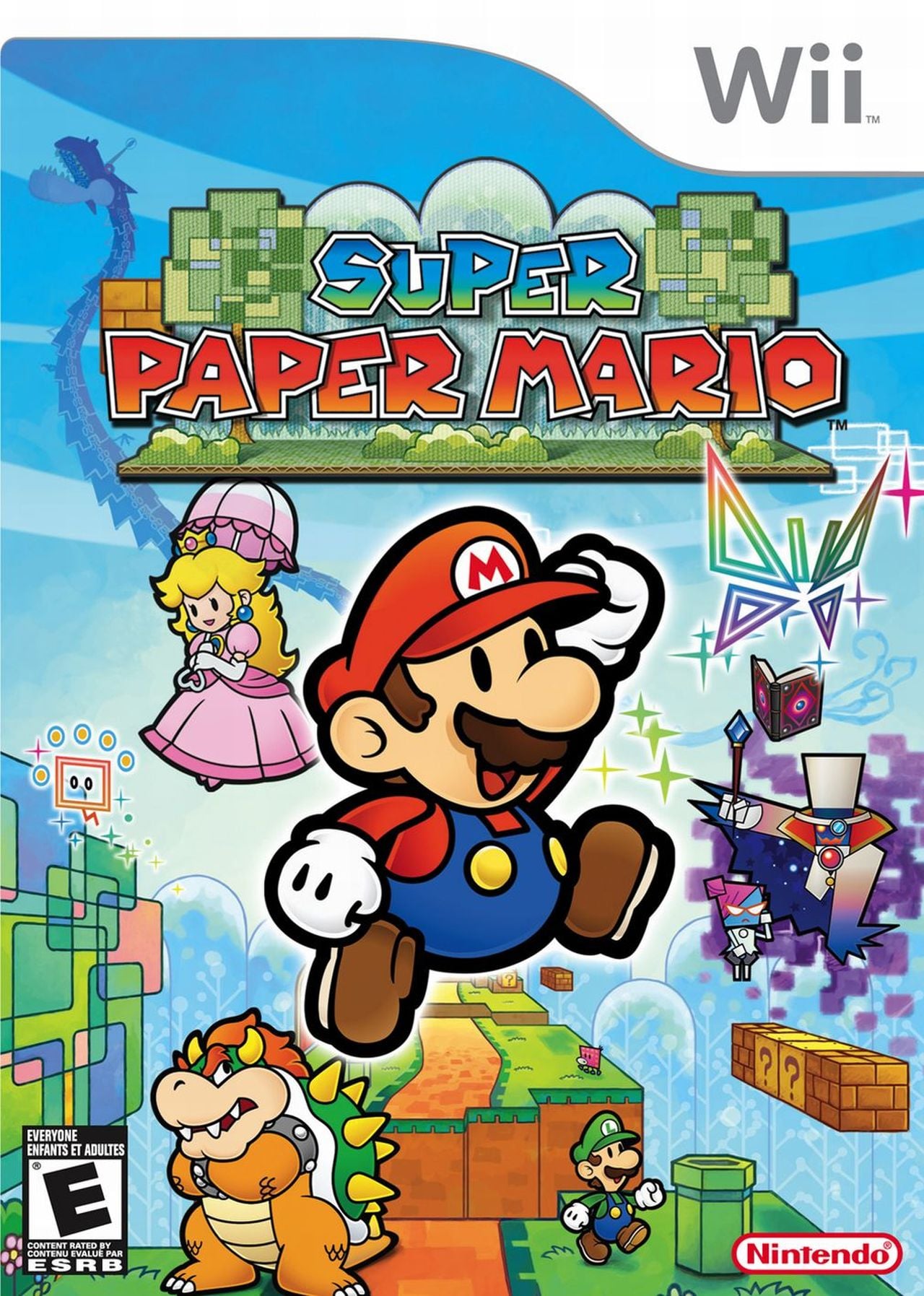
Super Paper Mario
Part Mario platformer, part RPG, part love story — and one of the most surprising games Nintendo ever made.
Super Paper Mario is one of those games that defies easy description. It launched in 2007 as the third entry in the Paper Mario series and immediately surprised everyone by ditching the turn-based combat of its predecessors for a hybrid action-platformer. On the surface it looks like a quirky 2D side-scroller in the Paper Mario visual style — flat characters, colourful cardboard worlds — but the deeper you get, the stranger, funnier, and more emotionally complex it becomes.
The game’s central mechanic — flipping between 2D and 3D perspectives — is inspired, turning every level into a spatial puzzle where what you see flat hides an entirely different world behind it. Platforms that seem impossible in 2D become reachable in 3D. Hidden rooms only exist in one dimension. Enemies that look invincible from one angle have an exposed back in another. It’s a genuinely novel idea that never stops being interesting.


But what really makes Super Paper Mario stand out — and what players still talk about years later — is its story. This is a Mario game with genuine emotional weight. Characters die. Love is lost and found. The villain turns out to be a tragic figure driven by grief. By the end, you’ll have experienced something that feels genuinely rare in the Mario series: a story that actually matters. Originally planned for GameCube, the game was eventually released on Wii in 2007 to strong reviews and sold over 4 million copies worldwide.
Super Paper Mario has the most ambitious and emotionally resonant story in the Mario series. What begins as a familiar “rescue the princess” setup quickly evolves into something much darker — a tale of lost love, world-ending despair, and the power of hope to overcome even the darkest prophecy. Here’s how it unfolds.
The Beginning — A Wedding That Will End All Worlds
Mario and Luigi are relaxing at home when Toad bursts in: Princess Peach has been kidnapped. Assuming Bowser is responsible as usual, the brothers race to his castle — only to find him just as confused as they are. Before anyone can figure out what’s happening, a mysterious cloaked figure appears in a flash of dark energy: Count Bleck, accompanied by his cold-eyed assistant Nastasia and a captive Princess Peach.
Bleck announces his intention to use Peach “to destroy all worlds” and forces her to marry Bowser against both their wills. The ceremony creates the Chaos Heart — a dark artefact born from a forced union of love — and from it erupts the Void: a growing black rift in the sky that will, if left unchecked, consume every world in existence. Mario is blasted unconscious by Bleck’s power. Luigi, Bowser and Bowser’s entire army are sucked away into the dimensional chaos.

Mario Awakens — Flipside and the Pure Hearts
Mario awakens in Flipside, a mysterious town between dimensions. There he meets Merlon, an ancient sage who explains the situation: an ancient prophecy called the Dark Prognosticus foretells the end of all worlds, and Count Bleck is fulfilling it. The only hope lies in the Light Prognosticus — a counter-prophecy that says a hero in red can use the eight Pure Hearts to defeat the Chaos Heart and stop the Void.
A small butterfly-like being called Tippi joins Mario as his guide. She can identify enemies, reveal secrets, and — crucially — has no memory of who she once was. Together, Mario and Tippi set off across eight worlds to find the Pure Hearts before the Void grows too large to stop.


Count Bleck’s Army — and What They’re Really Fighting For
Bleck’s forces pursue Mario throughout the game. They include Nastasia, his fiercely loyal secretary who can brainwash anyone into serving Bleck; O’Chunks, a blustering Scottish warrior with a big heart; Mimi, a shape-shifting girl who takes childlike glee in causing mayhem; and Dimentio, a jester-masked sorcerer whose elegant manner conceals something deeply sinister.
As Mario journeys on, it becomes clear that not all of Bleck’s followers believe in his cause. O’Chunks fights with passion but without conviction in the prophecy. Mimi follows out of devotion to Bleck himself. Even Nastasia — who carries out Bleck’s will without question — seems to be protecting something by staying close to him. And Dimentio… Dimentio has his own agenda entirely.

Luigi — The Dark Secret
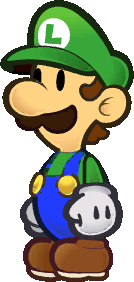
By Chapter 4, Mario discovers that Luigi has been captured and brainwashed by Nastasia. Renamed Mr. L, Luigi becomes a recurring antagonist — piloting giant robots, fighting Mario, and acting as Bleck’s reluctant agent. The twist cuts deep: it’s Mario’s own brother standing against him, and the game never lets you forget it. Defeating Mr. L doesn’t free Luigi — Nastasia’s hold over him holds firm until the very end.

The Revelation — Who Is Count Bleck?
The game’s emotional core is revealed across Chapters 7 and 8. Count Bleck’s real name is Blumiere — a nobleman from an ancient tribe who fell deeply in love with a human woman named Timpani. His father, furious at the relationship, had Timpani cast into the dimension void to die.
Shattered with grief and believing Timpani gone forever, Blumiere discovered the Dark Prognosticus and chose to end all worlds. If the worlds had no place for their love, then let all worlds be destroyed. He became Count Bleck — not out of evil, but out of despair so total it consumed him entirely.
And Tippi? The butterfly who has been at Mario’s side throughout the whole journey? Before she lost her memory, she was found near death between dimensions by Merlon, who turned her into a Pixl to save her life. Tippi was Timpani. The woman Count Bleck destroyed the worlds to mourn had been travelling with the hero sent to stop him all along.
⭐ The Twist at the Heart of Super Paper Mario
Count Bleck — the villain trying to end all worlds — is doing it because he lost the woman he loved. That woman is Tippi, Mario’s guide, who lost her memory when she was saved. The two people whose love created the Chaos Heart by being forced apart are reunited at the altar in the game’s climax — and their genuine love for each other is what finally cancels the Chaos Heart and stops the Void. Love, literally, saves the universe.
The Final Chapter — Dimentio’s True Plan
Just as Bleck stands defeated and ready to accept his fate, Dimentio reveals his true colours. He never believed in Bleck’s prophecy — he’s been manipulating events from the start, planning to seize the Chaos Heart for himself and use it to remake all worlds in his image. He possesses Luigi (the chosen vessel foretold to amplify the Chaos Heart’s power), merges with the Chaos Heart, and transforms into the monstrous Super Dimentio.
Even defeated in spirit, Bleck reaches out — and O’Chunks and Mimi, moved by the genuine love between Bleck and Tippi, help rally new Pure Hearts. Mario and his companions shatter Super Dimentio. But Dimentio leaves a fragment of his power to keep the Chaos Heart running even in death. The Void continues to grow.
With time running out, Bleck and Tippi — finally reunited and finally remembering who they are to each other — renew their vows of love at the altar where it all began. Their love, freely given this time, creates a new set of Pure Hearts that cancel the Chaos Heart, collapse the Void, and restore all that was destroyed. The two of them vanish together as the worlds are saved. Whether they survive is left deliberately ambiguous — but the implication is that, finally, they are at peace.

Super Paper Mario is a platformer-RPG hybrid that plays unlike anything else in either genre. You run, jump and explore levels in classic 2D side-scrolling style — but at any moment you can flip the world into 3D, revealing a completely different layout. Pipes hidden behind walls. Platforms that only exist at certain depths. Enemies with blind spots in one dimension but exposed in the other.


Combat is real-time rather than turn-based — you jump on enemies Mario-style, use items, or deploy Pixl abilities. Each playable character handles differently: Mario can flip dimensions and is the most versatile; Peach floats with her parasol for extra hang time; Bowser’s fire breath hits hard but he can’t flip; Luigi jumps higher and further than anyone but is harder to control. Switching between them (once unlocked) is key to solving the game’s puzzles.


Pixls are ancient beings that were created to serve heroes. They look like geometric shapes — diamonds, stars, blocks — and each grants Mario a unique ability. You collect them throughout the game by completing tasks or finding them in the field. You can only have one active at a time (plus Tippi), so choosing the right Pixl for each situation becomes part of the puzzle.







The game is divided into 8 chapters, each containing 4 levels. Each chapter takes place in a distinct world with its own visual style, tone, and theme — and a Pure Heart waiting at the end. The variety is remarkable, ranging from sunny grasslands to outer space to the literal realm of the dead.




Super Paper Mario was well received on release, though its departure from the turn-based formula of the previous Paper Mario games divided some long-time fans. Critics praised it lavishly for its story, writing, humour and dimensional mechanic while noting some chapters dragged with excessive dialogue.
Praised for
- The story — genuinely emotional and mature
- Writing: funny, clever, self-aware
- Dimension-flip mechanic is genuinely novel
- Huge variety across 8 chapters
- Count Bleck — best Mario villain ever?
- Dimentio as a genuinely surprising twist villain
- The ending — rare emotional resonance for the series
Criticisms
- Departure from turn-based combat divisive
- Some chapters feel slow (Chapter 5 especially)
- Excessive dialogue can break pacing
- Platforming challenges rarely feel difficult
- 3D flip underused in some levels
The game sold over 4 million copies worldwide, making it one of the better-selling Wii titles. It was later released digitally on Wii U eShop. Despite the mixed reaction from Paper Mario purists, its story is now widely considered one of the best Nintendo has ever told — and many regard it as the emotional high point of the entire Paper Mario series.
- Super Paper Mario was originally developed for GameCube. Prolonged development meant it was moved to Wii — the flip mechanic was adapted to use the Wii Remote pointer rather than GameCube buttons.
- In Mario’s house at the start of the game, if you look closely you can see pictures of Mario’s partners from the previous Paper Mario games — a nod to long-time fans.
- The European/PAL version changed one line of Dimentio’s dialogue. In other versions he says Luigi’s moustache is “shag”. In PAL he calls Luigi a pushover. Both are accurate.
- Super Paper Mario is the only game in the Mario series where the maximum attack stat is not capped at 99 — it can reach 150,000 with the right items and score multipliers.
- The back of the game’s manual features a picture of a Gold Fuzzy — an enemy that doesn’t actually appear anywhere in the game.
- A reference to Super Paper Mario was made in Paper Mario: The Thousand-Year Door as an upcoming game — meaning the game was teased in its own series predecessor.
- Super Paper Mario uses Hearts as its key item rather than Stars — the only main Mario RPG to do so, reinforcing the game’s theme of love over power.
- Chapter 6’s erasure of Sammer’s Kingdom mid-game is one of the most structurally daring things Nintendo has ever done in a Mario game — a whole world destroyed during play.
- The name “Dimentio” is a portmanteau of “dimension” and “dementia” — hinting at his reality-warping powers and unpredictable nature.
- Count Bleck’s real name, Blumiere, comes from the French “blême” meaning pale/pallid — reflecting his grief-stricken nature and the void-like colour palette of his design.
- Tippi’s real name, Timpani, is a musical instrument — a kettledrum. Merlon is also named after a musical term, continuing a subtle music theme in the game’s naming.
- The Pit of 100 Trials returns from Paper Mario: TTYD, now in both Flipside and Flopside — doubling the challenge for completionists.
Four videos from our collection covering Super Paper Mario: