
Wrecking Crew
Overview
Wrecking Crew (レッキングクルー, Rekkingu Kurū) is the second game and namesake of the Wrecking Crew series, developed by Nintendo R&D1 and published by Nintendo. It launched on the Family Computer in Japan on 18 June 1985, then made its way to the Nintendo Entertainment System as part of the North American NES launch lineup on 18 October 1985 alongside Super Mario Bros., Duck Hunt, Excitebike, and 14 other titles.
It follows the earlier arcade-only VS. Wrecking Crew (1984), which used the VS. System hardware. The NES version drops the arcade's competitive simultaneous multiplayer in favour of a deeper, puzzle-focused experience: 100 phases of vertical demolition where Mario must smash every wall on screen while avoiding pursuing enemies, falling drums, and the meddling Foreman Spike.
The game also pioneered something genuinely ahead of its time: a DESIGN mode that lets players create and save their own custom phases. The fact that Nintendo shipped a level editor in 1985 — a decade before Mario Paint, three decades before Super Mario Maker — is one of the most underappreciated firsts in their catalogue.
The Foreman Spike Origin

Foreman Spike — the bearded, hot-tempered construction-site foreman who tries to push Mario off the platforms — debuts here. He fills the role that Luigi occupied in the single-player VS. Wrecking Crew, but reimagined as an outright antagonist. Spike sometimes appears in the background smashing walls himself; sometimes he marches across the foreground trying to knock Mario off the beams. Hit him with the hammer and he falls instead.
Spike's comeback — 38 years later.
For decades, Foreman Spike was a deep-cut Nintendo character: a brief cameo in Mobile Golf (2001), a Costume in Super Mario Maker (2015), and otherwise forgotten. Then came The Super Mario Bros. Movie (2023), where Spike reappears as Mario and Luigi's former boss at the plumbing company — voiced by Sebastian Maniscalco, mocking the brothers' new business in the film's opening minutes. His outfit displays the name “Wrecking Crew” on his hat and left sleeve — a direct callback to this game.
Spike's influence on Nintendo runs deeper than the movie: in every Super Smash Bros. since the original (1999), Mario's third colour palette — brown overalls, white shirt — has been a tribute to Foreman Spike. Luigi's pink-shirted alt is based on his own Wrecking Crew sprite. So every time you've picked an alternate Mario colour in Smash, you've been playing as a 1985 NES character without knowing it.
Gameplay
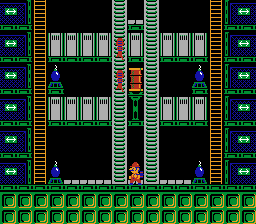
Mario (or Luigi in 2-player) is a demolition worker armed with a hammer. The goal of each of the 100 phases is simple: smash every wall on the screen. Unlike the arcade original, the NES version adds vertical scrolling, though each phase still takes place on a single wraparound screen.
The catch: enemies patrol the construction site. The regular hammer cannot damage them. Survival comes from trapping enemies under drums, knocking them off platforms with the rare Golden Hammer, or sending them through doors into the background — where they become harmless silhouettes for ~8 seconds. Time spent dawdling in one area summons a Fireball obstacle (a callback to the original Mario Bros.).
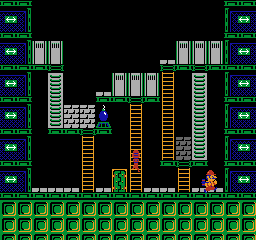
Demolition Objects
- Walls (bricks): Standard breakable wall sections. The bread and butter.
- Pillars: Vertical structures that can be knocked out, often supporting platforms above.
- Ladder walls: Climbable until destroyed. Foreman Spike can wreck these too.
- Dynamite: Damages any bricks lined up with it — and any platform-dwellers who don't move away fast enough.
- Drums: Stationary objects that fall when triggered, crushing any enemy underneath.
- Doors: Send enemies to the harmless background screen for a few seconds.
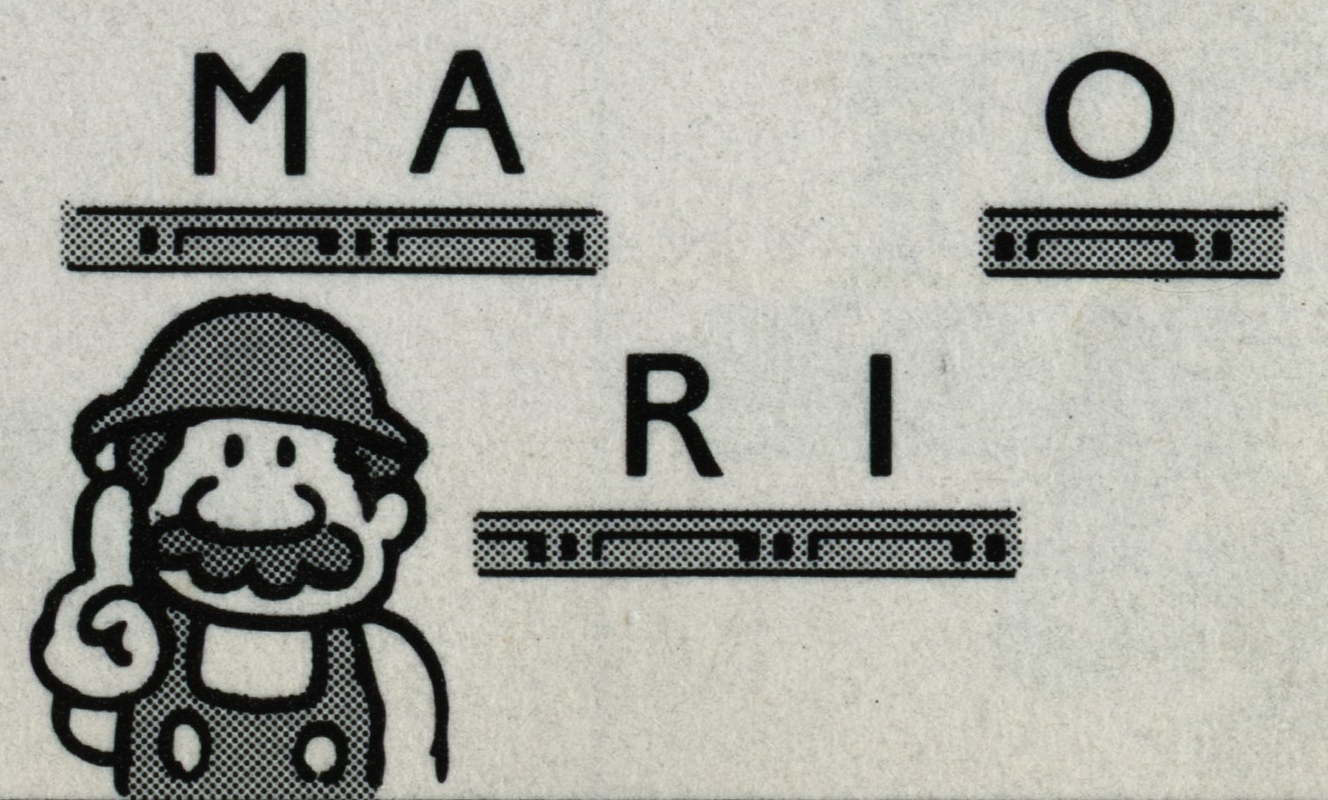
- Letters: Smash the walls in the right order to spell “MARIO” (or “LUIGI”) and earn an extra life.
- Golden Hammer: The legendary upgrade. Much faster wall destruction; can knock enemies all the way down. Worth 3,200 points.
The Hidden Prize Formula
In any phase with three or more pieces of dynamite, hitting three dynamite in a specific order reveals a hidden prize. The type of prize is determined by an obscure formula: take the phase number, add the number of hammer swings Mario made during that phase, divide by 8, and look at the remainder. The result is one of four prizes:
Pig Statue
Remainder of 0, 3, or 6
Santa Claus
Remainder of 2 or 5
Maneki-neko
Remainder of 4 or 7
Golden Hammer
Remainder of 1 (the jackpot)
The Bonus Stages after every fourth phase pit Mario against Foreman Spike in a race to find a single hidden coin in a row of walls. Finding it in the very first wall you smash awards 10,000 bonus points.
Playable Characters

Mario

Luigi
Enemies

Gotchawrench Jr.

Gotchawrench

Eggplant Man

Fireball
Foreman Spike
DESIGN Mode — A Level Editor in 1985
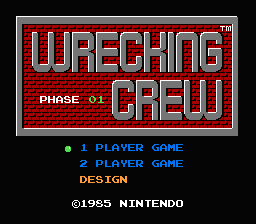
Hidden inside Wrecking Crew is one of Nintendo's most forward-looking features: a DESIGN mode that lets players construct their own phases by placing walls, ladders, drums, dynamite, and enemies on a blank grid. Custom phases can be saved — three decades before Super Mario Maker.
The catch: saving requires the Family BASIC Keyboard and Data Recorder peripherals — both of which were Japan-exclusive. Western players got a level editor they couldn't actually save designs from. The same limitation affected Excitebike and Mach Rider, both of which shared this peripheral dependency. The 1989 Famicom Disk System reissue removed this restriction — FDS could save directly to disk, no peripherals needed.
When Wrecking Crew hit Virtual Console and NES Switch Online, the emulators began faking the peripherals behind the scenes — meaning the level-saving feature finally became universally accessible to modern audiences. The current Nintendo Switch Online Famicom version is, oddly, the only re-release that does NOT support level saving — an unexplained regression from earlier Virtual Console releases.
Development Staff
The credits read like an early-Nintendo all-star team. R&D1 was the legendary in-house studio that gave us Metroid, the Game Boy, and most of Nintendo's early arcade work.
Producer
Gunpei Yokoi
Director
Satoru Okada
Game Designers
Yoshio Sakamoto
Makoto Kano
Music & Sound
Hirokazu Tanaka
Programmers
Toshiyuki Nakamura
Tomoyo-chan
Yase Sobajima
Akina-chan
Studio
Nintendo R&D1
Gunpei Yokoi (producer) was the legendary engineer behind the Game Boy, Game & Watch, and Metroid. Yoshio Sakamoto (designer) would go on to co-create Metroid the same year and direct most subsequent Metroid titles. Hirokazu Tanaka (composer) wrote the iconic Metroid, Kid Icarus, EarthBound, and Mother soundtracks. Wrecking Crew's development sat at the centre of a creative explosion within R&D1 that produced the foundations of Nintendo's 1980s identity.
Re-Releases
Few NES games have been re-released as comprehensively. Wrecking Crew has appeared on essentially every Nintendo digital storefront since 2004:
Famicom Disk System
Game Boy Advance (Famicom Mini)
Wii Virtual Console
3DS (Ambassador Programme)
3DS Virtual Console (Full Release)
Wii U Virtual Console
NES — Nintendo Switch Online
Cultural Legacy & References
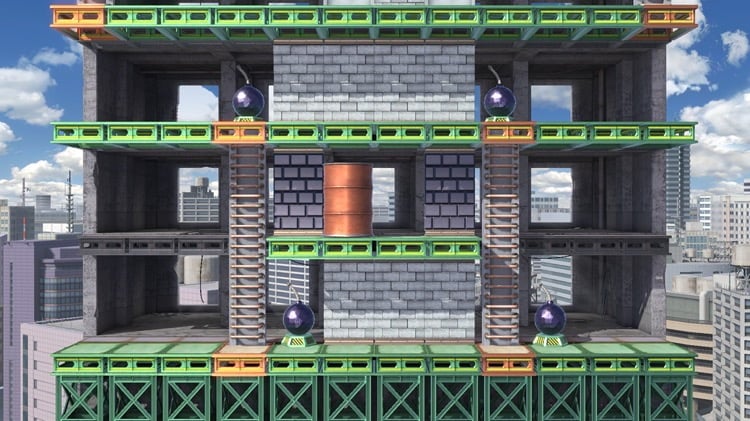
For a game that didn't have a true sequel until 1998's Super Famicom-exclusive Wrecking Crew '98, this title's DNA threads remarkably far through Nintendo's catalogue. The most prominent recent appearance: a dedicated Wrecking Crew stage in Super Smash Bros. for Wii U (2014) and Super Smash Bros. Ultimate (2018), with the Golden Hammer returning as a wieldable item.
References in Later Games
Kid Icarus (1986)
The Eggplant Wizard — one of Kid Icarus's most iconic enemies — was designed by Toru Osawa as a tribute to the Eggplant Men, combined with his personal love of eggplants.
Super Smash Bros. (1999) & sequels
Mario's third colour palette — brown overalls, white shirt — references Foreman Spike. Luigi's pink-shirt alt references his own Wrecking Crew sprite. Both alts have returned in every Smash since.
Wrecking Crew '98 (1998)
The proper Super Famicom sequel — competitive split-screen with garbage-block sending. Bundled a port of the original Wrecking Crew on the same cartridge.
Super Smash Bros. Melee (2001)
The Eggplant Man reappears as a collectible trophy. Mario's Spike-inspired colour palette and Luigi's pink palette return.
Mobile Golf (2001)
Foreman Spike makes a cameo — one of his earliest reappearances after the original game. A deep-cut Game Boy Color title.
Chibi-Robo! (2005)
The Eggplant Man returns under the new name “Kid Eggplant” — another Skip Ltd. easter egg.
DDR: Mario Mix (2005)
Waluigi's theme “Destruction Dance” is an arrangement of the Wrecking Crew Bonus Stage music — a thematic pun for the “destruction” framing.
Super Smash Bros. Brawl (2008)
The Golden Hammer debuts as a playable Smash item, with its original theme music intact.
WarioWare: Twisted! (2004) & D.I.Y. Showcase (2009)
9-Volt has a Wrecking Crew microgame in Twisted!; 18-Volt has the “Wreck. Crew” microgame in D.I.Y. Showcase.
NES Remix (2013)
Several “remix” challenges are based on Wrecking Crew phases — another way Nintendo introduced the game to a new generation.
Super Mario Maker (2015)
Foreman Spike is one of the Costume Mario outfits unlockable via 100 Mario Challenge or the Mystery Mushroom — complete with his original Wrecking Crew jingles when used.
WarioWare Gold (2018)
9-Volt has another Wrecking Crew-themed microgame — this one specifically referencing wall-smashing mechanics.
The Super Mario Bros. Movie (2023)
Foreman Spike returns as Mario and Luigi's former boss at the plumbing company, voiced by Sebastian Maniscalco. His outfit visibly displays the “Wrecking Crew” name on his hat and left sleeve — a direct callback to this 1985 game, 38 years later. One of the deepest cuts the movie pulled into mainstream visibility.
Reception
Most professional reviews come from the Virtual Console era, when critics revisited Wrecking Crew with fresh eyes. The consensus has been positive but qualified — the game is genuinely clever in its puzzle design, but the controls are notoriously stiff and the difficulty curve can feel arbitrary. Reviews from the 2007 Wii VC release through the 2013 Wii U eShop:
GameSpot — Austin Shau (Wii)
7/10 — called it a “surprisingly fun” puzzler, noted you may be put off by its rigidity but will eventually be entertained by the brain-teasing level designs.
IGN — Lucas M. Thomas (Wii)
7/10 — argued puzzle fans should “take new notice” of the game, suggesting that fans of Tetris, Bejeweled, Dr. Mario and Puzzle Quest would find a lot to enjoy.
Nintendo Life — Stephen Kelly (Wii U)
6/10 — called the puzzle-platformer ambitious despite occasional aggravation, saying it “paved the way for better projects to build on its foundation.”
Gallery
Box Art & Title Screen
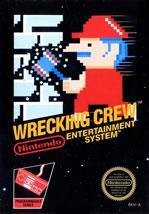
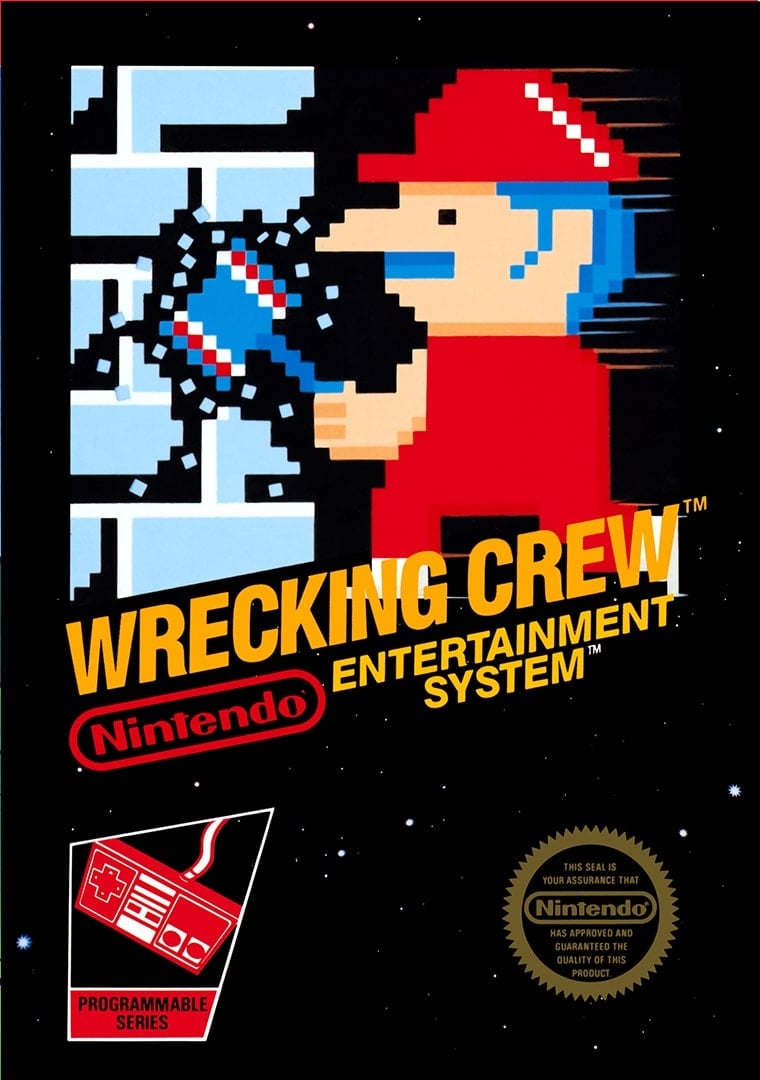
NES Box Art
Famicom Key Art
Famicom Title Screen
Gameplay Video
A complete playthrough of Wrecking Crew showing the full 100-phase grind — including hidden prizes, Foreman Spike encounters, and Golden Hammer power-ups in action.
Trivia
- NES launch title. Wrecking Crew was part of the 18-game NES launch lineup on 18 October 1985 — making it one of only 18 games Western players could choose from at the console's debut, alongside Super Mario Bros., Excitebike, and Duck Hunt.
- Mario\u2019s side gig before plumbing. At various points in Nintendo's early canon, Mario was a carpenter (Donkey Kong, 1981), a plumber (Mario Bros., 1983), and now a demolition worker. Plumbing didn't become his canonical job until Super Mario Bros. later in 1985.
- The game was directed by Satoru Okada, who would later co-design the Game Boy with Gunpei Yokoi and direct or produce most of the Game Boy and Game Boy Advance hardware revisions.
- The DESIGN mode was Nintendo's first level editor. Three decades before Super Mario Maker, this game shipped with a usable in-game phase editor — though Western players couldn't save their creations without Japan-only peripherals.
- The Family BASIC Keyboard and Data Recorder required to save custom phases were originally designed for the Family BASIC programming environment — making Wrecking Crew technically a creative computing tool dressed as a game in its Japanese release.
- Two-player isn't simultaneous. Unlike the arcade VS. Wrecking Crew, the NES game alternates players: one takes over after the other loses a life. The competitive simultaneous mode wouldn't return until Wrecking Crew '98.
- The game has 100 phases — an ambitious count for 1985 — and the cycle restarts from the beginning after Phase 100 is cleared. There is no proper ending.
- The maneki-neko (the “beckoning cat” statue) is one of the hidden prizes — making this one of the very few Western-released NES games to feature an explicitly Japanese cultural object as a gameplay item.
- Hirokazu Tanaka's phase BGM is widely considered one of the best NES soundtracks of the early 8-bit era — an irrepressibly catchy loop that countless Nintendo composers have cited as an influence.
- The Famicom Disk System version (3 February 1989, Japan only) is the rarest variant — the only release where DESIGN mode saving worked natively without external peripherals or emulation tricks.
- Ratings: ESRB E, PEGI 3, CERO A — the game has been rated for all ages in every territory.
- The Japanese title «レッキングクルー» is a direct katakana transliteration of the English “Wrecking Crew” — no localisation changes between regions in the title itself.