
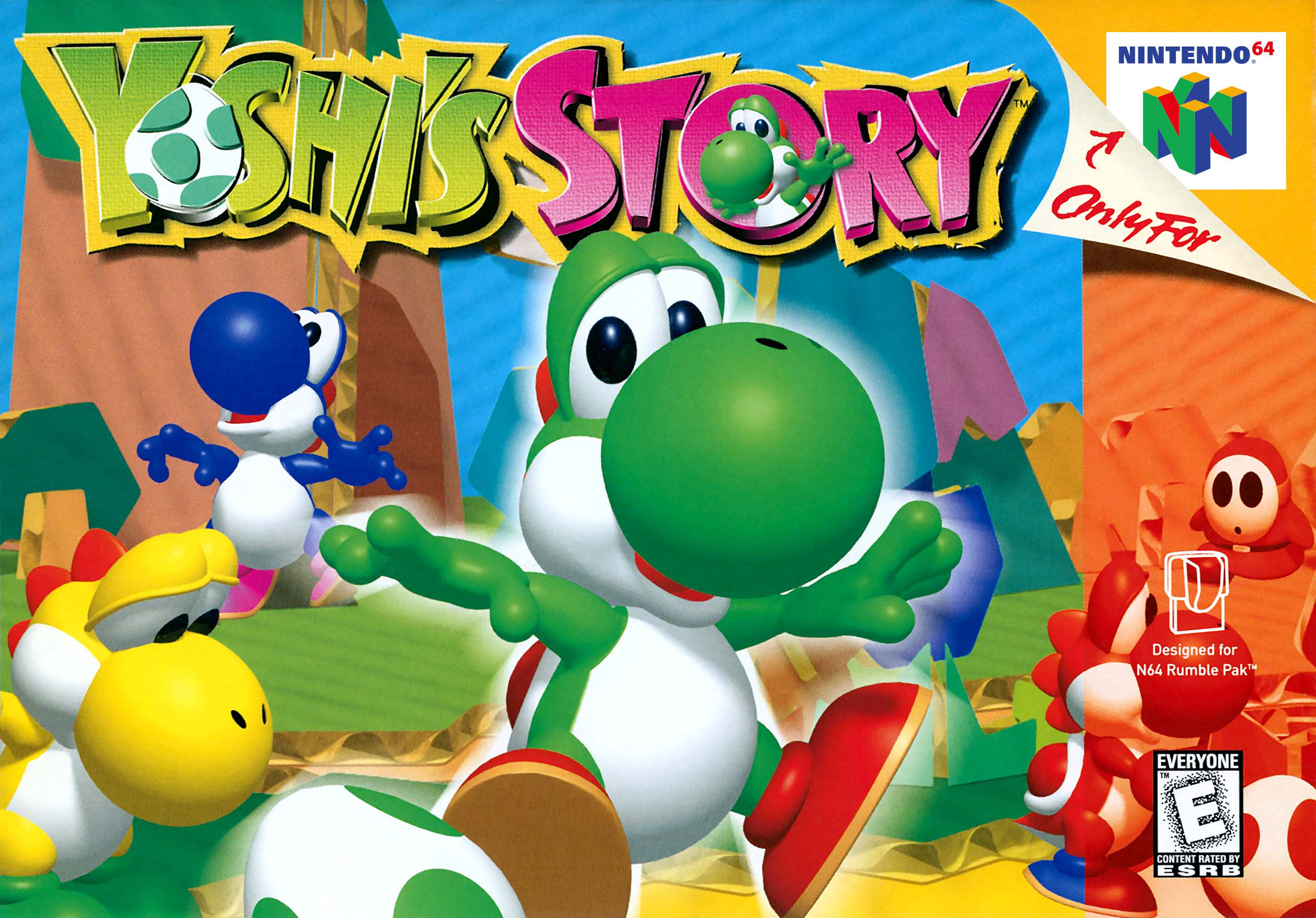
Yoshi's Story
Overview
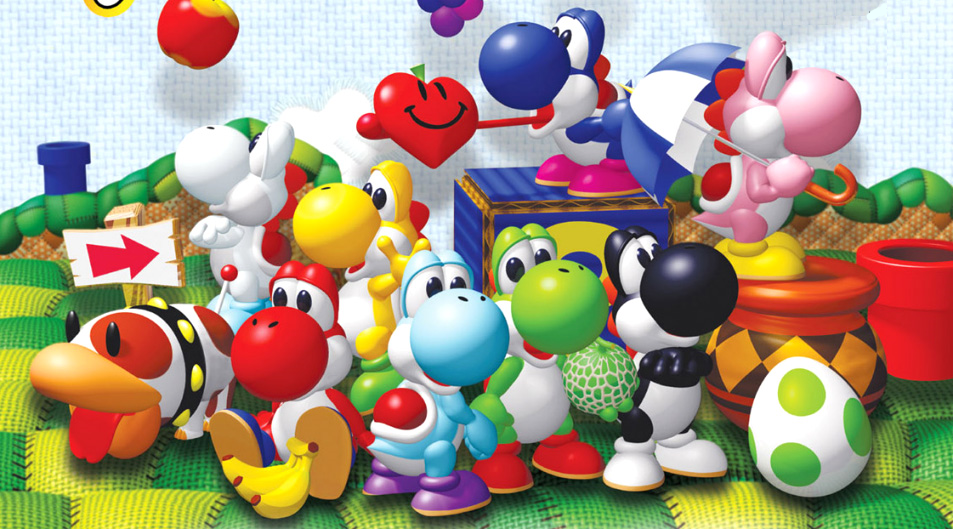
Baby Bowser has taken the Super Happy Tree and cast a spell on Yoshi's world, turning it into the pages of a picture book. The only Yoshis not affected by the spell were six hatchlings still protected by their shells. It's up to them to reclaim the Super Happy Tree and restore happiness to the world — that is the only thing that can break Baby Bowser's spell.
Innovative graphics give the look and feel of handmade materials in 24 fully textured and rendered courses across six “pages” of the island. Yoshi comes alive with personality made possible by the animation and sounds of the Nintendo 64 system — and for the very first time in Mario history, Yoshi has his own voice, provided by composer Kazumi Totaka.
Where its predecessor Super Mario World 2: Yoshi's Island was a goal-driven platformer about getting Baby Mario home, Yoshi's Story is a fundamentally different beast: levels end not when you reach a flag but when you eat exactly 30 fruits. Eat your favourite fruit to score more, find the right melons for points multipliers, sniff out hidden treasures — the gameplay loop is closer to a treasure hunt than a race to the finish.
Story
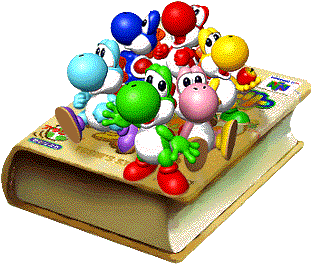
The Yoshis live in harmony on Yoshi's Island, and their ultimate source of happiness is provided by the Super Happy Tree. Baby Bowser becomes jealous of their happiness and steals the tree, crushing their joy — and then performs a spell to turn the entire island into a pop-up picture book.
Six Baby Yoshis hatch on the island and learn what Baby Bowser has done. They set out to retrieve the tree, venturing through six “pages” of the island, eventually fighting him at the end and restoring the Super Happy Tree.
If the player waits about nine seconds on the title screen, the book opens and reads aloud the tale below — reproduced here verbatim:
Out of the blue, the island fell, darkened by an evil spell.
The blink of an eye was all it took and the island became a storybook.
The Super Happy Tree vanished, too, and once-happy Yoshis began to stew.
Only Baby Bowser could be so mean, to ruin the happy Yoshis' dream.
The Island had paid an awful cost, for the Super Happy Tree was lost.
Elsewhere on the pop-up isle, some Yoshi eggs survived the trial.
The spotted eggs in that Yoshi nest would soon face Baby Bowser's test.
One by one, they began to hatch. Six little Yoshis — a perfect batch!
They scratched their heads and looked around. Some even tried to pound the ground.
Sadness darkened every Yoshi's face. It should've been a Super Happy place.
They quickly saw the problem at hand required a cunning Yoshi plan.
“If we grow Super Happy,” the Yoshis thought, “we'll spoil Bowser's evil plot.”
Their mission then was crystal clear. They had to go and spread the cheer!
So it was, they all agreed, to rescue the Super Happy Tree.
They set out to follow the trail of fruit to find where the tree had taken root.
One Yoshi wondered, as he bounced, if Baby Bowser could be trounced.
“We'll stay together,” the others cried, “and stomp his Baby Bowser hide.”
By eating fruit and having fun, the deed would surely soon be done.
And so the Yoshis' quest began, to find the tree and save the land.
Just turn the page and you will see how happiness grows in a tree.
After each completed page, the storybook turns and a recap appears narrating the Yoshis' progress — ending with the recurring refrain:
“The page turned, and the Yoshis grew happier.”
The Six Pages of the Quest
Each “page” is a discrete world with its own theme — from the gentle plains of the beginning to the magma-filled finale at Baby Bowser's castle. The end-of-page screens visualise the Yoshis growing happier, marking the trail back to the Super Happy Tree.
Gameplay
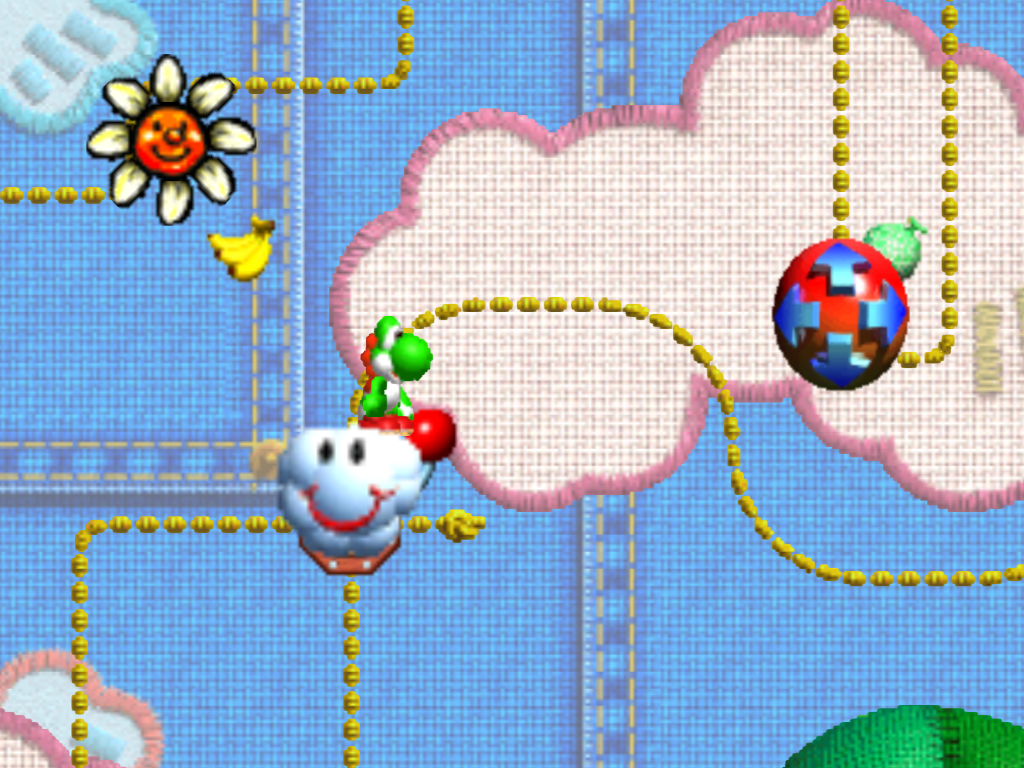
Yoshi's Story is played much like its SNES predecessor Super Mario World 2: Yoshi's Island, but with a few important changes. The timer that counted down for Baby Mario is gone (no more rescuing him on a clock); the Yoshi morph abilities (helicopter, train, etc.) are gone too.
To complete a level, the Baby Yoshis must eat exactly 30 fruits scattered through the level. Before starting a level, the player picks a Baby Yoshi. Each Yoshi has a different taste — eating a fruit (or Shy Guy) matching their own colour recovers more health and scores more points.
The Smile Meter is a flower in the top-left corner that serves as the life bar; petals fall off as the Yoshi takes damage, and the flower's facial expression changes from happy to sad as health drains. Hidden helpers include Miss Warps (who teleport Yoshis to different parts of the level) and Poochy (who can sniff out hidden objects from far away).
If a Baby Yoshi is defeated, that Yoshi is whisked off to Baby Bowser's castle by his Toadies. If all six Baby Yoshis are kidnapped, the game is over. Captured Yoshis (except the secret Black and White Yoshis) can be rescued by finding a White Shy Guy and finishing the level with it.
When you start a game in either Story Mode or Trial Mode, the game randomly selects a Lucky Fruit for the level — said Lucky Fruit heals a Yoshi's entire life bar when eaten, even if that Yoshi normally wouldn't like it.
There are four difficulty levels: Novice, Easy, Medium, and Hard.
Yoshi Moves
The Baby Yoshis can perform a range of moves to complete their adventure. Most are familiar from Yoshi's Island, but some have been tweaked and a brand-new ability — Sniffing — is exclusive to this game.
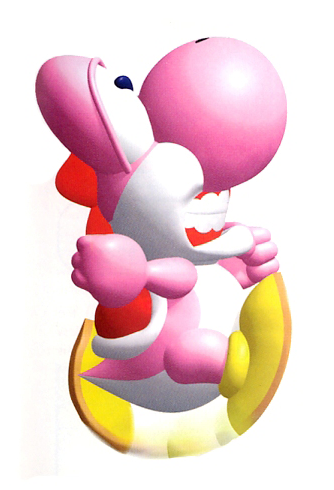
Jump & Flutter Jump
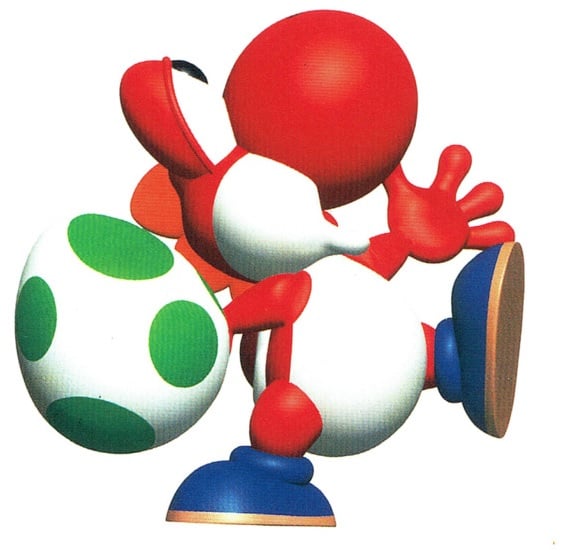
Throwing Eggs
Swallowing
Ground Pound
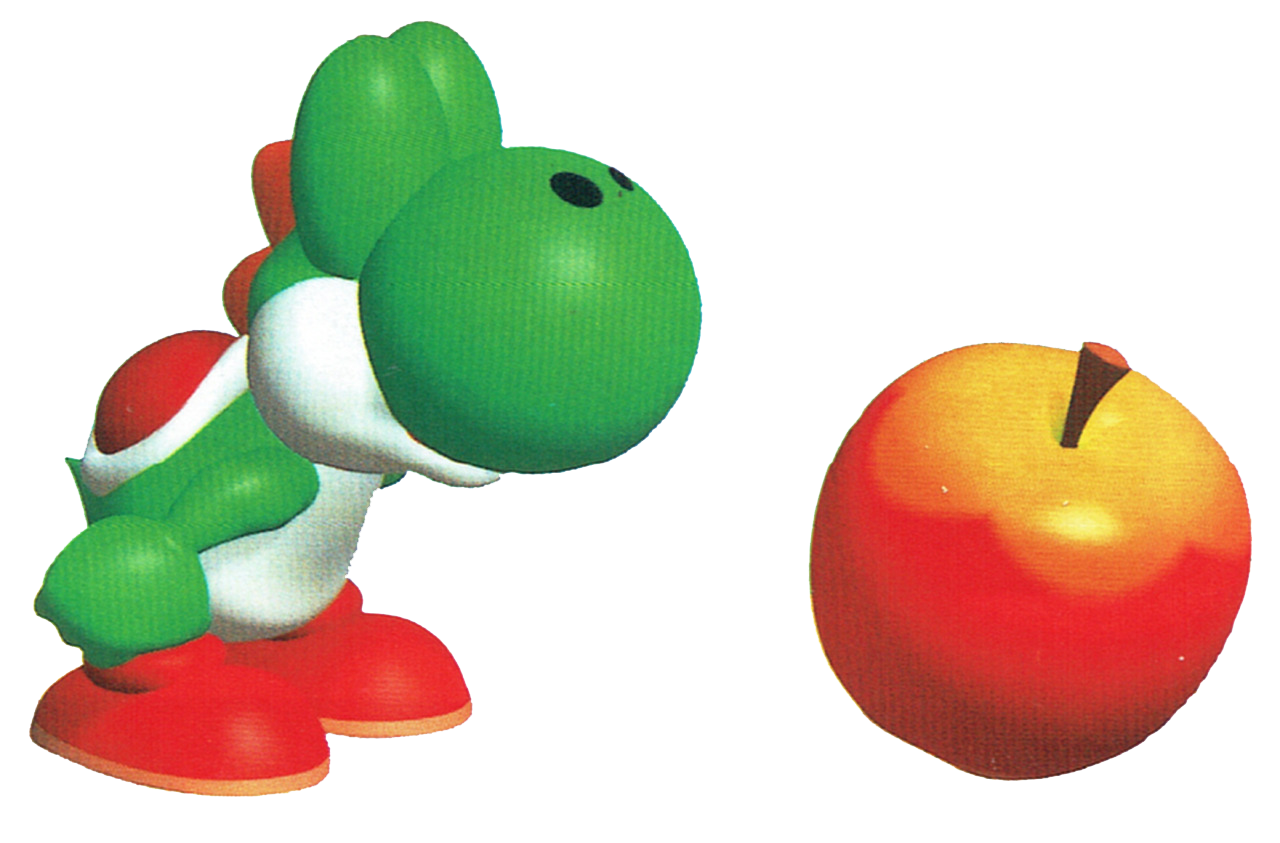
Sniffing (New!)
Game Modes
Story Mode
The main game. Yoshi's Story's Story Mode contains 24 levels (four per world, six worlds), but only six can be played in a single playthrough — the game jumps directly to the next world after a level is completed. To play every level you need to complete the game at least four different times, picking unvisited levels each time.
The player can choose which of the four levels on the first page they wish to start on. However, the choice of levels in later worlds is determined by the number of Special Hearts collected in the previous level. Whenever a level is completed, the Baby Yoshis start singing and a text appears to explain what happened in the level.
Trial Mode
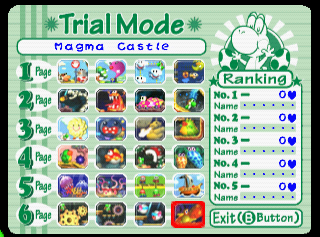
A score-attack mode that lets you replay any stage cleared in Story Mode. The Black and White Yoshis are NOT available here — they're Story-Mode-only.
The most efficient way to score is to eat nothing but melons. If you achieve this, a marker appears at the end of the level. Eating all 30 melons requires sniffing constantly to find every hidden one. To quit a stage early, press Z + START together.
Easter egg: if you wait 2 minutes 10 seconds on the Trial Mode menu, Totakeke's theme plays — composer Kazumi Totaka's signature 19-note song hidden in nearly every game he's worked on.
Practice Mode
An exclusive tutorial level explaining controls and techniques. The only level in the game without 30 melons to collect.
Playable Yoshis
All eight Yoshis are playable. Six default Yoshis hatch at the start of the game; two more — the Black Yoshi and White Yoshi — are unlocked by finding hidden Giant Eggs. The colour you pick functions like a life: each is a separate stock, and the order you select them in matters.
Each Yoshi has a Favourite Fruit that, when eaten, restores more health and scores more points than usual. Eating melons triggers the same bonus regardless of which Yoshi you're playing.
The Default Six

Green Yoshi
Favourite fruit:  Watermelon
Egg colour:  Green
Green

Red Yoshi
Favourite fruit:  Apple
Apple
Egg colour:  Red
Red

Pink Yoshi
Egg colour:  Pink
Pink

Yellow Yoshi
Favourite fruit:  Banana
Egg colour:  Yellow

Blue Yoshi
Favourite fruit:  Grapes
Egg colour:  Blue
Blue

Light Blue Yoshi
Egg colour:  Light Blue
The Hidden Two

White Yoshi
Favourite fruit:  All fruit
Egg colour:  White
White

Black Yoshi
Favourite fruit: All fruit
Egg colour:  Black
Black
Supporting Characters
The Baby Yoshis don't go it alone. These friendly faces lend a paw, a peep, or a sniff along the way.
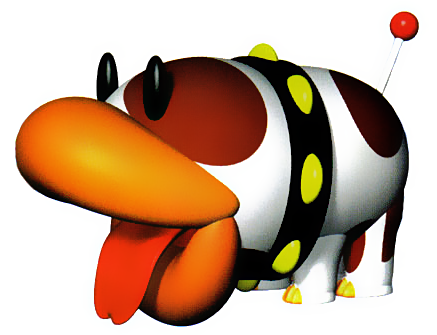
Poochy

White Shy Guy

Miss Warp

Balloon Bully

Dragon

Ghost Rider

Power Bee

Lakitu
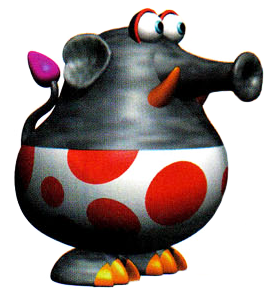
Pak E. Derm
Worlds & Levels
The six “pages” of the storybook each contain four levels (24 in total) but only one level per page is played in a single run — the choice in the next page is determined by the number of Special Hearts collected in the previous level. To experience every level you need to complete the game at least four separate times. Each page closes with an end-of-level screen showing the Yoshis a little happier.
Page 1 — Beginning
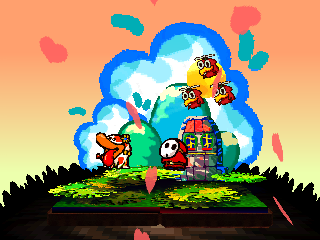
Plains
Coast
Coast
Tower
Page 2 — Cavern
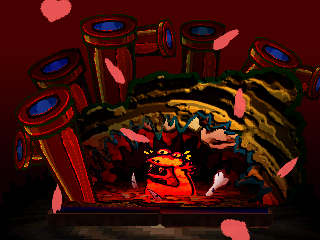
Cave (Black Yoshi Giant Egg here)
Lava / Coast
Sewer / Cave
Sewer (Black Yoshi Giant Egg here)
Page 3 — Summit

Coast
Tower (White Yoshi Giant Egg here)
Snow (White Yoshi Giant Egg here)
Snow / Sewer
Page 4 — Jungle
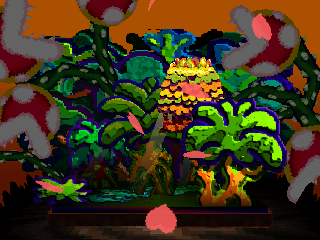
Village
Swamp
Brambles
Swamp
Page 5 — Ocean
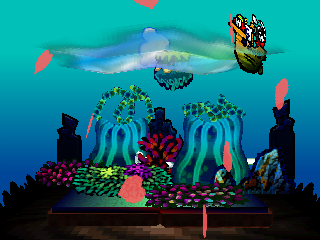
Coast / Underwater
Coast / Underwater
Plains
Coast
Page 6 — Finale
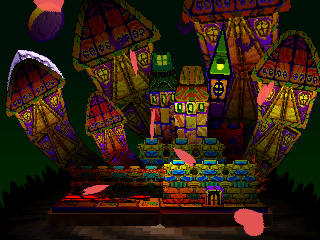
Castle
Castle / Tower
Castle / Cave
Lava / Castle / Cave
Bosses
Each “page” ends with a boss encounter on the page's 4-1 stage. Five named bosses culminate in the final showdown with Baby Bowser at Magma Castle.

Cloud N. Candy

Inviso

Cloudjin

Don Bongo
 (Final Boss) from Yoshi's Story” loading=”lazy”>
Baby Bowser (Final Boss)
Mini-Bosses
Smaller boss-style encounters that appear within individual levels — harder than regular enemies but not the page-finale boss.

Bone Dragon

Slug
Snorkel Snake
Enemies
A bestiary of Baby Bowser's minions, grouped by family. Cards show the standout enemy types — many appear in multiple colour variants throughout the game.
Shy Guy Family

Shy Guy

Flying Shy Guy (Fly Guy)

Snow Guy

Pak E. Derm

Toady

Bob-bomb
Ghost & Lava Family

Boo

Blargg

Spark Spook (Lava Bubble)
Water Family

Cheep Cheep

Piranha Plant

Bullet Bill
Other Notable Enemies

Bumpty

Goonie

Spider

Chomp (Chain Chomp)
Items & Fruit
Fruit is the core currency of Yoshi's Story — you need exactly 30 per level to complete it. Special items hide in the levels too, from health-restoring flowers to score-boosting Special Hearts.
Standard Fruit

Watermelon

Apple

Banana

Grapes

Melon

Heart Fruit
Special Items

Special Heart

Bomb Berry
Giant Egg
Pepper
Power Flower
Tulip
Bumber 'Chute
Coin (Hopping)
Key
Regional Differences
Many small but meaningful changes were made between the Japanese release (21 Dec 1997) and the international versions (9 March 1998 in N. America). Here's the complete catalogue.
- Yoshi voices — In the Japanese version, all eight Baby Yoshis share the same vocal range used for the Green and Yellow Yoshis. International versions gave each colour its own distinct voice.
- Egg Block colours — Japan: all Egg Blocks have green spots regardless of which Yoshi you're playing. International: the Egg Block spot colour matches your current Yoshi's colour.
- Cloudjin damage flash — Cloudjin flashes red when hurt in the Japanese version only.
- Data erase audio — Japan: erasing save data plays an explosion sound. International: plays a fanfare instead.
- Intro font — Japan: the intro is written in a rainbow pastel font. International: a normal font coloured with a two-tone gradient.
- Fruit display at level completion — International: eating 30 of the same fruit shows an image of that fruit on the Level Complete screen. Japan: only a heart icon appears.
- Save in Story Mode — Not possible in the Japanese version. International versions added Story Mode saves.
- Language switching — NTSC version: switch between Japanese and English text. PAL version: the Japanese option was replaced with German and French.
- Eating-on-ground momentum — The international version cancels all momentum when the Yoshi eats a fruit while on the ground.
- Blargg's Boiler — Japan: two bubbled melons above the second-to-last bone bridge. International: only one.
- Shy Guy Limbo music — Only the international versions have a music track for sections where Bamboo Dancers appear.
- Baby Bowser distance — In the final fight, the Yoshis start slightly farther away from Baby Bowser in the Japanese version.
- European Game Over sound — The European version contains an additional sound effect on the Game Over screen.
- Ghost Stream vs Vine Slime — Some Ghost Stream sections in the international versions were replaced with Vine Slimes in the Japanese version.
- Hidden coin letters — The international version adds secret coin formations that spell letters in every level, triggered when a Heart Fruit is eaten by Yoshi. These were entirely absent in the Japanese version.
- Practice Mode glitch — The Japanese version has a glitch that allows the player to play any level from the first world in Practice Mode. International versions fixed this.
Reception
Yoshi's Story received broadly mixed reviews on release. Critics praised the music, graphics and ease of play, but criticism focused on the short play length, low difficulty, and the repetitive fruit-collection objective. Despite the lukewarm reception, the colourful art style and warm soundtrack have earned the game an enduring cult following.
| Publication | Reviewer | Score | Quote |
|---|---|---|---|
| IGN | Peer Schneider | 7/10 | “Story will most definitely sell many many copies based on the reputation of its predecessor. But there will be a lot of unhappy gamers once they discover that Nintendo's mantra seems to have changed to Quality over Quantity of Levels. Trust us: You'll love it when you rent the game, but don't buy it.” |
| GameSpot | Joe Fielder | 5.3/10 | “Yoshi's Story doesn't provide lots of motivation to make you want to pull this off or really even play the game for more than 20 minutes. After a while, you realize it's the same trick over and over: find a piece of fruit, find a heart, find a piece of fruit, find a heart.” |
| Nintendo Life | Jonathan Bee | 6/10 | “Yoshi's Story tells a bare-bones story against a brilliantly colourful backdrop, utilizing some novel platforming mechanics to bolster interest but ultimately falling a little flat in execution. It doesn't approach the level of its classic predecessor on the SNES, but fans of the series might want to take a visit to relive those days of yore.” |
| Metacritic | — | 65 | Aggregator score — “mixed or average reviews” |
| GameRankings | — | 59.91% | Aggregator score |
Sales
The game sold 1.28 million copies in the Americas and 2.85 million worldwide. Despite its mixed reception it became a Nintendo 64 Player's Choice title on August 23, 1998. PC Data reported 679,219 copies sold in the US by the end of 1998, earning $32.6 million — making it the country's 8th best-selling N64 release of the year. In Japan it sold 53,428 copies on launch day alone (placing it #7 on Famitsu's weekly chart), with a total of 618,789 by the end of 1998. In Germany it sold 150,000 units in its first nine months on sale.
Trivia & Easter Eggs
- The game was first revealed at Shoshinkai 1996 under the title Yoshi's Island 64, with an early logo nearly identical to the SNES Yoshi's Island logo. It was originally planned as a direct sequel before the health meter and storybook framing changed its identity.
- This is the first game ever to give Yoshi a voice. Composer Kazumi Totaka provided all the Yoshi vocals himself — making him both the game's composer AND Yoshi's voice actor. He's voiced Yoshi in essentially every Mario game since.
- It was the first Yoshi platformer not produced or directed by Shigeru Miyamoto. Miyamoto served as supervisor and contributed design ideas, but Hideki Konno took the director role (he had previously directed Super Mario World 2: Yoshi's Island).
- Totakeke's Theme easter egg: wait 2 minutes 10 seconds on the Trial Mode stage-select screen and Kazumi Totaka's signature 19-note tune plays. Totaka hides this melody in nearly every game he's composed for — Yoshi's Story is one of its earliest hiding places.
- The game was the first Super Mario/Yoshi game on the Nintendo 64 in North America rated E for “Everyone” — the ESRB had just switched from the previous “K-A” (Kids to Adults) rating to “E” in 1998.
- Nintendo described the game's graphics as “2.5D” — lush, hand-crafted-looking levels rendered as 2D sprites against pre-rendered 3D backgrounds. Miyamoto said the 2D format was necessary to create the artistic style the team wanted.
- A short tech demo called Yoshi Demo was shown when the Game Boy Advance was first announced (April 10, 2000). It was either a port of Yoshi's Story to the GBA or a direct sequel — it was never released, but the GBA game Yoshi Topsy-Turvy later inherited the same art style and mechanics, making it the closest thing to a spiritual sequel.
- Promotional Shaped CD: a 15-track promotional soundtrack Music to Pound the Ground To was released in North America. The disc was physically shaped like Yoshi's head — striking but incompatible with most non-portable CD players.
- The full Japanese soundtrack album, Yoshi Story Original Soundtrack, was released by Pony Canyon on February 4, 1998. The European version was Love, Peace & Happiness, a 28-track album released by Nintendo of Europe on April 9, 1998.
- Yoshi's sprites in Yoshi's Story reuse Yoshi's design from Mario Kart 64 — that's where his classic blocky-N64-era look originated.
- The Yoshi soundtrack was made available in its entirety on the Nintendo Music app on June 24, 2025.
- A small portion of the “Flower Garden” track from Yoshi's Island can be heard 43 seconds into the “Games of Happiness” track in Yoshi's Story — a hidden audio callback.
- Despite the mixed reviews, the game still became a Nintendo 64 Player's Choice title less than five months after its NA release.
- Yoshi's Story was the subject of volumes 19 and 20 of Super Mario-kun, the long-running Japanese Mario manga.
- In the Japanese version, the opening intro is written in a rainbow pastel font; international versions use a more standard two-toned gradient font instead.
- The game was originally intended for a North American release by the 1997 holiday season — but was delayed until March 1998. A Nintendo official said this was “based on us demanding A-plus quality.”
- The Super Smash Bros. Brawl Chronicle (North American version) erroneously states that Yoshi's Story was released on February 20, 1998 — the actual release date was March 9, 1998.
- The serial code for the Japanese cartridge is NUS-NYSJ-JPN. The iQue Player (China) release was on March 25, 2004.
- The game has been re-released on the Wii Virtual Console (2007), Wii U Virtual Console (2016), and Nintendo Switch Online (N64 Classics) on October 25, 2021.
- Hiroshi Yamauchi — the legendary president of Nintendo who steered the company from playing cards to global gaming dominance — was the game's executive producer.
References to Other Games
Yoshi's Story draws heavily on its predecessor, but its own design DNA can be felt across two decades of Yoshi and Mario games since.
Super Mario World 2: Yoshi's Island (1995)
- Yoshi's Story was originally to be called Yoshi's Island 64 when first announced at Shoshinkai 1996.
- Many elements return: flutter jump, eggs, Shy Guys, Boos, Bumpties, fruit, Toadies. The two games share very similar gameplay DNA.
- A small portion of the “Flower Garden” track can be heard 43 seconds into the “Games of Happiness” track in this game.
Mario Kart 64 (1996)
- Yoshi's sprites in Yoshi's Story use Yoshi's design from Mario Kart 64 — the same blocky-cute look.
References in Later Games
The Yoshi's Story aesthetic has echoed through Mario's history for nearly thirty years.
Super Smash Bros. (1999)
- The Yoshi's Island stage is based on Yoshi's Story — the pastel storybook-edge stage shape with clouds and Flying Shy Guys. (The MarioWiki article for the stage is now titled “Super Happy Tree”.)
- Some of Yoshi's moves and animations in Super Smash Bros. originate from Yoshi's Story.
Super Smash Bros. Melee (2001)
- The Yoshi's Island stage from the original SSB returns, AND a new stage called Yoshi's Story is playable.
Super Mario Sunshine (2002)
- The main way of keeping the Yoshis healthy in this game is by eating fruits — a direct callback to the 30-fruit mechanic of Yoshi's Story.
Yoshi Topsy-Turvy (2004) / Yoshi's Touch & Go
- Yoshi's Island is turned into a storybook again — the spiritual sequel that picked up where Yoshi's Story left off.
Mario Superstar Baseball (2005) / Mario Super Sluggers (2008)
- The Super Happy Tree appears in Yoshi Park.
- In Super Sluggers, the park's music is an arrangement of “Yoshi's Song” and the “Yoshi's Story” theme.
Super Mario 64 DS (2004)
- The Yoshis' Smile Meter reappears in the minigame Loves Me…? — the flower-petal life bar from Yoshi's Story revived as a yes/no game.
Super Smash Bros. Brawl (2008) / SSB for 3DS (2014)
- An arrangement of “Yoshi's Tale” from Yoshi's Story is a playable track on the Yoshi's Island stage in both games.
Mario & Sonic at the London 2012 Olympic Games
- Rail Lift (1-3) appears as the setting of the Dream Long Jump event.
- An arrangement of “Yoshi's Song” is used as background music for the event.
Mario Tennis Open (2012)
- All eight Yoshis from Yoshi's Story (including the unlockable Black and White Yoshis) are playable in the game.
Nintendo Land (2012)
- The Yoshi's Fruit Cart attraction requires the player to collect fruits — a direct nod to the 30-fruit mechanic.
- All Yoshi's Story fruits except the Bomb Berry appear.
- An arrangement of “Yoshi's Song” plays in the daytime stages, and “Yoshi's Tale” plays in the nighttime stages.
- “Yoshi's Song” and “Yoshi's Tale” are both included in the credits medley.
Mario Golf: World Tour (2014)
- The Yoshi Lake course is inspired by Yoshi's Story.
- Its music is an arrangement of the “Yoshi's Story” track.
Yoshi's Woolly World (2015)
- Some of the elements were borrowed from and inspired by Yoshi's Story, and it also stars Yoshi without Mario similarly to that game.
Super Smash Bros. Ultimate (2018)
- The Yoshi's Story stage reappears, along with the Yoshi's Island stage from Super Smash Bros. (renamed “Super Happy Tree”).
- Don Bongo, Pak E. Derm, the Super Happy Tree, and Blargg all appear as spirits, using their Yoshi's Story appearances.
WarioWare: Get It Together! (2021)
- A microgame based on Yoshi's Story is included.
The Super Mario Bros. Movie (2023)
- At the construction site, crates have pictures of grapes and bananas that resemble their Yoshi's Story depictions.
- Watermelons with zigzag lines appear on a fruit stand later in the film, also resembling the Yoshi's Story watermelons.
Super Mario Bros. Wonder (2023)
- Wheel lifts (large rotating platforms) return from Yoshi's Story.
Videos
Longplay of Yoshi's Story in HD, played as the NTSC version on the Nintendo 64.
Nintendo 64 longplay with chapter timestamps for every page-opening level (1-1 Treasure Hunt, 2-1 Bone Dragon Pit, 3-1 Cloud Cruising, 4-1 Jungle Hut, 5-1 Lots O'Jelly Fish, 6-1 Mecha Castle).