
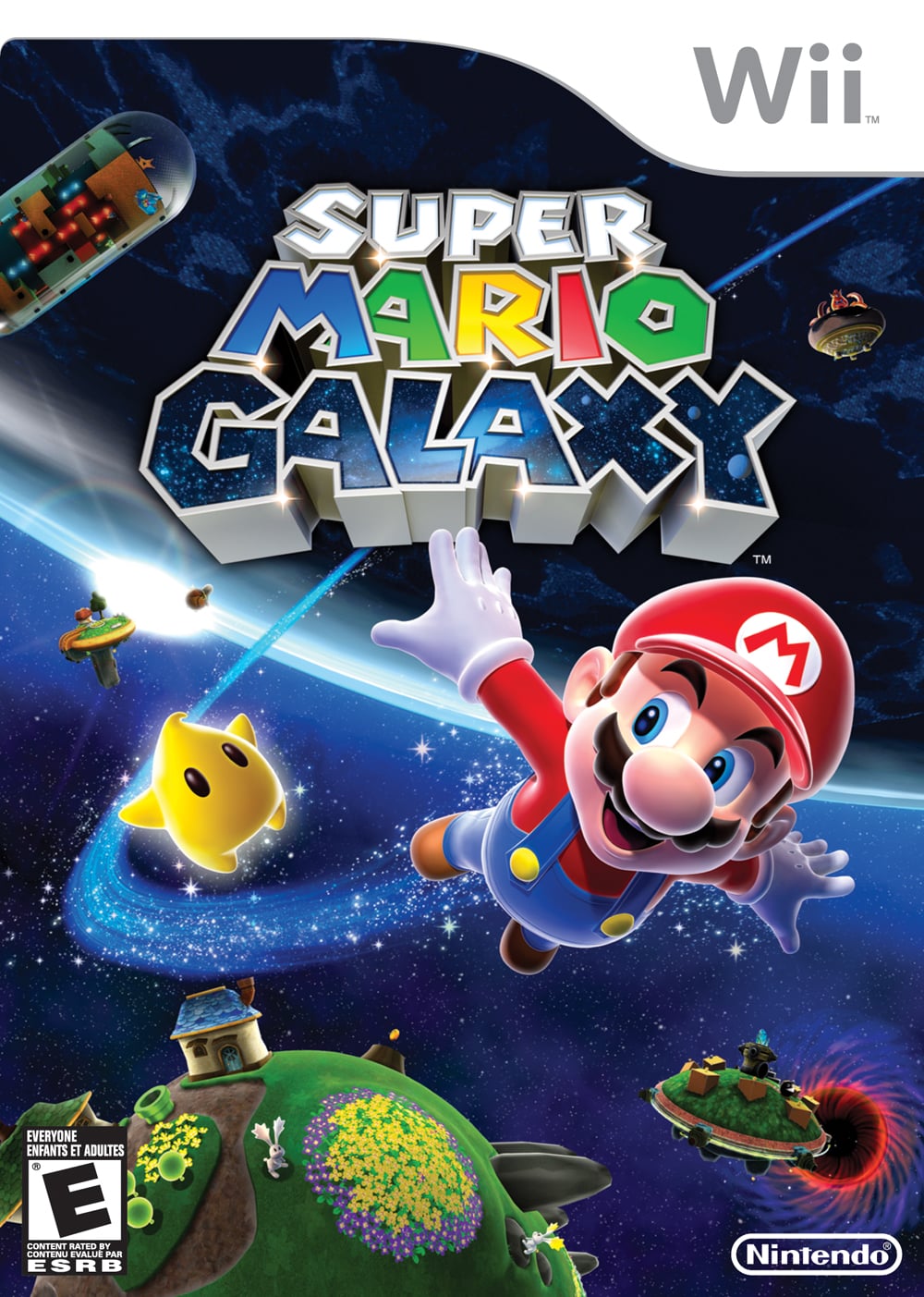
Super Mario Galaxy
The ultimate Mario experience — spherical planets, outer space, and orchestral wonder
Overview
Super Mario Galaxy is the third 3D entry in the Super Mario series and, by almost any measure, one of the greatest games ever made. Released for Wii in November 2007, it takes Mario out of the Mushroom Kingdom entirely — launching him into outer space, across 42 galaxies, through environments that no Mario game had ever attempted before. Gravity bends around spherical planetoids. Mario runs along the outside of tiny worlds. The camera orbits with him. Nothing quite like it had existed before.
The game arrived at a moment when the Wii had proven its motion controls could work for casual games — and Super Mario Galaxy proved they could work for a masterpiece. Using the Wii Remote to collect Star Bits and perform the spin move, with the Nunchuk handling movement, the controls are intuitive yet deep. It went on to win a BAFTA, score 97/100 on Metacritic (one of the highest scores ever recorded), and sell over 12 million copies worldwide.

Mario and Peach soar through the cosmos

Pull Stars in the Space Junk Galaxy
The game was developed by Nintendo EAD Tokyo — the same team that created Donkey Kong: Jungle Beat — under the direction of Yoshiaki Koizumi and produced by Shigeru Miyamoto. Its development traced back to a Super Mario 128 tech demo shown at SpaceWorld 2000, which demonstrated 128 Marios moving simultaneously on spherical surfaces — the seed of what would eventually become Galaxy.
Story
Once every hundred years, a great comet flies over the Mushroom Kingdom. From it fall shooting stars which the Toads gather as Star Bits — mysterious fragments that coalesce into Power Stars. It is a time of celebration: the Star Festival.

The Star Festival — the opening of Super Mario Galaxy
Princess Peach invites Mario to the festival with a letter: “I’ll be waiting for you at the castle on the night of the Star Festival. There’s something I’d like to give you.” Mario sets off — but arrives to find Bowser attacking. The Koopa King tears Peach’s castle from the ground with a massive UFO and hurls it into space. Mario is launched into the cosmos by a mysterious object.
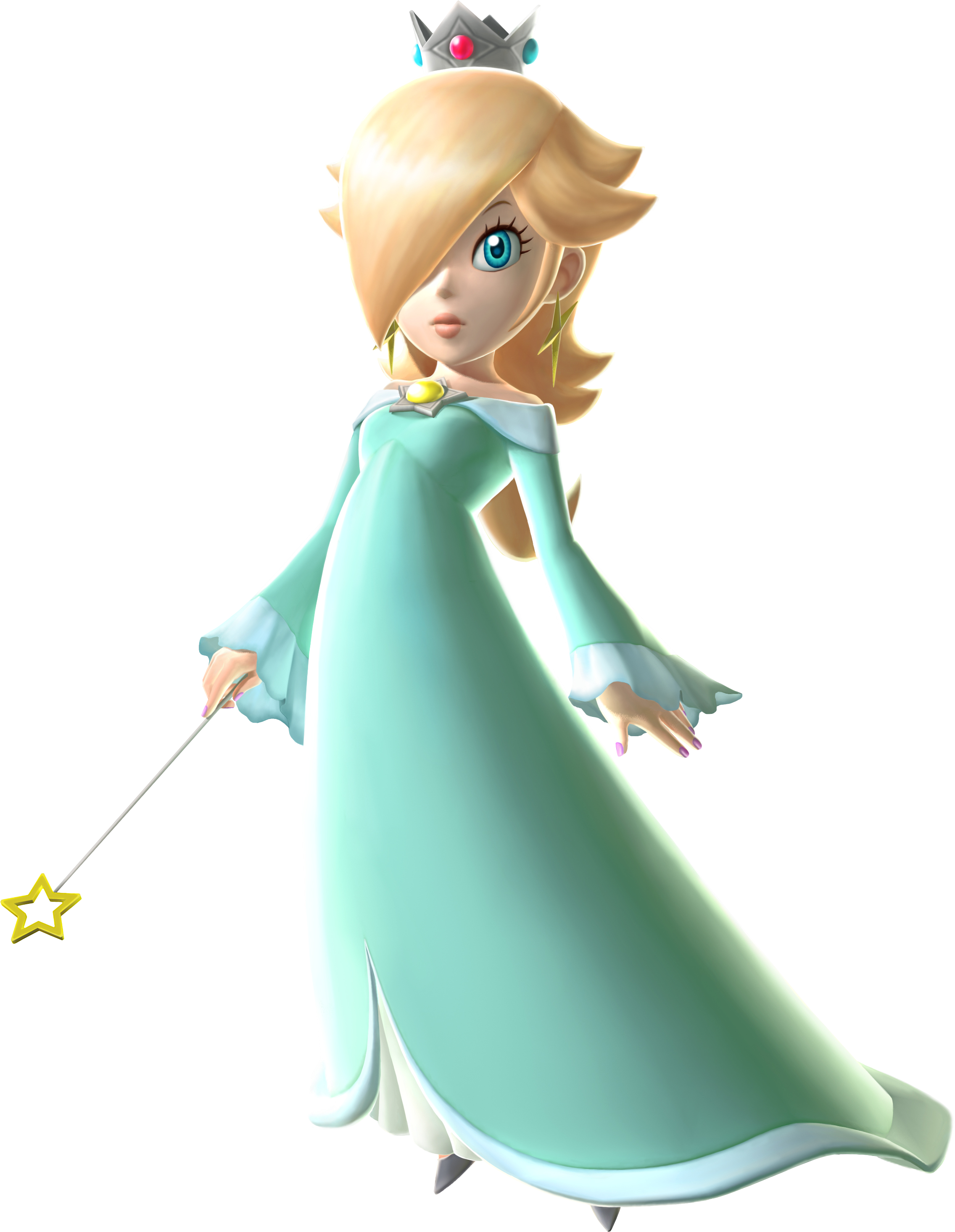
He awakens on the Comet Observatory — a star-shaped space station home to Rosalina, a mysterious cosmic guardian, and her family of star children called Lumas. Bowser has stolen the observatory’s Power Stars and Grand Stars, leaving it adrift. Mario must travel across the galaxies to recover them, power the Observatory, and rescue Princess Peach from Bowser’s new kingdom at the centre of the universe.

Mario meets Rosalina in the Comet Observatory library
“Every hundred years, a huge comet flies by in the skies above the Mushroom Kingdom. One year, that comet filled the entire sky, and from it fell a stream of shooting stars.” — official instruction booklet
Gameplay & controls
Super Mario Galaxy builds on the 3D platforming of Super Mario 64 and Sunshine but transforms it fundamentally with one core idea: gravity is directional. Each planetoid, planet and asteroid has its own gravitational pull. Mario walks around their surfaces — upside-down, sideways, in loops — with the camera adjusting constantly to keep it comprehensible. The result is an experience unlike any platformer before it.
Core controls
Shake the Wii Remote to perform Mario’s signature spin — the most versatile move in the game. Defeats enemies, activates Launch Stars, interacts with objects, and gives a brief mid-air boost.
Point the Wii Remote at the screen to collect Star Bits. In Co-Star Mode, a second player controls the pointer to stun enemies and collect bits while player one handles Mario.
Collected from the environment with the pointer or from defeated enemies. Can be fired at enemies to stun them. Also fed to hungry Lumas to unlock new galaxies.
Spin into a Launch Star to be fired across space to a new area or planet. The primary mode of travel between planetoids.
Use the pointer to pull Mario through chains of Pull Stars — floating guide points — to navigate across gaps in space.
A second player joins with a second Wii Remote. They control a star cursor: collecting Star Bits, stunning enemies, and even holding Mario mid-air. Asymmetric co-op.
Prankster Comets
Prankster Comets appear over galaxies and add special challenge missions. There are five types:
Dino Comet
Unlocks a mission in a galaxy where Mario must race a cosmic clone of himself to the Power Star
Fast-Foe Comet
All enemies and hazards in the galaxy move at double speed
Ghost Comet
A Cosmic Mario clone races Mario to the Power Star — identical to the Cosmic Comet
Speedy Comet
A strict time limit is applied to completing the galaxy mission
Purple Comet
Replaces all coins with Purple Coins — collect 100 to earn the star
Playing as Luigi
After completing the main game, Luigi becomes fully playable for the entire adventure. He handles differently from Mario — jumping higher and further but with less traction, making him harder to control but faster across open ground. Collecting all 120 stars with Luigi unlocks a special ending.
The Comet Observatory
The Comet Observatory is Mario’s hub world — a beautiful, star-shaped space station that serves as home to Rosalina and the Lumas. As Mario collects Grand Stars, he restores power to the Observatory’s six domes, each of which opens access to a new set of galaxies. The Observatory itself is explorable, with different areas unlocking throughout the game:


Galaxies
There are 42 dedicated galaxies across 6 domes. Each galaxy contains multiple Power Star missions, and some have hidden stars unlocked via Prankster Comets or secret paths. Here are key galaxies from each dome:


Characters
Super Mario Galaxy introduces one of the most beloved new characters in the franchise’s history alongside the familiar cast:




Power-ups
Super Mario Galaxy introduces an entirely new set of power-ups — most unique to this game — each transforming Mario’s abilities in spectacular ways:


Bosses
Most bosses are enhanced versions of regular enemies, and nearly all telegraph their weaknesses through environmental hints in the level before the fight. All are defeated using the spin attack on their vulnerable points:


Reception
Super Mario Galaxy received universal acclaim on release and has retained its status as one of the greatest games ever made. Its Metacritic score of 97/100 — from 73 critical outlets — makes it the fourth highest-rated game on the site of all time, behind only Ocarina of Time, SoulCalibur and GTA IV. It was the highest-rated game on GameRankings (with at least 20 reviews) before that site closed in 2019.
Critics praised the game’s artistic vision, its orchestral soundtrack (one of the first Mario games with a full live orchestra), the inventive use of gravity mechanics, and the deeply felt story of Rosalina and the Lumas. It won a BAFTA for Best Game in 2008 and multiple Game of the Year awards. Sales surpassed 12 million copies worldwide.
- 97/100 Metacritic — all-time great
- BAFTA Best Game 2008
- Full live orchestral soundtrack
- Rosalina’s storybook — emotionally resonant
- Inventive gravity-based platforming
- Co-Star Mode for 2 players
- Some galaxies feel short
- Camera can struggle in tight spaces
- Purple Coin missions feel repetitive
- Co-Star player has a limited role
Trivia & facts
- Super Mario Galaxy began life as the Super Mario 128 tech demo shown at SpaceWorld 2000 — a demonstration of 128 Marios moving simultaneously on spherical surfaces that wowed the industry but never became a game until Galaxy
- The game’s development was originally codenamed “Super Mario Revolution” in 2005, after the Wii’s internal codename “Revolution”
- It was the first 3D Mario game where Wiggler appeared as a standard enemy rather than a boss
- The game opens with a letter from Peach to Mario — a direct callback to Super Mario 64 and Super Mario 64 DS
- Super Mario Galaxy won a BAFTA for Best Game in 2008 — one of the first Nintendo games to win the award
- The game features the first full live orchestral soundtrack in the main Mario series — composed by Mahito Yokota and Koji Kondo
- The sequel Super Mario Galaxy 2 was announced at E3 2009 — notably not at the same E3 where Galaxy was announced, but two years later
- Yoshi’s head can be spotted as a small planet in Space Junk Galaxy — an Easter egg foreshadowing Galaxy 2
- The soundtrack contains heavy remixes of Super Mario Bros. 3’s music, particularly in the Bowser boss stages
- Like Paper Mario, Bowser steals Peach’s entire castle to capture the princess — lifting the whole structure into space
- A planet in the game bears a strong resemblance to a giant Megavitamin from Dr. Mario
- The game was released in Korea under the translated title “Super Mario Wii: Galaxy Adventure”
- A trading card game based on Super Mario Galaxy was released, featuring characters, items and enemies from the game
- There are visual similarities between the Ricco Harbor Blooper Safari minigame from Sunshine and Galaxy’s surfing sections in Sea Slide Galaxy
Videos
Four videos from our collection covering Super Mario Galaxy:
E3 2007 gameplay trailer
North American TV commercial
Let’s Play Together commercial
Gameplay footage