
 |
Character fact sheetName: Donkey Kong (DK) (ドンキーコング, Donkī Kongu in Japanese) First Appearance: Donkey Kong (Arcade, 1981) Home: DK Island / Kongo Jungle Voiced by: Takashi Nagasako (Japanese, 1999–present), Grant Kirkhope (1999–2004), Chris Sutherland (2007–2018), Akira Tsuda (Japanese, 2025–present) Associates: Diddy Kong (nephew/sidekick), Cranky Kong (grandfather), Funky Kong, Dixie Kong, Pauline (modern friend), the Kong family |
General profile
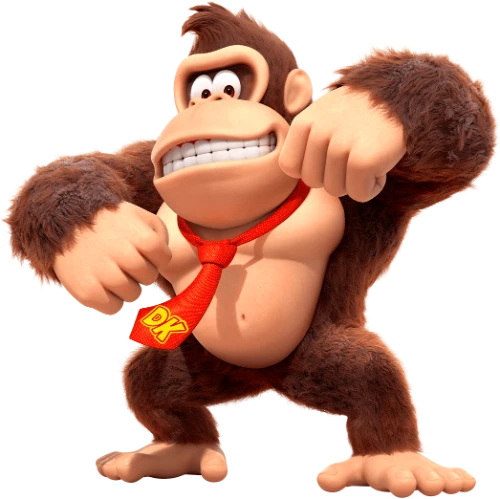
Donkey Kong, known affectionately to fans as "DK," is one of Nintendo’s most iconic characters and a foundational figure in video-game history. He debuted as the antagonist of the 1981 Donkey Kong arcade game — making him Mario’s original enemy and the very first major Nintendo character outside of Mario himself. Modern DK — with his trademark crimson tie bearing the "DK" logo, his enormous muscular ape build, and his cheerful but reckless personality — was reimagined for Donkey Kong Country on the SNES in 1994 by British developer Rare. This Rare-era redesign has since become the canonical Donkey Kong appearance and is the version recognised today across all Mario-adjacent media.
The relationship between the 1981 arcade Donkey Kong and the modern DK is a fascinating piece of Nintendo retroactive continuity: the original arcade villain has been recanonised as "Cranky Kong" — the modern DK’s grandfather (or in some sources great-grandfather) — while modern Donkey Kong is officially the grandson, the new generation. This generational succession was first established in Donkey Kong Country (1994), which features Cranky Kong as a wisecracking old timer who lives in a treehouse and refers explicitly to having been the original Donkey Kong of the arcade games. Donkey Kong Jr. — the playable character of the 1982 Donkey Kong Jr. arcade game — is sometimes interpreted as the modern DK’s father in the Rare canon, though Nintendo has never officially confirmed this.
DK has anchored two full game franchises: the original Donkey Kong arcade series (1981–1983, including Donkey Kong, Donkey Kong Jr., and Donkey Kong 3) and the Rare-developed Donkey Kong Country / Country Returns / Country: Tropical Freeze / Donkey Kong Bananza series (1994–2025). Beyond these solo franchises, he has been a permanent fixture of the Mario series spin-offs — Mario Kart from MK64 (1996), Mario Party from Party 1 (1998), Super Smash Bros. from the original Smash 64 (1999), every major Mario sports title, and the 2023 Super Mario Bros. Movie (where he was voiced by Seth Rogen). The Switch 2 launch title Donkey Kong Bananza (July 2025) brought DK back into the platforming spotlight after an 11-year gap since Tropical Freeze.
Quotes
Enemies
Donkey Kong’s arch-nemesis across the entire Donkey Kong Country lineage is King K. Rool, the swaggering King of the Kremlings who repeatedly steals DK’s banana hoard, kidnaps his friends and family, and threatens DK Island. K. Rool has appeared as the primary antagonist of Donkey Kong Country (1994), Donkey Kong Country 2: Diddy’s Kong Quest, Donkey Kong Country 3, and Donkey Kong 64. DK also fights the Tiki Tak Tribe (DKC Returns, 2010), the Snowmads led by Lord Fredrik (DKC: Tropical Freeze, 2014), and in earlier games against Mario himself (in the 1981 arcade game, where Mario rescues Pauline from him). In modern continuity, the 1981 conflict has been retconned to the original arcade Donkey Kong (Cranky Kong), with modern DK and Mario now considered allies.
Friends
Donkey Kong’s closest companion is his nephew Diddy Kong, who has been his constant sidekick since Donkey Kong Country (1994). Diddy serves as DK’s co-protagonist in nearly every Country entry, in Donkey Kong 64, in Mario Kart games, and in Mario sport spin-offs. Beyond Diddy, DK’s extended family includes Cranky Kong (his grandfather, the original arcade DK), Funky Kong (Cranky’s nephew, the bombastic surfer), Dixie Kong (Diddy’s girlfriend), Tiny Kong (Dixie’s sister), and Chunky Kong. The Kong Family forms one of the most extensive familial groups in Nintendo continuity. DK is also on friendly terms with Mario (in modern continuity, after their 1981 quarrel was retconned), Princess Peach, Pauline (his former captive turned friend, particularly in Donkey Kong Bananza), and the wider Mushroom Kingdom cast.
Appearances
Donkey Kong (Arcade, 1981)
 DK’s 1981 arcade debut was both the character’s and Mario’s introduction to the world. Designed by Shigeru Miyamoto and developed by Nintendo R&D2, the original Donkey Kong arcade game features DK as the villain: he steals Mario’s girlfriend Pauline and climbs to the top of an unfinished construction site, hurling barrels and fireballs at Mario as he tries to climb up to rescue her. The character was created by Miyamoto specifically as "a stubborn but lovable giant ape" — a deliberate Hollywood reference to King Kong (1933) and Mighty Joe Young (1949). The arcade game sold approximately 132,000 units and became one of the most commercially successful arcade games of the early 1980s.
Donkey Kong Jr. (1982) and Donkey Kong 3 (1983)
The original arcade-era trilogy concluded with Donkey Kong Jr. (1982) and Donkey Kong 3 (1983). In Donkey Kong Jr., the player controls DK’s son rescuing his captured father from Mario — the rare instance in video-game history where Mario is the antagonist. In Donkey Kong 3 (1983), DK serves as the boss-character pursued through a greenhouse setting by exterminator Stanley the Bugman.
Donkey Kong Country (1994) and the Rare reboot
 In November 1994, British developer Rare released Donkey Kong Country for the Super Nintendo Entertainment System — a complete reimagining of the character that re-defined Donkey Kong for the modern era. Developed by Tim and Chris Stamper at Rare, the game introduced the now-canonical DK design: a muscular brown ape with a red tie bearing the "DK" logo. It also retconned the original 1981 DK as "Cranky Kong" (the grandfather), introducing modern DK as a new generation of the same family line. Donkey Kong Country sold approximately 9.3 million copies worldwide, making it the highest-selling third-party SNES game and the third-highest-selling SNES game overall. The Rare design has remained DK’s canonical appearance ever since.
Donkey Kong Country 2, 3, and Donkey Kong 64 (1995–1999)
The original Donkey Kong Country trilogy continued with Donkey Kong Country 2: Diddy’s Kong Quest (SNES, 1995) and Donkey Kong Country 3: Dixie Kong’s Double Trouble (SNES, 1996). The Nintendo 64 entry Donkey Kong 64 (1999), also developed by Rare, expanded the Kong Family roster and introduced the famous "DK Rap" opening theme — a deliberate parody of 90s rap that has become an enduring meme. DK 64 sold approximately 5.27 million copies.
Donkey Kong Country Returns (2010) and Tropical Freeze (2014)
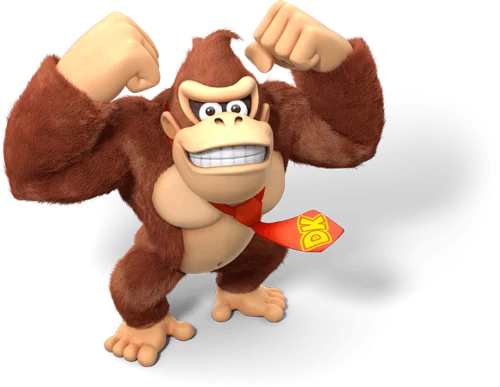 After Rare’s departure from Nintendo in 2002, the Country series was revived by Texas studio Retro Studios. Donkey Kong Country Returns (Wii, 2010) re-established the platformer pedigree, selling approximately 6.5 million copies worldwide. Its sequel Donkey Kong Country: Tropical Freeze (Wii U, 2014) introduced new Kong cast members Cranky Kong as a playable character and a substantially upgraded co-op mode; the Switch port (2018) is widely considered the definitive version. Tropical Freeze has sold over 6.4 million copies across both platforms.
The Super Mario Bros. Movie (2023)
 Donkey Kong featured as one of the major supporting characters in Illumination’s The Super Mario Bros. Movie (April 2023), voiced by Seth Rogen. The film’s portrayal of DK depicts him as the brash, hot-headed son of King Cranky Kong and ruler of the Jungle Kingdom — a deliberate adaptation of the Country-era Kong dynasty for a family-friendly cinematic narrative. The film earned over $1.36 billion worldwide, making it the most commercially successful video-game adaptation of all time. A sequel — The Super Mario Galaxy Movie — is scheduled for April 2026 release, with Donkey Kong confirmed to return.
Donkey Kong Bananza (2025)
 Donkey Kong returned to the platforming spotlight in Donkey Kong Bananza, the launch flagship title for the Nintendo Switch 2 (July 2025). Developed by the EPD team behind Super Mario Odyssey rather than Retro Studios, Bananza is the first major Donkey Kong platformer in 11 years (since Tropical Freeze in 2014) and marks DK’s transition into a 3D destruction-based platformer. The game features Pauline as DK’s reluctant co-protagonist — a significant character moment that reconciles the two former arcade antagonists. Donkey Kong Bananza was one of the Switch 2’s flagship launch titles and sold over 4.6 million copies in its first quarter.
Mario Kart series (1996–present)
DK has been a playable racer in every Mario Kart since Mario Kart 64 (1996), classified as a heavyweight throughout. He has appeared in Mario Kart 64, Mario Kart: Super Circuit, Mario Kart: Double Dash!!, Mario Kart DS, Mario Kart Wii, Mario Kart 7, Mario Kart 8 / 8 Deluxe, Mario Kart Tour, and Mario Kart World (Switch 2, 2025). Mario Kart 8 Deluxe’s Booster Course Pass DLC added a re-designed "DK Mountain" track in 2023.
Super Smash Bros. (1999–present)
Donkey Kong joined the inaugural Super Smash Bros. roster for the Nintendo 64 (1999) and has been included in every Smash entry since: Melee (GameCube, 2001), Brawl (Wii, 2008), Smash for 3DS/Wii U (2014), and Super Smash Bros. Ultimate (Switch, 2018). His signature attacks include the "Giant Punch" (a chargeable forward smash) and the "Final Smash Konga Beat," in which DK summons the conga drums from Donkey Konga for an area-of-effect strike.
Mario Party / Mario Tennis / Mario Sports / Mario Strikers
DK has been a default character in every Mario Party since Mario Party (Nintendo 64, 1998), in every Mario Tennis since the original (1995), in Mario Power Tennis, Mario Tennis Aces, Mario Golf series, Mario Super Sluggers, Mario Strikers Charged, Mario Strikers: Battle League, and the Mario & Sonic at the Olympic Games series since the original Beijing 2008 entry. He is consistently classified as a Power-type athlete with strong physicality and limited mobility.
Trivia & Official Sources
- Donkey Kong was created by Shigeru Miyamoto in 1981 for the arcade game of the same name. The character’s name was Miyamoto’s reference to the donkey-like stubbornness he intended for the antagonist plus a play on the "Kong" nomenclature familiar from King Kong (1933). The name was approved by Nintendo of America despite their initial scepticism that the donkey-association made sense in English.
- The original 1981 arcade DK and the modern Rare-designed DK are different generations of the same family in current Nintendo continuity. The 1981 DK was retconned as "Cranky Kong" (modern DK’s grandfather) in Donkey Kong Country (1994).
- DK’s signature crimson tie with the "DK" logo was designed by Rare’s artists for Donkey Kong Country (1994) as a deliberate "company logo" aesthetic, intended to evoke the corporate-character branding of Mickey Mouse and Bugs Bunny.
- Donkey Kong Country (SNES, 1994) sold approximately 9.3 million copies worldwide, making it the highest-selling third-party SNES game and the third-highest-selling SNES game overall (behind Super Mario World and Mario Kart).
- The "DK Rap" — the opening theme of Donkey Kong 64 (1999) — was composed by Grant Kirkhope as a deliberate parody of 90s hip-hop. The Rap has become one of the most-meme’d pieces of game music in history; Kirkhope has performed it live at multiple Nintendo events and at the Game Music Festival in London (2019, 2023).
- Takashi Nagasako has voiced Donkey Kong in Japanese continuously since 1999 (Donkey Kong 64), making him the longest-running DK voice in any language. He continued in the role through Donkey Kong Bananza (2025).
- In The Super Mario Bros. Movie (2023), Donkey Kong was voiced by Seth Rogen. Rogen’s portrayal was a deliberate departure from previous DK voicings, emphasising the character’s brash, comedic side rather than his traditional "noble gentle giant" characterisation.
- The Kong Family, as established by Rare in Donkey Kong Country (1994), now numbers over twenty named characters — Cranky Kong, Donkey Kong, Diddy Kong, Dixie Kong, Tiny Kong, Chunky Kong, Funky Kong, Lanky Kong, Wrinkly Kong, Kiddy Kong, and many more. This makes the Kongs one of the most extensive family groups in any Nintendo franchise.
- DK’s in-game height has never been officially measured by Nintendo. The Pix’n Love Encyclopedia Super Mario Bros. (2018) lists him only as "much taller and heavier than Mario," with informal fan estimates ranging from 195 cm to 220 cm based on character model comparisons.
- Donkey Kong is the third-most-recognisable Nintendo character globally, behind only Mario and Pikachu, according to a 2019 Nintendo brand-recognition survey conducted in 11 markets.
- The 1994 Rare redesign of Donkey Kong was so significant that Nintendo retroactively replaced the original arcade-game DK in all subsequent re-releases of the 1981 arcade game with the modern Rare design. The 2024 Nintendo Switch Online arcade collection uses the Rare design even for the original 1981 game.
- Donkey Kong, Pauline, and Mario form one of the only three-way character relationships in Nintendo continuity to have been reconciled across multiple decades — the 1981 captor/captive/rescuer triangle has been re-cast in modern continuity as a friendship between adults who acknowledge their shared history.
- The Donkey Kong Country soundtrack, composed by Dave Wise and Eveline Novakovic at Rare in 1994, is widely considered one of the greatest 16-bit-era video game soundtracks. It has been re-released as a vinyl box set and orchestrally re-recorded for multiple Nintendo concerts.
- The 2023 Super Mario Bros. Movie earned $1.36 billion worldwide — making it the most commercially successful video-game adaptation of all time. DK’s climactic kart-chase scene in the film was singled out by critics as one of the movie’s most successful sequences.
- Donkey Kong Bananza (Switch 2, 2025) was the first major DK platformer not developed by Rare or Retro Studios — it was developed instead by Nintendo EPD (the same team behind Super Mario Odyssey). The game introduced a new "destruction-platforming" subgenre and was one of the Switch 2’s biggest launch successes.
- Donkey Kong has been continuously playable in every Mario Kart, every Mario Party, every Super Smash Bros., every Mario Tennis, every Mario Golf, and every Mario Strikers entry since their respective 1990s debuts — making him one of only three characters (alongside Mario and Bowser) to have a 100% appearance record across all major Mario spin-off franchises.
- The Donkey Kong arcade game (1981) features Mario’s very first appearance as the "Jumpman" character. Mario was not given his name "Mario" until the 1981 American Donkey Kong arcade flyer, named after Nintendo of America’s landlord Mario Segale. This makes Donkey Kong the indirect catalyst for Mario’s very name.