
 |
Character fact sheetName: Diddy Kong (ディディーコング, Dexdī Kongu in Japanese) First Appearance: Donkey Kong Country (SNES, 1994) Home: DK Island / Kongo Jungle Voiced by: Chris Sutherland (1994–2004), Katsumi Suzuki (Japanese, 2007–present), Andreas Tobler (Smash Ultimate 2018), various Japanese performers in modern Mario games Associates: Donkey Kong (uncle and best friend), Dixie Kong (girlfriend), Tiny Kong, Funky Kong, Cranky Kong, the wider Kong Family |
General profile
Diddy Kong is Donkey Kong’s nephew, sidekick, and the second member of the Kong family core duo. Created by Rare’s Tim Stamper for Donkey Kong Country on the SNES (1994), Diddy was originally designed as "Donkey Kong Jr." — a more direct reimagining of the 1982 arcade character. After Nintendo objected to that name choice, Rare renamed him "Diddy Kong" and gave him a more distinct visual identity. The character now sports a backwards red baseball cap with the "Nintendo" logo, a red sleeveless tank-top emblazoned with golden stars, and his trademark hyperactive, acrobatic personality. He is significantly smaller and more agile than Donkey Kong — about 60% of DK’s height — and his gameplay role across the DK Country series emphasises his speed, jumping ability, and acrobatics over DK’s brute strength.
Diddy’s defining role across the Donkey Kong Country franchise is as DK’s constant companion. In DK Country (1994) he serves as the playable secondary character, switching with DK on-the-fly. In DK Country 2: Diddy’s Kong Quest (SNES, 1995) he steps into the protagonist role himself, leading the rescue mission with Dixie Kong as his partner. In DK Country 3 (1996) he is a captured character whose rescue drives the plot. Donkey Kong 64 (1999) gave him his largest individual role as one of the five playable Kongs in the game’s expansive 3D world.
Beyond the Country / Country Returns series, Diddy is one of the most prolific Mario series spin-off characters. He has appeared in nearly every Mario Kart since Mario Kart 64 (1996), every Mario Party from Mario Party 5 (2003) onward, every Super Smash Bros. from Brawl (2008) onward, every Mario Tennis from Power Tennis (2004) onward, and the modern Mario Strikers: Battle League (2022). He also headlined his own racing spin-off, Diddy Kong Racing (Nintendo 64, 1997), developed by Rare — a launch milestone for the N64 era.
Quotes
Enemies
Diddy’s primary enemy is King K. Rool, the King of the Kremlings and DK’s arch-nemesis. Diddy fights K. Rool across the entire DK Country trilogy (1994–1996), in Donkey Kong 64 (1999), and in the Smash Bros. series. Beyond K. Rool, Diddy opposes the Tiki Tak Tribe (DK Country Returns, 2010), the Snowmads led by Lord Fredrik (DK Country Tropical Freeze, 2014), and assorted Kremling and jungle enemies. In Mario Kart and Mario Party contexts he competes against the standard Bowser-camp roster.
Friends
Diddy’s closest associate is his uncle Donkey Kong, with whom he has been paired since DK Country (1994). Their relationship has the dynamic of a hyperactive nephew and his more measured uncle figure. Diddy’s girlfriend is Dixie Kong, who debuted as his replacement partner in DK Country 2: Diddy’s Kong Quest (1995); the two have remained an in-universe couple ever since. He has warm relations with the wider Kong Family — Cranky Kong (DK’s grandfather and the original 1981 arcade DK), Funky Kong, Wrinkly Kong, Tiny Kong (Dixie’s sister), and Chunky Kong. In Mario Kart and Mario Party contexts he gets along with the broader Mushroom Kingdom heroic cast.
Appearances
Donkey Kong Country (SNES, 1994)
 Diddy debuted in Donkey Kong Country for the Super Nintendo Entertainment System (November 1994), developed by British studio Rare. He serves as the secondary playable character alongside Donkey Kong, with players able to switch between the two Kongs on-the-fly during levels. Diddy’s gameplay role emphasises speed and acrobatics over DK’s power; his attack moves include the Cartwheel Attack and the Acrobatic Jump. Diddy was created by Rare’s Tim and Chris Stamper. Donkey Kong Country sold approximately 9.3 million copies and established Diddy as one of the most-recognised Mario series supporting characters of the SNES era.
Donkey Kong Country 2: Diddy’s Kong Quest (SNES, 1995)
 Diddy headlined his own platformer with Donkey Kong Country 2: Diddy’s Kong Quest for the SNES (November 1995). The game has Diddy as the primary protagonist (the first Kong other than DK to headline a Mario series platformer) with Dixie Kong as his secondary partner. The plot has King K. Rool kidnap Donkey Kong, with Diddy and Dixie travelling across Crocodile Isle to rescue him. DKC 2 sold approximately 5.2 million copies and is widely considered one of the greatest 16-bit platformers of all time.
Diddy Kong Racing (Nintendo 64, 1997)
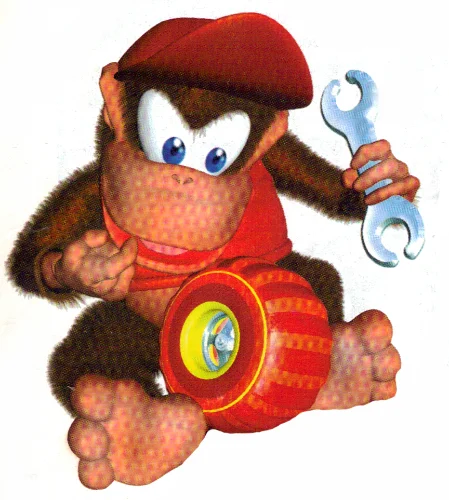 Diddy headlined his own racing spin-off in Diddy Kong Racing for the Nintendo 64 (November 1997), developed by Rare. The game served as the launch flagship for the Christmas 1997 Nintendo 64 release window and introduced new characters Banjo (later of Banjo-Kazooie) and Conker. Diddy Kong Racing sold approximately 4.5 million copies and is credited as a major influence on subsequent kart-racing games. The 2007 Nintendo DS remake Diddy Kong Racing DS was the only Nintendo-developed sequel.
Donkey Kong 64 (1999)
Diddy returned in Donkey Kong 64 for the Nintendo 64 (November 1999), developed by Rare. The game expanded the Kong Family to five playable Kongs — Donkey Kong, Diddy Kong, Lanky Kong, Tiny Kong, and Chunky Kong — with Diddy serving as the fast-acrobatic specialist. He gains the iconic Rocketbarrel Boost ability in this game, which has been retained as his special move in subsequent Smash Bros. appearances. The game sold approximately 5.27 million copies.
Donkey Kong Country Returns (Wii, 2010) and Tropical Freeze (Wii U, 2014)
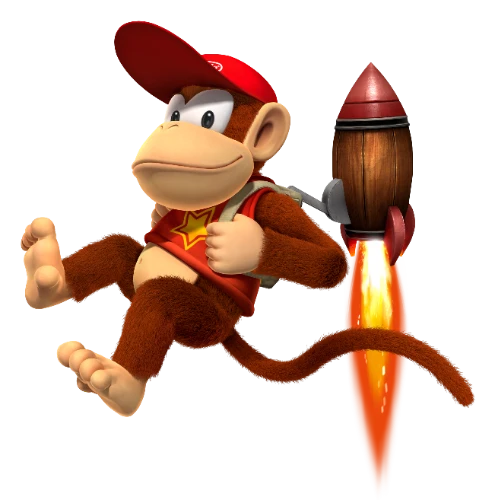 Diddy returned to the platforming spotlight in Donkey Kong Country Returns for Wii (2010) and Donkey Kong Country: Tropical Freeze for Wii U (2014), both developed by Texas studio Retro Studios after Rare’s departure from Nintendo. In both games Diddy serves as DK’s acrobatic co-op partner with his unique Rocketbarrel jet-pack ability. Tropical Freeze’s Switch port (2018) is widely considered the definitive version of the game.
Super Smash Bros. Brawl (2008) and subsequent Smash entries
 Diddy joined the Super Smash Bros. roster with Brawl for the Wii (2008) as one of the new fighters added for the third Smash entry. He returns in Smash for 3DS / Wii U (2014) and Smash Ultimate (Switch, 2018). His signature moves include the Peanut Popgun (a peanut-firing rifle), the Banana Peel (a slip trap), and the Rocketbarrel Boost. Smash 4’s Diddy Kong was the subject of controversy in the competitive scene due to his "Diddy combos" that dominated the early metagame.
Mario Kart series (1996–present)
Diddy has been a playable racer in Mario Kart 64 (1996, unlockable in the Special Cup), Mario Kart: Double Dash!! (2003, co-piloting with DK), Mario Kart Wii (2008), Mario Kart 7 (3DS, 2011), Mario Kart 8 Deluxe (Switch, Booster Course Pass 2023), Mario Kart Tour (2019–2025), and Mario Kart World (Switch 2, 2025). He is consistently classified as a lightweight racer with high acceleration, handling, and off-road traction.
Mario Party / Mario Strikers / Mario Tennis / Mario Sports series
Diddy has been a default character in nearly every Mario Party since Mario Party 5 (GameCube, 2003), in every Mario Tennis from Power Tennis (2004), in every Mario Strikers from the original Super Mario Strikers (2005), and in every Mario Sports spin-off including Super Sluggers, Tennis Aces, and Mario Golf: Super Rush. In Mario Strikers: Battle League (Switch, 2022) he is one of the default Mario Strikers captains.
Trivia & Official Sources
- Diddy Kong was created by Rare’s Tim and Chris Stamper for Donkey Kong Country (SNES, 1994). The character was originally designed as a reimagining of "Donkey Kong Jr." (the 1982 arcade character), but Nintendo of Japan objected to the "Donkey Kong Jr." name and the character was renamed "Diddy Kong" for the final release.
- Diddy’s name comes from the British slang "diddy" meaning "small" — a deliberate British-English wordplay by Rare’s development team in Leicestershire, England.
- Chris Sutherland — a Rare developer who would later voice Donkey Kong himself — originally voiced Diddy Kong’s vocalizations in the original Donkey Kong Country trilogy (1994–1996). Katsumi Suzuki has been Diddy’s Japanese voice since approximately 2007.
- Diddy’s red baseball cap with the "Nintendo" logo is one of the most iconic accessory designs in the Mario series. The cap’s "Nintendo" branding has been preserved in every appearance since 1994.
- The Pix’n Love Encyclopedia Super Mario Bros. (2018) describes Diddy as "Donkey Kong’s acrobatic nephew and the second member of the Kong family core duo."
- Diddy is officially Donkey Kong’s nephew (not his son) in Rare’s canonical family tree. The relationship was established in Donkey Kong Country (1994) by Rare’s narrative writer Greg Mayles and has not been altered in any subsequent Mario series entry.
- Donkey Kong Country (SNES, 1994) sold approximately 9.3 million copies worldwide, making it the highest-selling third-party SNES game. Diddy’s introduction in this game established his presence in Mario series spin-offs from 1994 onward.
- Diddy Kong Racing for the N64 (1997) sold approximately 4.5 million copies and was the launch flagship for the Christmas 1997 N64 release window. The game introduced characters Banjo and Conker to gaming audiences, both of whom would later star in their own Rare-developed franchises.
- Diddy is officially classified as a small-character in Mario series spin-offs (typically alongside Toad, Yoshi, and other small-class characters). His height is approximately 60% of Donkey Kong’s, making him one of the more diminutive members of the Kong Family.
- Diddy’s relationship with Dixie Kong has been canonically depicted as romantic since Donkey Kong Country 2 (1995). The two are the longest-running romantic couple in the Donkey Kong sub-franchise.
- Diddy’s Peanut Popgun — a peanut-shooting rifle from the Donkey Kong 64 era — has been retained as his Smash Bros. signature attack since Brawl (2008). The weapon shoots peanut-shaped projectiles that bounce around the stage.
- The Rocketbarrel Boost ability — introduced in Donkey Kong 64 (1999) — has been Diddy’s signature vehicle/transformation across the entire Smash Bros. series and was retained in DK Country Returns (2010) and Tropical Freeze (2014).
- Donkey Kong 64 (1999) sold 5.27 million copies. The famous DK Rap opening, featuring Diddy alongside the other Kongs, has become one of the most-meme’d pieces of Mario series music in history.
- Diddy amiibo figures were released in the Super Smash Bros. amiibo line (2014) and the Donkey Kong Country amiibo line (2018). The 2014 Smash amiibo features Diddy in his classic SNES posture with the Peanut Popgun.
- Diddy has been a continuously playable character in every Mario Kart since Mario Kart 64 (1996), every Mario Party since Mario Party 5 (2003), every Super Smash Bros. since Brawl (2008), and every Mario Tennis since Power Tennis (2004) — making him one of the most reliably-present Mario series supporting characters.
- Diddy has been confirmed by Illumination to appear in The Super Mario Galaxy Movie (April 2026) in a supporting role alongside Donkey Kong. His film voice cast was not publicly named as of late 2025 pre-release marketing.