
 |
Species name: Goomba (Kuribo in Japanese, “chestnut person”) First Appearance: Super Mario Bros. (NES, 1985) Home: Goomba Village / Goomba Road / various Mushroom Kingdom forests Voiced by: Wordless rustling vocalizations across all appearances Notable individual Goombas: Goombella (Paper Mario: The Thousand-Year Door, 2004), Goombario (Paper Mario, 2000), Goombrat, Captain Goomba, the Goomba Village leader, the various paper Goomba family members |
General profile
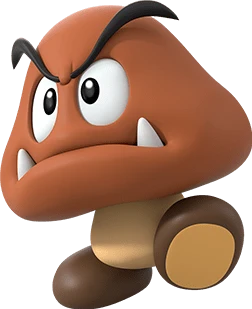
The Goomba is the most iconic enemy species in the entire Mario series and one of the most-recognised video game enemy archetypes ever designed. Introduced in 1985’s Super Mario Bros. for the Nintendo Entertainment System, Goombas are small, brown, mushroom-shaped creatures with two angry-looking eyes, sharp fangs, and two stubby feet that wobble back and forth as they walk. The species’ visual silhouette, a chunky mushroom cap atop two stubby feet, has remained essentially unchanged across the species’ 40-year history and has become the immediately-recognisable shorthand for “Mario enemy” in popular culture. The Goomba is to the Mario series what the Slime is to the Dragon Quest series: the most basic, the most numerous, and the most-defeated enemy type.
Goombas serve as the Mario series’ baseline rank-and-file enemy. Their defining gameplay role is as the player’s introduction to the standard Mario combat-by-jumping mechanic: a single jump on a Goomba’s head defeats it, a single touch from a Goomba damages or kills Mario. This brutal-but-simple combat dynamic has been preserved unchanged across every Mario series mainline platformer since 1985. The species’ enormous variety of sub-types (Paragoombas with wings, Hyper Goombas with charge attacks, Mega Goombas of giant size, Goombrats with spike helmets, Mini Goombas, Tower Goombas, Goombette romantic counterparts) provides the species with substantial gameplay-design versatility across the broader Mario series.
Goombas have a complex relationship with the Mushroom Kingdom’s political history. The Paper Mario series canonised the Goombas as a once-loyal Mushroom Kingdom species that defected to Bowser’s Koopa Troop during one of Bowser’s early invasions, becoming the foot-soldier rank-and-file of his army from that point forward. Modern Mario series canon has nuanced this somewhat, with individual Goombas (notably Goombella in TTYD, Goombario in the original Paper Mario, and Captain Goomba in M&L: Superstar Saga + Bowser’s Minions) shown as good-aligned individuals who buck the species’ standard villainous role. The Goomba Village in the original Paper Mario establishes that a peaceful good-aligned Goomba community continues to exist within the Mushroom Kingdom geography.
Quotes
Enemies
The Goomba species’ primary enemies are Mario, Luigi, and the wider Mushroom Kingdom heroic cast. Goombas serve as the rank-and-file foot soldiers of Bowser’s Koopa Troop, which makes them opposed by default to essentially every protagonist character in the Mario series. They are defeated by jumping, fire flowers, star power-ups, kart-collision impacts, and various other standard Mario combat mechanics. In Mario and Luigi RPG series, individual Goomba enemies are encountered as turn-based combat opponents with statistically modest abilities, the species’ rank-and-file status is preserved across all variations of the Mario series narrative.
Friends
Goombas have varying allegiances depending on the specific individual. The mainstream Goomba species serves Bowser’s Koopa Troop and has no friends among the Mario series heroic cast. However, several notable individual Goombas have allied with Mario: Goombario (Mario’s Tattle expert in the original Paper Mario, 2000), Goombella (Mario’s Tattle expert in Paper Mario: The Thousand-Year Door, 2004), Captain Goomba (the playable Koopa Troop leader in Mario and Luigi: Superstar Saga + Bowser’s Minions, 2017), and the Goomba Village community (the peaceful good-aligned Goomba community shown in the original Paper Mario). These good-aligned individuals demonstrate that the species’ default villainous role is not biological but cultural.
Appearances
Super Mario Bros. (NES, 1985)
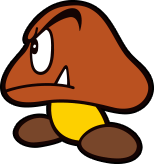 The Goomba debuted in Super Mario Bros. for the Nintendo Entertainment System (September 1985, Japan; October 1985, North America). The character was designed by Shigeru Miyamoto and Takashi Tezuka of Nintendo R&D4 as a deliberately-late addition to the SMB enemy roster, the species was created during development specifically to give the player an easier early enemy than the originally-planned Koopa Troopa. The Goomba’s simple design (a single mushroom-cap sprite with stubby feet) allowed Miyamoto’s team to add the species late in development without significantly increasing the game’s graphic data requirements.
Super Mario 64 (1996) and 3D adaptation
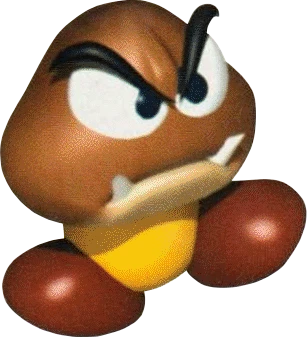 Super Mario 64 (1996) marked the Goomba species’ transition to 3D rendering. The 64-era Goomba design preserves the species’ iconic silhouette while adapting it to the new polygonal graphics technology. The 1996 Goomba design has remained essentially the canonical visual reference for all subsequent 3D Mario series appearances, with minor refinements for graphical updates across the GameCube, Wii, Wii U, Switch, and modern Switch 2 era.
Paper Mario series (2000-present)
The Paper Mario series has consistently featured Goombas as both standard enemies and as substantive party members. The original Paper Mario (Nintendo 64, 2000) introduced Goombario, Mario’s Goomba Tattle expert, as the first party member. Paper Mario: The Thousand-Year Door (GameCube, 2004) introduced Goombella, the most-loved Goomba party member in the series, who serves as Mario’s first TTYD party member and the game’s primary Tattle expert. The 2024 Switch remake of TTYD reintroduced Goombella to a new generation of fans.
Super Mario Odyssey (Switch, 2017)
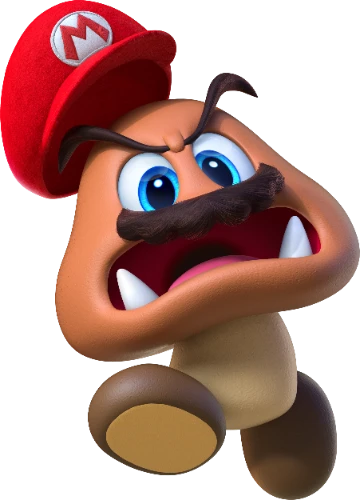 Goombas appear as capturable enemies in Super Mario Odyssey (Switch, 2017). Mario can use Cappy to possess Goombas and use them to stack up into vertical Goomba Towers, a key gameplay mechanic for accessing certain elevated areas. The Goomba Tower mechanic was preserved from earlier 3D Mario series entries (Super Mario 3D Land, Super Mario 3D World) and expanded with the Capture functionality in Odyssey. Goombette, a female Goomba variant who serves as a romantic NPC in Odyssey’s Wooded Kingdom, was introduced in this game.
Super Mario 3D Land / 3D World Goomba Towers
 Goomba Towers, vertical stacks of Goombas arranged on top of each other, were introduced as a gameplay mechanic in Super Mario 3D Land (3DS, 2011). The mechanic was preserved in Super Mario 3D World (Wii U, 2013) and expanded with the Capture mechanic in Super Mario Odyssey (2017). Goomba Towers represent one of the most-iconic Mario series enemy-arrangement mechanics of the 2010s.
Mario Kart and Mario Party recurring appearances
 Goombas have been continuously present in the Mario Kart and Mario Party series since their earliest entries. In Mario Kart they appear as track obstacles and as occasional CPU-driven karts; in Mario Party they appear as recurring NPCs, mini-game opponents, and board-event characters. The Mario Party Superstars (Switch, 2021) Goomba artwork represents the species’ most-recent canonical visual reference for spin-off contexts.
Super Mario Bros. Wonder (Switch, 2023)
The standard Goomba returned in Super Mario Bros. Wonder for Switch (October 2023) with subtle visual refinements over their 2010s-era design. The species’ role as the game’s baseline rank-and-file enemy is preserved, with the Wonder Effect (the game’s signature transformation mechanic) occasionally turning Goombas into oversized “Wonder Goombas” with altered behaviour patterns.
Trivia & Official Sources
- The Goomba was designed by Shigeru Miyamoto and Takashi Tezuka of Nintendo R&D4 as a deliberately-late addition to the Super Mario Bros. enemy roster in 1985. The species was created during development specifically to give the player an easier early enemy than the originally-planned Koopa Troopa.
- The Japanese name Kuribo literally translates to “chestnut person” (Kuri = chestnut, -bo = -person). The Western name “Goomba” is derived from the Italian word “gumbah,” a casual term for a close friend, an ironic choice given the species’ enemy status.
- Super Mario Bros. (NES, 1985) sold approximately 40.24 million copies worldwide, making it the second-best-selling NES game of all time (after Super Mario Bros. 3). The Goomba’s introduction in this game has made the species one of the most-encountered enemy types in all of video gaming history.
- The Pix’n Love Encyclopedia Super Mario Bros. (2018) describes the Goomba as “the most basic and most numerous enemy species in the Mario series, foot-soldier rank-and-file of Bowser’s Koopa Troop.”
- Paper Mario canon establishes that Goombas were once a loyal Mushroom Kingdom species who defected to Bowser’s Koopa Troop during one of Bowser’s early invasions. The Goomba Village in the original Paper Mario shows that a peaceful good-aligned Goomba community continues to exist within the Mushroom Kingdom geography.
- The Goomba species has produced numerous notable individuals who have allied with Mario: Goombario (Paper Mario, 2000), Goombella (Paper Mario: TTYD, 2004), Goombrat (a spike-helmeted variant), Captain Goomba (Mario and Luigi: Superstar Saga + Bowser’s Minions, 2017), and the Goomba Village community leadership.
- Goomba variants in the Mario series include Paragoomba (winged), Hyper Goomba, Mega Goomba (giant), Goombrat (spike-helmeted), Mini Goomba, Tower Goomba, Goombette (female), and the seasonal Bone Goomba (skeletal) and Headphone Goomba (Super Mario Odyssey). Each variant has distinctive combat behaviours.
- The Goomba Tower mechanic, vertical stacks of Goombas arranged on top of each other, was introduced in Super Mario 3D Land (3DS, 2011) and has been preserved through Super Mario 3D World (Wii U, 2013) and Super Mario Odyssey (Switch, 2017).
- Goombette, a female Goomba variant who serves as a romantic NPC in Super Mario Odyssey (Switch, 2017), was introduced as the species’ first canonically-female non-Paper-Mario character. Her introduction confirmed the existence of female Goombas in the broader Mario series canon.
- The Goomba is one of the most-merchandised Mario series characters of all time. Goomba plush toys, keychains, action figures, and various other merchandise have been continuously available through Nintendo’s official channels since the 1980s.
- Goomba amiibo figures have not been released as standalone products. The species has been included in the 2017 Mario Sports Superstars amiibo line as background art on specific figure cards.
- The Goomba appears as a default playable character in the Mario Party series, in some Mario Kart entries (notably Mario Kart Tour’s 2019-2025 mobile run), and as a Spirit in Super Smash Bros. Ultimate (2018).
- The species’ “Goomba” Western name has been preserved unchanged across all localisations and re-releases since 1985. Some Mario series materials have used the alternative spelling “Goombah,” but this has not become canonical.
- The Goomba is one of the most-frequently-defeated enemy types in video game history. Estimates of the number of Goombas defeated across all copies of all Mario series games place the cumulative total in the trillions.
- The Goomba has been confirmed by Illumination to appear in The Super Mario Galaxy Movie (April 2026). The species’ inclusion in the 2023 Super Mario Bros. Movie and its sequel confirms the Goomba’s status as one of the most-recognised Mario series visual icons.
- The Goomba design has been adapted to fit each Mario series art-style without losing the species’ core visual silhouette. The Paper Mario flat-paper Goomba, the Yoshi‘s Woolly World yarn-and-felt Goomba, the Mario Maker pixel-art Goomba, and the modern 3D Goomba all preserve the iconic “mushroom cap with stubby feet” design that has made the species an enduring visual icon.