
 |
Character fact sheetName: Wario First Appearance: Super Mario Land 2: 6 Golden Coins (1992) Home: Wario’s Castle / WarioWare Inc. HQ, Diamond City Voiced by: Kevin Afghani (2023–present), Charles Martinet (1996–2023) Associates: Waluigi, WarioWare crew (Mona, 9-Volt, Jimmy T, Ashley…), Captain Syrup (rival), greed |
General profile
Wario is Mario’s greedy, gluttonous, treasure-obsessed anti-hero rival — and, with two major spin-off franchises to his name (the Wario Land platformers and the WarioWare microgame series), one of Nintendo’s most commercially successful Mario-adjacent characters. Wario is short and stocky like Mario but built like a barrel: bulging muscles, a hooked nose, an enormous zigzag moustache, a yellow cap with a stylised "W" (an inverted M), purple overalls, and ever-glinting greedy eyes. His name is a portmanteau of the Japanese word warui (悪い, "bad") and "Mario" — a play on his nature as Mario’s evil reflection.
Where Mario is selfless and brave, Wario is selfish and brash; where Mario rescues princesses, Wario raids ancient tombs for gold; where Mario rescues kingdoms out of duty, Wario only acts when there’s treasure or money in it. Despite this, Wario is treated as a redemption-arc-friendly anti-hero rather than a true villain. His Wario Land games cast him as a flawed protagonist battling pirates and tomb-raiders for personal profit, and his WarioWare games turn him into a hapless small-business owner of the eponymous Diamond City microgame studio.
Wario was created in 1992 by Hiroji Kiyotake — part of Gunpei Yokoi’s Nintendo R&D1 team that handled Game Boy software — to give the new Super Mario Land 2 a personal antagonist distinct from Bowser. The character’s immediate popularity led R&D1 (later Nintendo Software Planning & Development) to spin him off into his own platformer series and ultimately the WarioWare franchise, which has now produced over a dozen games across thirteen platforms.
Quotes
Enemies
Wario’s principal rival is Mario, though their relationship is more competitive than truly hostile in modern entries — in spin-offs they race, party, play tennis, and occasionally even cooperate, with Wario typically losing through his own greed or hubris. He has more conventional enemies in his solo Wario Land franchise: Captain Syrup of the Black Sugar Pirates (his recurring nemesis since Wario Land 1 in 1994), the Shake King (Shake It!), assorted tomb-raiders and dungeon-bosses across the series, and the Goldfish-King in Wario Land 3. In WarioWare the "villain" role is occupied by Wario himself — most plots involve him scheming to swindle his employees out of their share of the company profits.
Friends
Wario’s closest associate is Waluigi, his tall and lanky business partner / sidekick / fellow anti-hero who debuted in Mario Tennis (2000). His extended "family" is the WarioWare Inc. cast — Mona, 9-Volt and 18-Volt, Jimmy T., Ashley and Red, Dribble & Spitz, Kat & Ana, Dr. Crygor, Penny Crygor, Orbulon, Young Cricket and Master Mantis, and the always-introduced "Wario’s Family" secondary cast (Wanda, Wassup, etc.). In sport and party games he is allied with Bowser’s camp by convention rather than by loyalty — he and Waluigi are most often paired against the Mario/Luigi duo.
Appearances
Super Mario Land 2: 6 Golden Coins (1992)
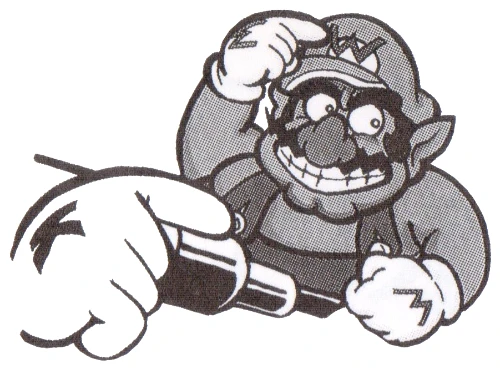 Wario debuted as the final boss of Super Mario Land 2: 6 Golden Coins on the Game Boy. While Mario was off saving Princess Daisy in Sarasaland during Super Mario Land, his childhood rival Wario seized control of Mario’s castle in Mario Land. The game has Mario travel through six zones to collect the six titular Golden Coins, then re-enter his own castle to defeat the imposter. The final boss fight against Wario is a pure platformer duel — Wario uses three transformation forms (Carrot, Bunny, and a giant Super Wario state) before being defeated. The character’s personality, design and goofy attitude were already fully formed by this debut, designed by Hiroji Kiyotake.
Wario Land: Super Mario Land 3 (1994) and the Wario Land series
 Just two years after his debut, Wario headlined his own platformer in Wario Land: Super Mario Land 3 (Game Boy, 1994). This first Wario Land recasts him as the protagonist hunting Captain Syrup’s Black Sugar Pirates for their stolen treasures. The series continued with Virtual Boy Wario Land (1995), Wario Land II (GBC, 1998 — the first game where Wario is functionally invincible and instead transforms when damaged), Wario Land 3 (GBC, 2000), Wario Land 4 (GBA, 2001), the 3D-platformer Wario World (GameCube, 2003), and the cel-shaded Wario Land: Shake It! (Wii, 2008). Each entry leans further into Wario’s greedy-anti-hero schtick, with the Wii Shake It! installment turning treasure collection into the primary scoring mechanic.
Wario World (2003)
The only mainline 3D Wario platformer to date, Wario World for the Nintendo GameCube took Wario into a beat-em-up format. Developed by Treasure Co. Ltd., the game gave Wario a power-grab moveset of throws, ground-pounds, and shoulder-charges, casting him against Black Jewel’s curse that has transformed his castle into a portal-cursed gauntlet. While not as commercially successful as the 2D entries, Wario World is often cited by fans as the most physical, brutal incarnation of the character.
WarioWare Inc.: Mega Microgame$ (2003) and the WarioWare series
 The WarioWare sub-franchise launched in 2003 with WarioWare Inc.: Mega Microgame$ on Game Boy Advance — a then-unprecedented collection of hundreds of 3- to 5-second "microgames" tied together by absurdist comedy and a Diamond City studio premise. Wario is the bumbling CEO of WarioWare Inc., trying to monetise his microgame collection through whatever scheme arrives in his head that morning. The series has now produced thirteen entries: Mega Party Game$! (GCN), Touched! (DS), Twisted! (GBA), Smooth Moves (Wii), Snapped! (DSiWare), D.I.Y. (DS), Game & Wario (Wii U), Gold (3DS), Get It Together! (Switch), and Move It! (Switch). Each introduces new microgame mechanics and recurring side-character cameos.
Mario Kart series (1996–present)
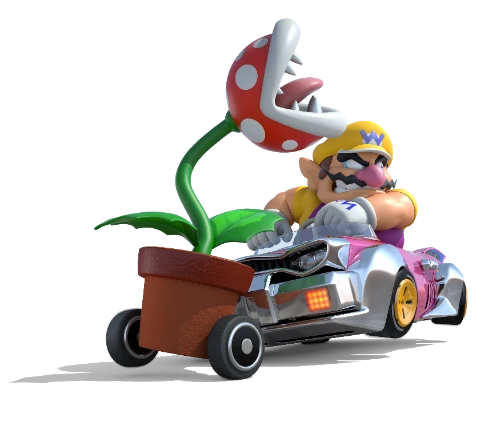 Wario has been a playable racer in every Mario Kart since Mario Kart 64 (Nintendo 64, 1996), classified consistently as a heavyweight. He appears with his signature yellow-and-purple kart in Mario Kart: Super Circuit, Double Dash!! (where he co-pilots with Waluigi), DS, Wii, 7, 8, 8 Deluxe, Tour, and Mario Kart World (Switch 2, 2025). Mario Kart 8’s "Excitebike Arena" DLC course features a Wario-themed motorbike section.
Super Smash Bros. Brawl (2008) onward
Wario joined the Super Smash Bros. roster in Brawl (Wii, 2008), wearing his classic SML2 yellow-and-purple overalls plus an alternate costume of the WarioWare biker outfit. His infamous "Wario Waft" — a chargeable gas-attack that grows more powerful over time — is one of the most distinctive moves in the Smash roster. He returns in Smash for Wii U/3DS, Smash Ultimate, and has been confirmed by Sakurai as "a character who will be in every future Smash Bros."
Mario Party, Sports, and other Spin-offs (1998–present)
Wario has been a default character in every Mario Party since Mario Party (Nintendo 64, 1998), and every Mario Tennis from Mario Power Tennis (GameCube, 2004) onward. He appears in Mario Tennis Aces, Mario Strikers, Mario Strikers: Battle League, Mario Golf, Mario Super Sluggers, and the Mario & Sonic at the Olympic Games series. He also features in Mario & Wario (SNES, 1993, Japan only) — a puzzle game where Wario drops a bucket on Mario’s head.
WarioWare: Move It! (2023) and recent appearances
 The most recent mainline Wario title is WarioWare: Move It! (Switch, November 2023) — a return to the motion-controlled microgame format pioneered by Smooth Moves. The game features over 200 microgames and reintroduces the entire WarioWare cast. Wario also makes a cameo in Super Mario Bros. Wonder (2023) as a hidden 8-bit poster in one of the Flower Kingdom’s Special World levels.
The Super Mario Bros. Movie (2023) cameo and Super Mario Galaxy Movie (2026)
Wario does not appear in the 2023 Super Mario Bros. Movie’s main cast, but he and Waluigi were confirmed by Illumination directors Aaron Horvath and Michael Jelenic to appear in the 2026 sequel The Super Mario Galaxy Movie. The actor cast as Wario in the sequel had not been publicly named as of the film’s pre-release marketing in late 2025.
Trivia & Official Sources
- Wario was designed by Hiroji Kiyotake of Nintendo R&D1 (the team that also created Samus Aran and the Metroid series) specifically as a personal antagonist for Mario in Super Mario Land 2. Kiyotake’s original design sketches show that Wario was conceived as "Mario’s shadow self" before being given his now-iconic yellow-and-purple colour scheme.
- Wario’s name combines the Japanese word warui (悪い, "bad," "evil") with "Mario." His logo — a stylised "W" — is an upside-down Mario "M."
- Charles Martinet voiced Wario continuously from Mario Kart 64 (1996) through Mario Strikers: Battle League (2022) — a 26-year tenure as one of the longest-running villain-voice roles in video games. He was succeeded by Kevin Afghani in October 2023 starting with Super Mario Bros. Wonder.
- Wario’s catchphrase "Wahaha!" was improvised by Martinet during his first Wario voice session in 1996. He has said in retrospective interviews that he based Wario’s vocal performance on "Mario after seven garlic bulbs and three beers."
- The WarioWare franchise has sold over 12 million combined units across all entries as of 2024 — making it Nintendo’s most commercially successful spin-off after the Mario Kart, Smash Bros., and Mario Party series.
- Wario’s signature attack — the Shoulder Bash / Body Slam — has been his primary moveset element since Wario Land 1 (1994) and is canonically powerful enough to break stone walls in his platformers.
- The Pix’n Love Encyclopedia Super Mario Bros. (2018) lists Wario’s height as "approximately 156 cm" (5´1") — making him exactly Mario’s height. Their builds, however, differ dramatically: Wario is roughly twice Mario’s weight.
- Wario’s relationship with Waluigi is officially classified by Nintendo as "rival and partner" rather than "brother." Although both are tall-and-short anti-hero counterparts to Mario and Luigi, no canonical material confirms them as biologically related. The German Club Nintendo of 2000 referred to them as Geschäftspartner ("business partners").
- The character’s love of garlic was first established in the manual for Wario Land 4 (2001), where eating garlic restores Wario’s health. Subsequent games (and Smash Bros.) have made garlic his signature consumable.
- Wario’s 1996 inclusion in Mario Kart 64 was the moment when Nintendo formally adopted him as part of the "Mario family" for spin-offs — prior to that, he was specifically "the Wario Land character" rather than a recurring cast member.
- The Wario family in WarioWare includes his cousin Wanda, his second cousin Wassup, and the never-shown but oft-referenced "Granny Wario." These characters were created specifically for WarioWare: Mega Microgame$ (2003) and have appeared in every subsequent entry.
- In Wario Land 4 (2001), Wario’s home is a treasure-filled mansion called "Wario’s Castle" located on a small island. By WarioWare (2003) onward he relocates to Diamond City, where he runs WarioWare Inc. — Nintendo has never reconciled these two settings.
- Wario’s motorbike — the iconic two-wheeled red-and-yellow vehicle from WarioWare: Touched! and his Smash Bros. alternate costume — is called the "Wario Bike" in official Nintendo materials and was designed by Kiyotake as "the only vehicle Wario would ever willingly ride."
- The WarioWare: Smooth Moves (Wii, 2007) instruction manual is the only Nintendo publication to officially describe Wario as "a man of many flaws but one undeniable virtue — his unwavering belief in himself."
- In Super Smash Bros. Ultimate, Wario is the only fighter with two completely different default costumes (Overalls vs. Biker) that share neither colour palette nor silhouette — a unique privilege granted to him by Sakurai because "Wario himself wouldn’t want to choose."
- Wario’s appearance in Wario Land II (1998) made him the first major Nintendo platformer protagonist who cannot die — the game uses a transformation system instead, where damage turns Wario into various states (Crazy Wario, Flat Wario, Zombie Wario) that the player must navigate back to recover. This mechanic was a deliberate inversion of standard platformer tropes.